
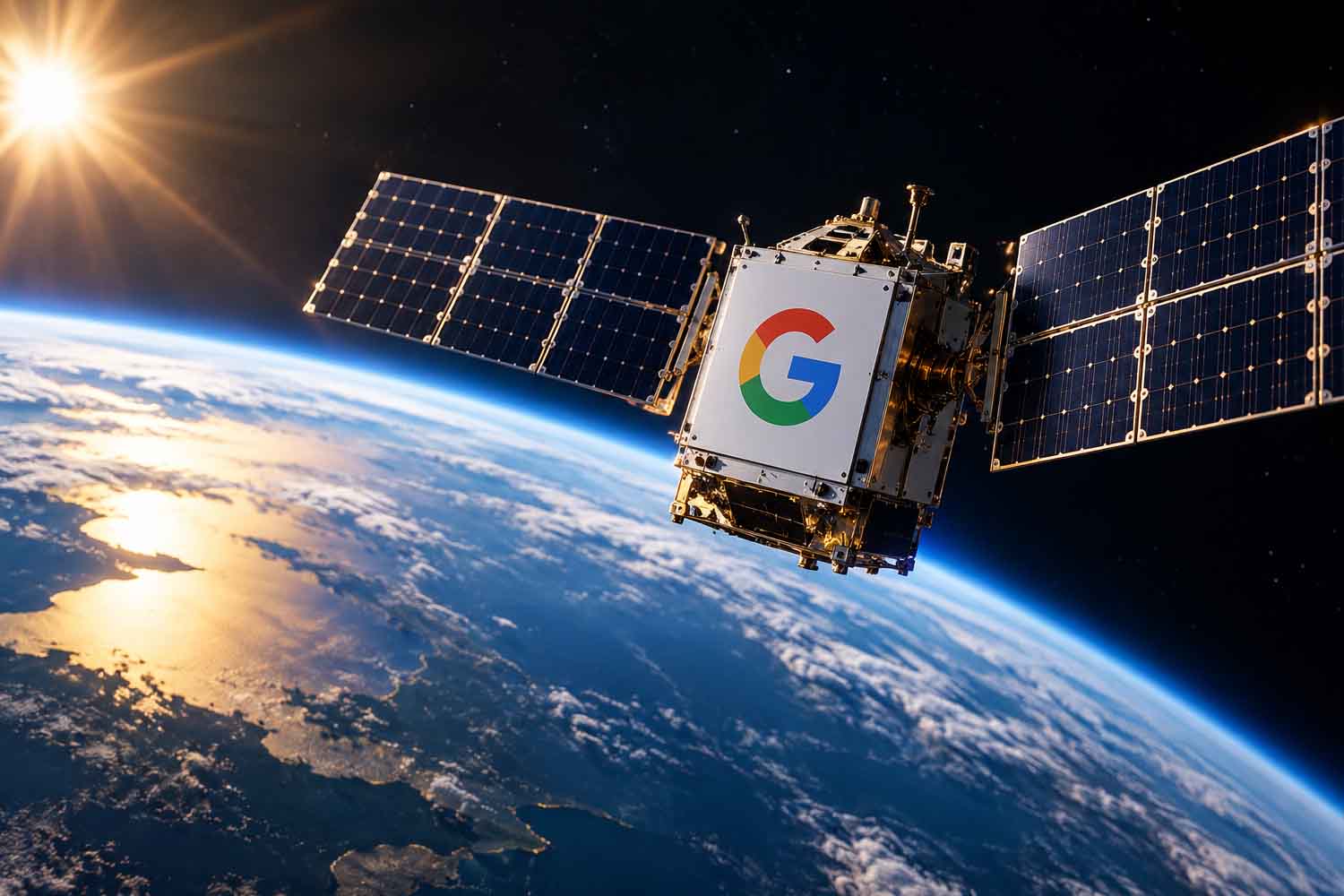
On Thursday 1 October, a SpaceX Falcon 9 is expected to launch from the Vandenberg base in California, bringing into orbit Google’s first TPUs destined to work in space. The experimental satellite will fly on the shared Transporter-18 mission and is the first orbital test of Project Suncatcher, the project with which Big G wants to understand if a part of the calculation necessary for artificial intelligence can one day be moved above our heads.
For about a year the small system will have to run AI workloads, including simple requests to Gemini, while Google will collect data on consumption, radiation and temperatures. We are a long way from a server farm suspended in space: the test serves first and foremost to verify whether the chips manage to survive the launch and continue to function in orbit. Google says it with less imagination than the title “space data center”: this first mission must find out what works, where something breaks and what will need to be redesigned. blog.google
First you need to avoid cooking the chips in space
The journey to low Earth orbit will last about ten minutes and will already be a rather energetic test. According to Google, during launch the vehicle can experience accelerations of up to approx 10 times that of gravitywhile on the individual components the stresses can reach between 50 and 100 g. The satellite was then subjected to vibration tests along all three axes. The hardware held up.
Then comes the radiation. Researchers have already brought Trillium TPUs to the Crocker Nuclear Laboratory at the University of California at Davisexposing them to a proton beam while they ran artificial intelligence loads. Tests showed that the chips can withstand a higher overall ionizing dose than expected during a five-year space mission. These are laboratory tests: from October 1st those that cannot be perfectly reproduced on Earth begin. The most interesting problem, however, is much less science fiction: processors get hot. And space lacks the air that on Earth allows traditional fans and cooling systems to carry away some of the heat.
Google has therefore built a system that transfers heat through conductive materials and tubes to radiators capable of dispersing it by radiation into a vacuum. The solution was tested in a thermal vacuum chamber; in orbit it will have to demonstrate that it can do the same job in real conditions. In the experimental configuration the chips will be able to work for short periods, on the order of about fifteen minutes, before needing to cool down. Fans: zero. Thermodynamics: a lot. blog.google
Why Google wants to take data centers into space
The idea comes from a very earthly problem. The expansion of artificial intelligence requires enormous amounts of computing power as well as electricity, infrastructure, land and cooling systems. With Project Suncatcher, Google is studying the possibility of directly powering computers with solar energy collected in orbit.
According to the company’s calculations, in the right orbit a solar panel can produce up to eight times more energy than an equivalent one on Earththanks to an almost continuous exposure to sunlight. The hypothesis described in the Project Suncatcher technical paper envisages satellites in low Earth orbit synchronous with the Sun, each equipped with a TPU chip and connected to the others through optical communications. And this is where the single October 1 satellite begins to look like what it is: a tiny brick in a much more complicated infrastructure.
A true orbital data center would distribute computations among many satellites. To achieve performance comparable to that of terrestrial infrastructure, Google estimates that the links between nodes would need to sustain tens of terabits per second. In the lab, the team achieved 800 gigabits per second in each direction with a pair of transceivers. In orbit, however, those links will have to work between moving objects flying very close to each other.
The next step is scheduled for 2027, when Google aims to put it into orbit two satellites and directly experience high-speed laser communications. Each future unit could contain dozens of TPUs and work together with the others like the servers of a distributed computing center. To maintain the connection they will have to continuously know their own position and that of their neighbors with an accuracy that Google likens to trying to hit a coin from miles away while both dots move.
Solar energy is abundant, orbit much less so
There is also an economic promise on paper. In the preprint of Project Suncatcher, so in a study that had not yet completed its normal peer-review process at the time of publication, researchers hypothesize that the cost of accessing low-Earth orbit could fall below $200 per kilogram by the mid-2030s. Under those conditions, some cost items of orbital computing could approach those of terrestrial infrastructures. The conditional, here, works almost as much as the TPUs: it depends on the evolution of the launchers, the durability of the hardware, the maintenance that is impossible to do with a wrench and several technologies still to be demonstrated.
There is also a resource that seems infinite up there just looking at it from below. The new Space Environment Report 2026 from the European Space Agency recalls that in 2025 more than 300 launches were carried out and brought into orbit over 4,000 new payloads. Large constellations continue to grow and too much equipment remains in the most congested areas even after the end of its operational life, increasing the risk of collision. European Space Agency
This doesn’t mean that Google’s little experiment will produce a debris problem on its own. The scale imagined for the future, however, matters. A network of space data centers will have to bring together power, cooling, laser communications, flight training, launch costs and satellite end-of-life management.
For now, Google has to pass a test that is much simpler to explain: on October 1st send four chips into space and see if they continue to do their job. Building an orbital data center will require a lot of other hardware. And a few more radiators.
