
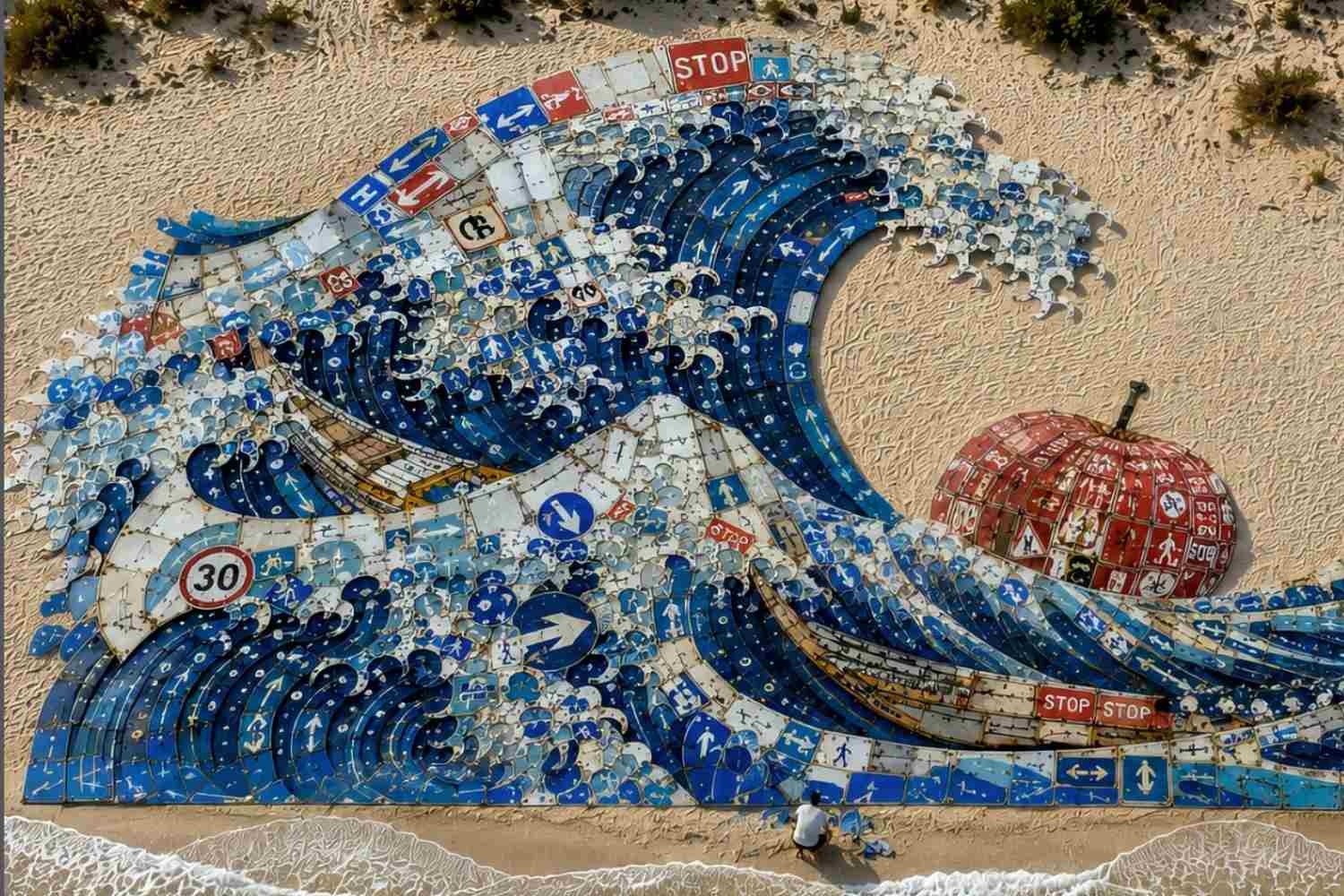
A dazzling intuition transforms disused urban signs into a surprising visual language thanks to the work of the artist Maurizio Sergiusti, known by the pseudonym Scoobafish. Through his baptized project Urban Pixelthe author recovers hundreds of used road signs in Sardinia, marked by scratches, dents and layers of rust, to assemble them into enormous works of art visible mainly from above.
The key principle of this technique consists in using each panel exactly as it appears, without cutting it out, repainting it or altering its surface, preserving the material memory and previous history of each individual object intact. Observed from the ground, the materials maintain their original identity of stop signs, speed limits or prohibitions, but by taking a step back or observing the composition from above, the individual fragments merge into a single and coherent monumental image.
View this post on Instagram
From Concerto 0 to the impressive installation of The Last Wave in Sardinia
The experimentation process officially began with Concert 0a preliminary work created by combining 127 panels over an area approximately 6 meters wide to give shape to a partially decomposed apple, a strong visual metaphor on consumption and environmental degradation. Next, with the installation It Takes So Littlethe artist used 172 panels on fire-affected land in San Teodoro to draw a burnt match over 16 meters long.
View this post on Instagram
Now the challenge has moved to a much higher scale with the project The Last Waveunder development on a Sardinian beach. The intervention involves the manual assembly of almost 1,000 signs to reinterpret the famous shapes of the Great Wave off Kanagawa by Katsushika Hokusai, inserting a new deteriorated apple at the center of the composition to extend the critical reflection on waste and resource management.
View this post on Instagram
The ephemerality and magic of retroreflective materials between photography and video
One of the most fascinating aspects of the installations lies in the behavior of the materials when the sun goes down. The retroreflective surfaces of the road signs, hit by the night light beams, return a second and completely different image, bringing out individual details without the aid of any integrated artificial lighting.
Conceived as strictly temporary interventions, the works of Urban Pixel they remain in the field for only a few hours before being dismantled and removed completely, leaving their existence to continue through photographic archives and aerial video footage. In this way, the artist restores new dignity to objects created to impose road rules, temporarily transforming them into pieces of a landscape mosaic that questions the viewer on the profound relationship between man, nature and consumption.
