
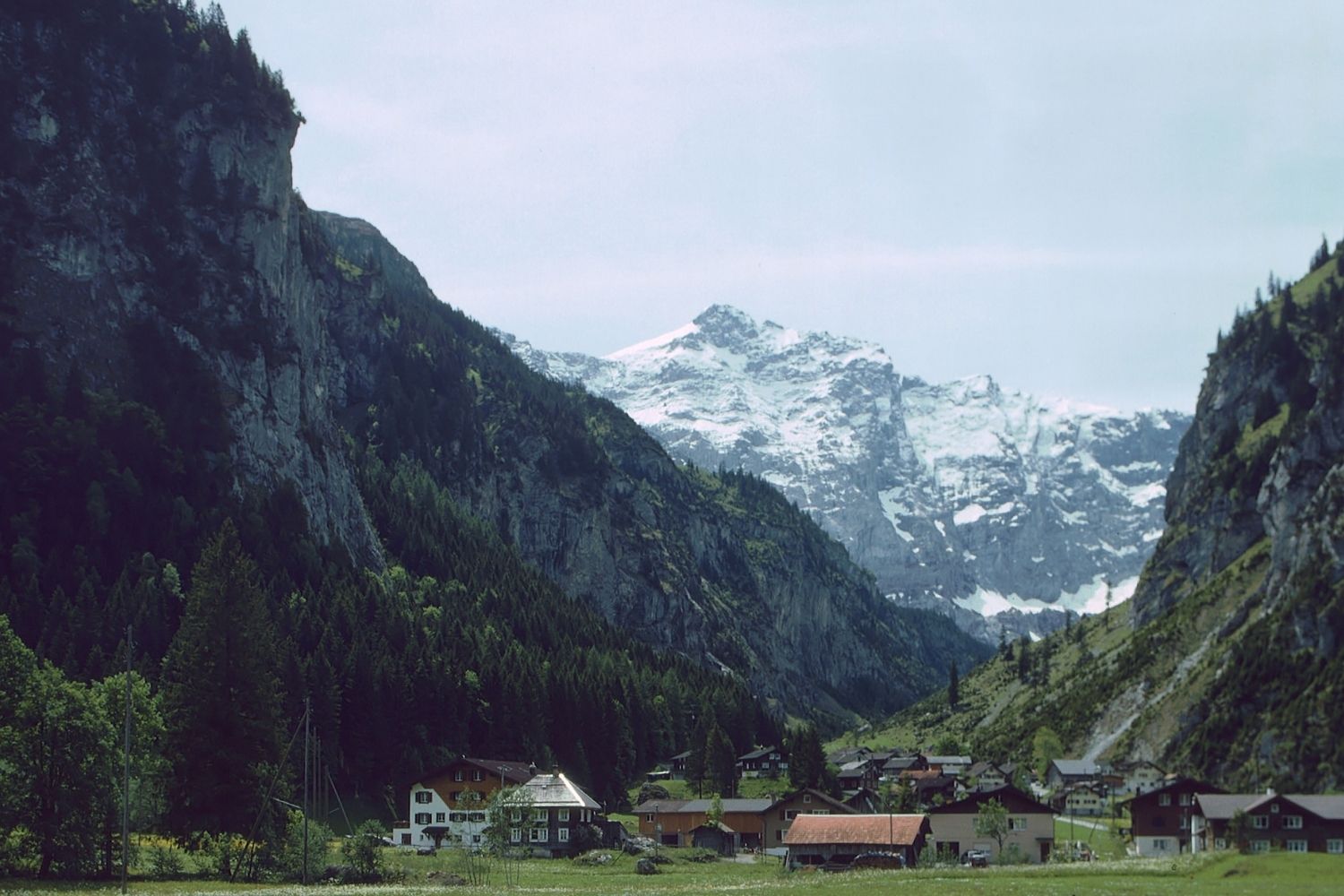
On Monday morning, approximately 2,000 cubic meters of rock broke away from the north face of Gross Ruchen, in the canton of Uri, at an altitude of 2,900 metres. The municipality of Unterschächen reports no injuries or damage to buildings or infrastructure, but a dense cloud of dust has reached the valley floor. Among the possible causes, the authorities indicate the melting of ice underground, after a period of extreme heat.
Am Montag hat sich in der Nordwand des Gross Ruchen im Kanton Uri a #Felssturz ereignet. Rund 2000 Kubikmeter Fels brachen auf etwa 2900 Metern Höhe ab. Die Staubwolke breitete sich bis ins Urner Reusstal aus.
Als wife Ursache gilt die extreme Hitze, die Eis im Untergrund… pic.twitter.com/o1kbbCKJLz
— Bergwelt (@bergwelt_me) September 29, 2026
Permafrost, the hidden glue of the rock
Permafrost refers to the ground (soil, rock or debris) whose temperature remains at or below 0 °C continuously. In the Alps it is mainly present above 2,500 metres; in Switzerland it affects approximately 5% of the territory. Robert Kenner, a researcher at the WSL, the Swiss federal institute for the study of forest, snow and landscape, explained that, as long as it is sufficiently cold, permafrost prevents water from infiltrating the cracks in the rock. If the liquid penetrates, the pressure generated can destabilize the wall.
For small landslides and rockfalls, Kenner indicates an “already clear” trend of increase, particularly above 3,000 metres. For large events, geology and the presence of water in the rock also have an impact, and should remain rare. As a point of comparison, in Blatten in May 2025, more than nine million cubic meters of rock and ice flowed into the Lötschental.
An off-the-charts summer
In Switzerland, Glacier Loss Day, the date on which winter snow reserves run out and the glacier begins to consume its ice, fell on June 29, three days after the record set in 2022, when glaciers lost around 6% of their mass. At the Konkordiaplatz on the Aletsch, glaciologist Matthias Huss documented a subsidence of the surface of almost six metres.
In Piedmont, on 1 September, a collapse affected the north-eastern side of Monviso, covering around a thousand meters of altitude difference. Arpa Piemonte estimates the material deposited at a few thousand cubic meters. The agency’s station, at over 3,300 meters, never recorded temperatures below zero from June 10 to September 10. Arpa indicates thermal stress as a probable triggering factor and permafrost degradation as a possible contributory cause, in an already fractured rock mass. A similar event occurred in September 2023.
The limitations of the data
The most exposed areas, steep walls above 2,800-3,000 metres, correspond to around 1% of the Swiss territory, according to Kenner. However, the number of slopes at risk cannot be quantified: for a long time, collapses at high altitudes were not systematically recorded and a historical series is missing. Large gaps are announced with slow but measurable movements, even for decades, without a complete prediction being possible.
