
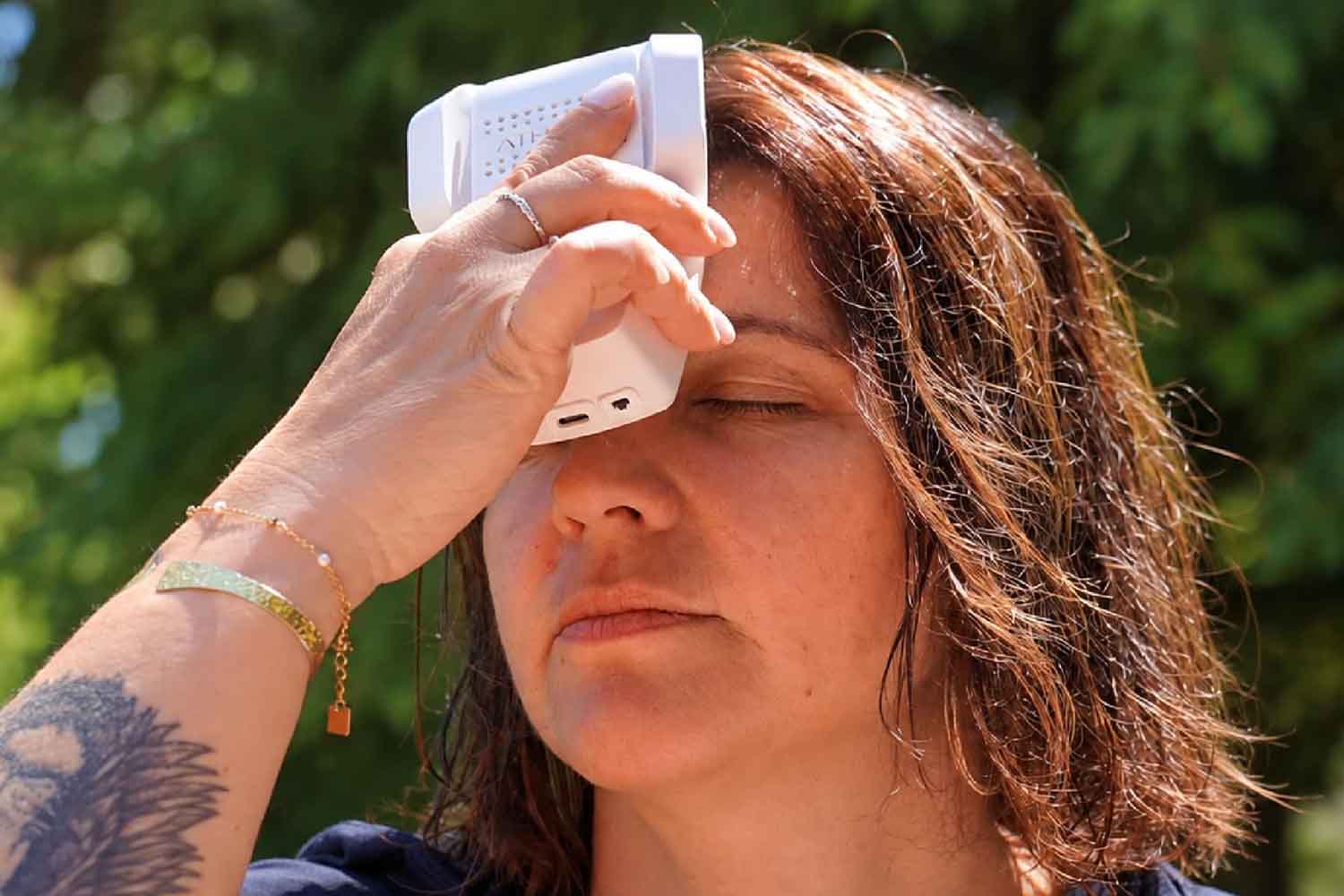
Five seconds to reach the operating temperature, an appliance the size of a hand and a production that has just increased from 600 to 1,500 pieces per month. Hera is a small French portable cryotherapy device designed to provide relief during hot flashes, especially those related to menopause.
The idea comes from Thaddée Caron, founder of the startup Athana, who says he started working on it after seeing his mother Marina struggling with hot flashes without finding a practical solution to use when they arrived. From that very domestic problem an object was born which today is assembled in France, has arrived in pharmacies and in 2026 also won a silver medal at the Concours Lépineas shown in the official palmarès of the 2026 edition.
How Héra works
The principle is quite simple. Turn on the device and place the cooling surface on areas such as the face, neck, nape, décolleté or wrists. According to Athana, Héra reaches the set temperature in about five seconds and allows you to choose between two cooling levels, 10°C and 5°C.
Essentially, instead of desperately searching for a fan, an open window or the frozen food section of the supermarket, the cold is applied directly to the skin when the hot flash hits. The device is rechargeable via USB-C and can be used multiple times throughout the day. Athana markets it as comfort and well-being devicenot as a medical device. And it’s a useful distinction, especially when moving from sensations to numbers.
The first data comes from 100 women
In 2024 the company conducted one Internal use study on 100 menopausal women. According to data published by Athana in the history of the project, 96% of participants declared themselves satisfied, while an average reduction of 32% in hot flashes was observed.
The most immediate data, however, concerns the cold: Athana reports a decrease in 15°C of the skin temperature at the point of application after five seconds. These are interesting results, with a rather clear limitation: they come from an internal evaluation of the company and do not yet equate to a clinical demonstration of the effectiveness of Héra. Athana herself specifies this and has started a research process dedicated to better verifying the effects of the device.
Now comes the clinical study
The new clinical investigation on Héra will be conducted at the Institut Rafaël under the scientific responsibility of the oncologist Alain Toledano. The protocol provides 50 adultsfollowed for three months, with hot flashes considered bothersome and on hormone therapy for at least six months. Participants will have to note the frequency and intensity of the episodes in a diary and complete questionnaires used in the research to also evaluate the impact on daily life, quality of sleep and quality of life.
For now, however, we are still before the first participant. The protocol was submitted to the Comité de protection des personnes and the French agency ANSM, but the inclusions have not yet started and there are no clinical results. No preventive rejection, therefore, and not even promotion with advance praise: the device produces cold quickly and the internal study has given encouraging signs. How much this affects hot flashes under controlled conditions will be the next step.
From 600 to 1,500 Héra per month
In the meantime, the product has already entered a decidedly less experimental phase from an industrial point of view. On 18 September Athana and AMIPI Industrie inaugurated a new production line dedicated to Héra in Cholet, western France. The capacity has thus passed from 600 to 1,500 devices per month.
There is also another interesting piece of the story. Héra is assembled and packaged in the so-called learning and inclusive uses of AMIPI, where people with cognitive disabilities also work. To insert the device into the line, the different assembly phases were broken down and adapted so that the work could also become a tool for developing precision, dexterity and memorization skills. Three specific stations were created for the new activity.
That’s quite a leap for an object born from a hot flash observed in the family. Production already runs at 1,500 pieces per month; to understand how much those five seconds of cold can make a difference on hot flashes, however, we will have to wait for the study to begin.
