
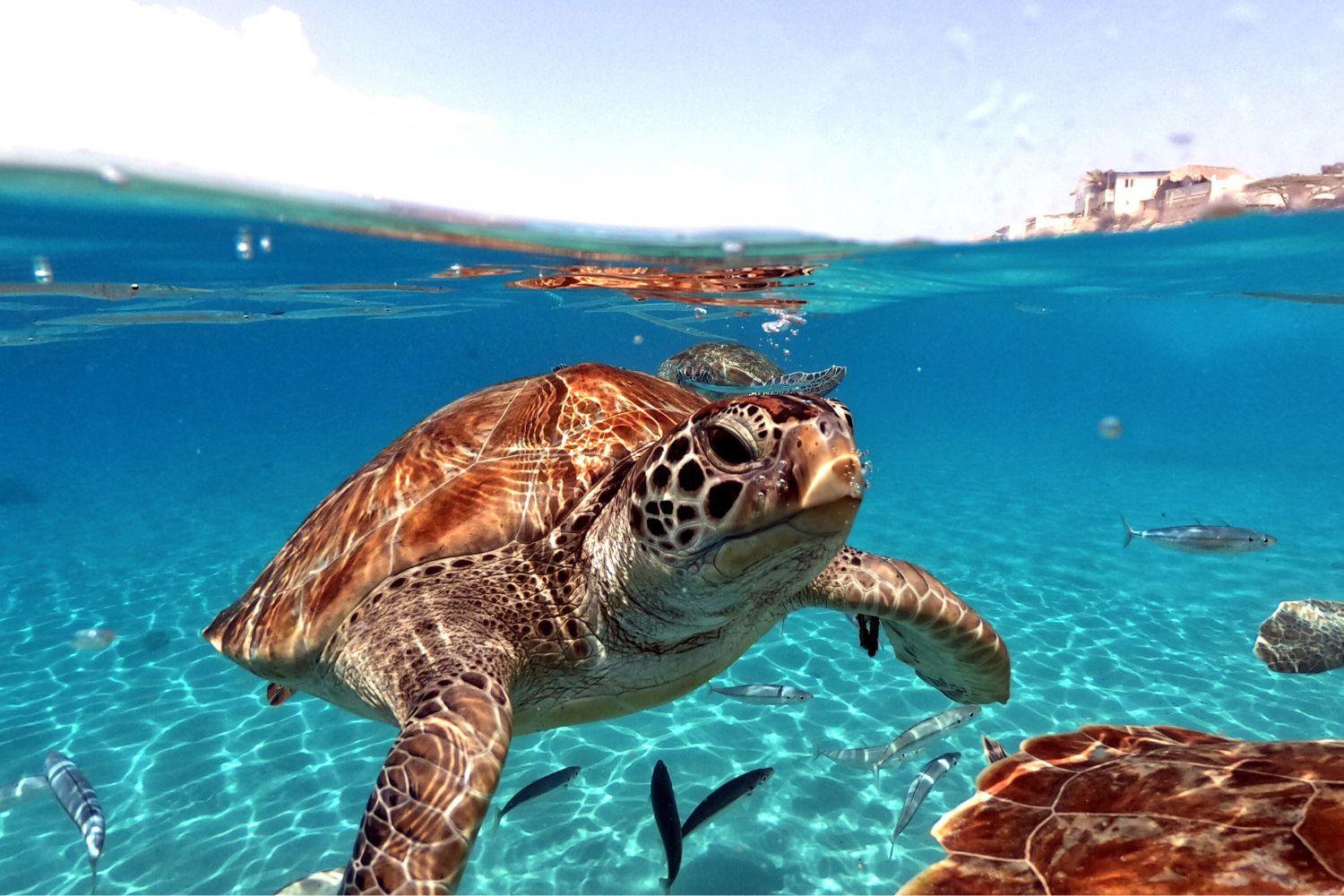
Not all sea turtles undertake extraordinary migratory journeys across the ocean, research led by the University of the Sunshine Coast UniSC (Australia) could in fact make another certainty fall: scientists have in fact identified a population of the Galápagos Islands that does not seem to want to move from there.
It has long been known that sea turtles are able to orient themselves using signals from the earth’s magnetic field, the sun and ocean currents, traveling long distances in search of food before returning to the places where they were born to reproduce.
For this reason a population of the islands Galapagos it’s so peculiar: instead of wandering across vast expanses of ocean, it doesn’t move. In other words, these turtles don’t really seem to want to move, and this surprised the authors of the discovery themselves.
Here we demonstrate that yellow-green sea turtles, one of two genetically distinct forms, occupy single foraging areas spanning one or more Galápagos islands,” explains co-author John W. Rowe. “We expected them to migrate to distant beaches in the western Pacific to breed, yet, interestingly, none of our turtles equipped with satellite transmitters left the Galápagos Marine Reserve during the three years of our study.
Sea turtles of the Galápagos Islands
Green turtles are distinguished from the other six living species of sea turtles because the adults are primarily vegetarians. Young turtles actually begin their lives feeding on both plants and animals, but as they mature their diet shifts primarily to algae and marine plants.
Scientists actually identified two genetically distinct forms involved in this study: green turtles are generally found in the tropical and subtropical areas of the western Pacific, while black turtles are found in the eastern Pacific, west of the Americas and south to Southern California.
The islands Galapagos they are the only known place where both forms share the same waters. There, green and black turtles mix and feed on the same types of marine vegetation (this extraordinary archipelago is known for incredible biodiversity, and it is no coincidence that it was the site of Charles Darwin’s first studies on evolution).
However, they are not completely identical: in fact, young green turtles tend to grow faster than black ones, which suggests that there may be physiological differences between them that scientists have not yet fully characterized.
The researchers wanted to better understand where the green sea turtles spent their time, how much territory they occupied, and whether they moved between islands within the Galápagos Marine Reservecovering 198,000 km².
How the research was conducted and what it found
In 2015, the team identified nine adult specimens in shallow water near four islands, seven males and two females, gave them names and attached electronic transmitters that sent position signals. Monitoring lasted a maximum of 418 days, and typically ended when a transmitter became disconnected or stopped sending signals.
The results revealed a strong preference for shallow coastal habitats. Best of all, although the turtles occasionally strayed up to 25 km from the coast, most of them remained much closer to the islands.
Five of the nine turtles spent most of the study period near a single island: Bernardo And Will be they moved between Isabella And San CristobalWhile Leandro he traveled between Isabella and Spanish. Ainoa she turned out to be the most adventurous of the group: after being marked near San Cristobalmoved to Santa Cruz and then to Isabella.
The researchers also noticed a seasonal pattern: movements between the islands occurred only during the coldest period, from April to October. On average, each turtle used a territory of 1,498 km², although the size of that territory varied considerably from one individual to another.
But, overall, tracking data suggests that green sea turtles living around the Galapagos they can be surprisingly linked to their territory. However, the researchers clarified that their observations only cover a limited period of the turtles’ lives. Longer migrations may have occurred at other times and therefore may not have been detected during the study.
This possibility is especially important for females.
Since green sea turtles do not lay their eggs on the beaches of the Galápagos, we believe that they will eventually leave the area to return to their native beaches in the western Pacific – says Juan Pablo Muñoz Pérez, another co-author of the study – In contrast, some black turtles nest in the Galápagos: depending on the individual, these can be permanent residents of the archipelago, move to other nearby oceanic islands or even to feeding grounds off the coast of America Central and Southern
A discovery that could open the doors to a new world
The discovery, at the moment, leaves more questions than answers, but it opens the door to a world of different possibilities, and the results have certain implications for conservation: in fact, since some turtles move between different islands, protecting just one favorite feeding area may not be enough.
The scientists also highlighted the importance of preserving the coastal waters and inter-island routes that turtles depend on to travel around the archipelago.
Since individual turtles may depend on the waters around multiple islands, the quality of habitat available for foraging should be kept intact on all islands, and not allowed to deteriorate anywhere
he concluded Rowe
The work was published on Frontiers in Amphibian and Reptile Science.
Sources: Science Daily / Frontiers in Amphibian and Reptile Science
