
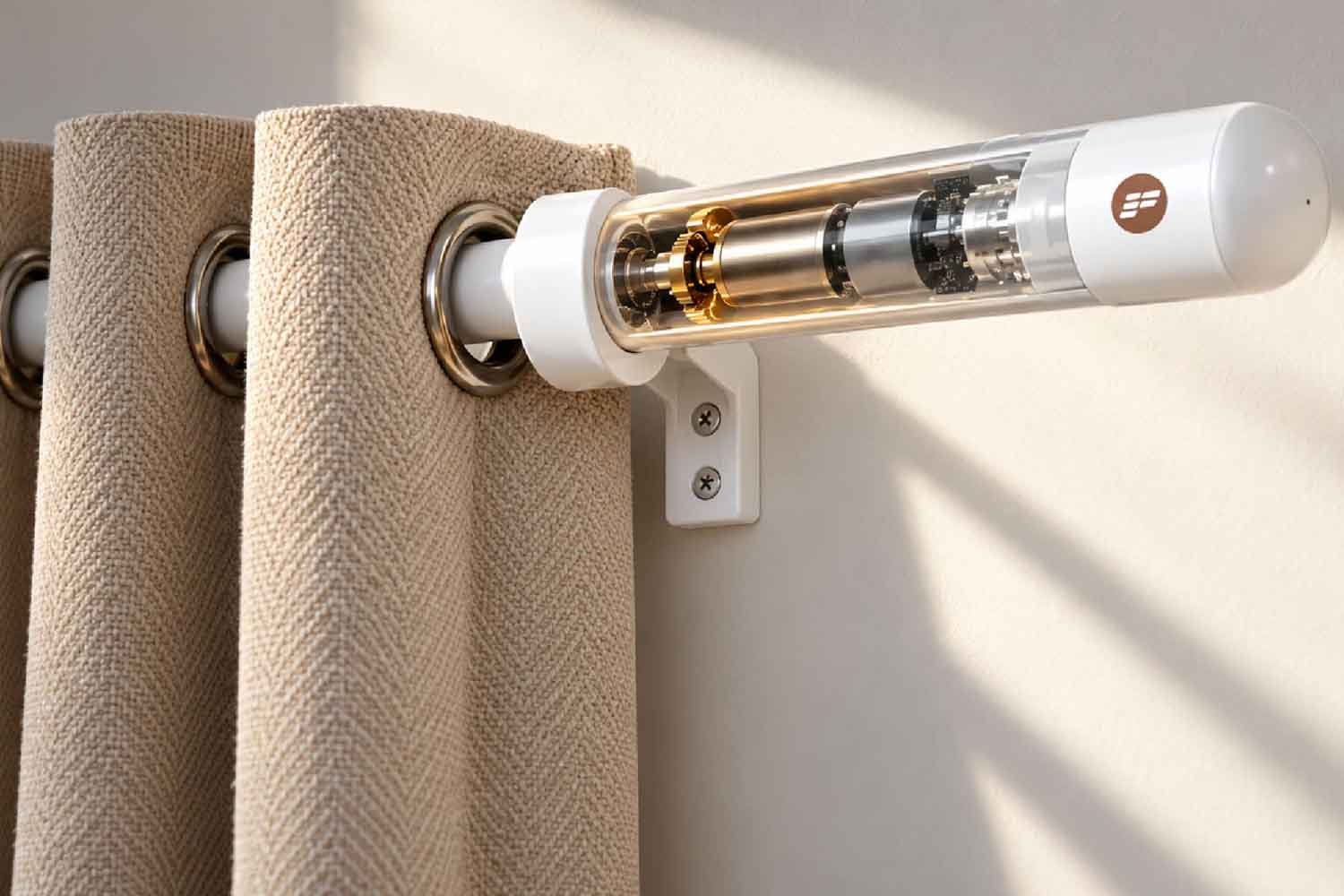
The curtains open when the sun rises, close in the evening and, if desired, they can do so without having a power cable running down the wall. It’s called Reze Flow M5 and it’s a motorized telescopic curtain rod that arrived on Kickstarter: the motor disappears inside the rod, while an optional solar module applied to the window can take care of the power supply.
The interesting part is that it does not require special curtains. The idea is to replace the old rod and continue using your curtains, as long as the rings and eyelets are compatible. The system holds, according to the data declared by the manufacturer, up to 15 kg of fabric and opens the curtains from the center towards the two sides. The expected dimensions cover windows from approximately 112 to 208 centimeters in the L version and from 188 to 361 centimeters in the XL.
It can be programmed with sunrise and sunset
The engine and electronics are hidden inside the shaft, while management passes through the ecosystems of the connected home. The M5 uses Matter and is compatible with Apple Home, Amazon Alexa and Google Home. With the ecosystems that support these automations it is possible to program opening at a certain time or at sunrise and closing at sunset. You can also choose partial opening, for example 50%.
The campaign also features an adjustment linked to natural light during the day, designed to move the curtains when the radiation becomes excessive. A less spectacular function than the cinematic awakening at dawn, probably more useful at three in the afternoon in August.
The solar panel is optional
The Reze Flow M5 can work with the normal power supply or with the B7 solar module, offered separately or in the campaign packages. It is therefore more correct to talk about a curtain rod that can also be powered by solar energy than an exclusively solar device. A small distinction, but useful especially for poorly exposed windows or for those who prefer to simply plug in and close it there.
If the Wi-Fi fails, you don’t have to wait for the connection to return while staring dejectedly at the sun from the window: a Bluetooth remote control is included in the package and manual start-up by pulling the curtain slightly is also available. In the event of an electrical blackout, the stick can be used manually like a traditional one, as indicated by the manufacturer in the FAQ section of the project.
It’s quiet, at least in the manufacturer’s tests
Remac declares a maximum noise of 45 decibels in a test carried out one meter away with a four meter long rod and 15 kg curtains. It is data provided by the company, so it will need to be verified in daily use, but on paper it means preventing the device responsible for waking us up gently with the light from deciding to do it with the motor first.
Installation, however, requires a minimum of real work. The M5 does not apply to the old stick: you have to remove it, drill new holes and mount the dedicated brackets. Beyond two meters of extension, a third central support is also necessary. Home automation can open the curtains for us; the drill, for now, keeps its job.
How much does it cost and when should it arrive
The project is still in crowdfunding on Kickstarter, so we are not talking about a product already normally available in stores. The campaign offers the M5-L stick starting from around 160 dollars in promotional formulas, while the package with M5-L and B7 solar module reaches around 229 dollars. For the XL model the figures go up. The delivery indicated by the promoters is scheduled for November 2026.
It is a forecast of a participatory financing campaign, not the guaranteed delivery date of a normal online purchase. As with any crowdfunding project, production and shipping may be delayed even after the financial goal has been reached.
Essential? Hard to argue. But between automatic shutters, connected thermostats, light bulbs that obey your voice and vacuum cleaners that run around the house without supervision, there was actually no one in charge of drawing the curtains. He had evidently hidden himself inside the stick.
