
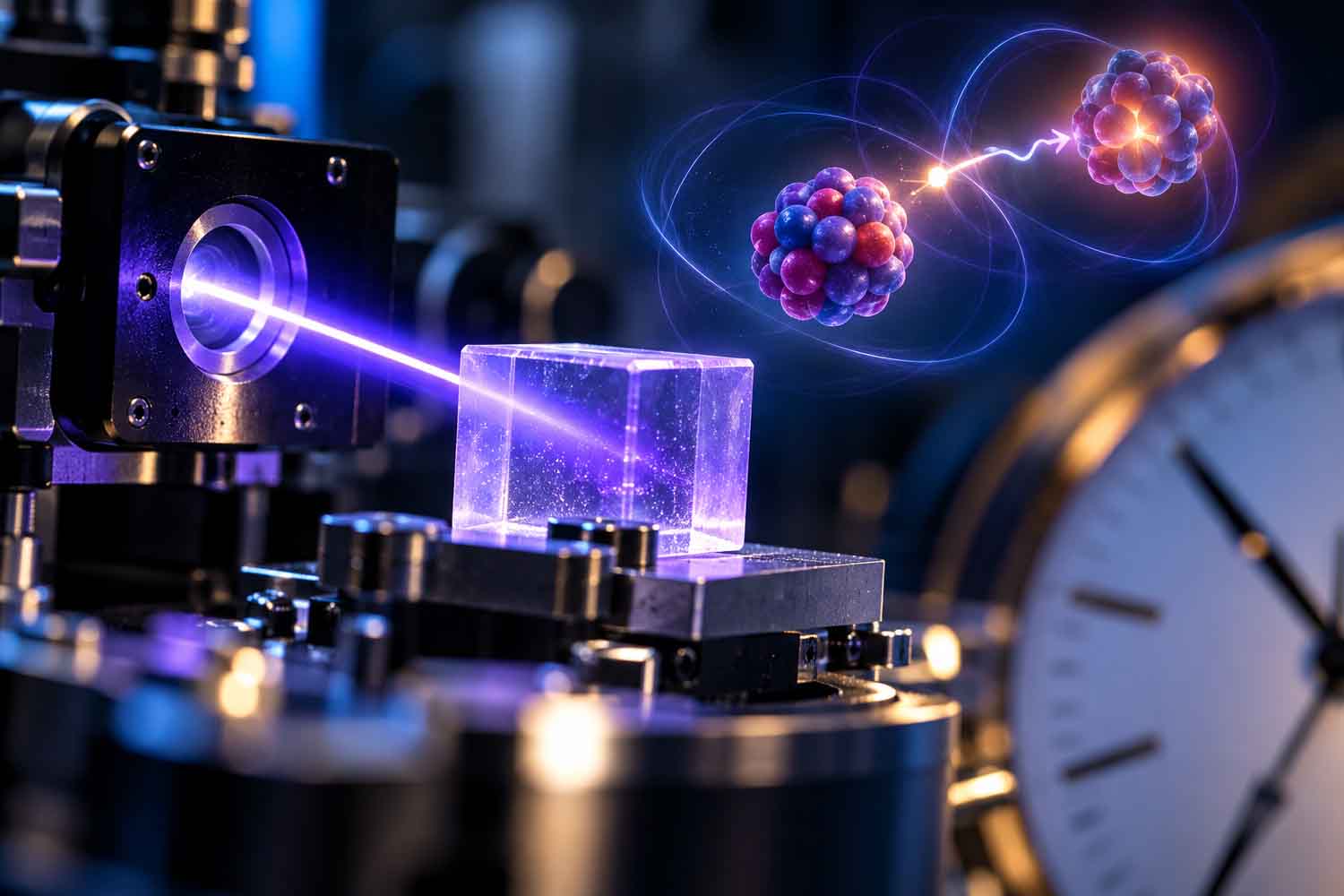
Two groups of scientists, one in Vienna and the other in Beijing, built the world’s first functioning nuclear clocks. Inside them there are no hands, gears or even a dial: there are crystals containing thorium-229, a laser and a system capable of maintaining the frequency of light constant. The results were published on October 7, 2026 in two studies in the scientific journal Nature. And they could be the beginning of a new generation of tools for measuring time.
The promise is remarkable: clocks so precise that they can accumulate just one second of error over billions of years. For now we are still far away. Prototypes work, but more advanced atomic clocks still do better. In short, the future of time measurement has arrived in the laboratory and has already found someone who beats it.
How does a nuclear clock work?
To understand why this invention is important we must start from atomic clocks, those which already today allow us to measure time with extraordinary precision.
Traditional clocks count something that repeats itself regularly. An old pendulum, for example, swings back and forth. A quartz watch uses the oscillations of a crystal. Atomic clocks instead use the properties of atoms, which can absorb energy at very specific frequencies.
An atom is made up of a central nucleus, composed of protons and neutrons, surrounded by electrons. The latter can move from one energy level to another by absorbing or emitting energy. Atomic clocks exploit precisely these transitions to have an extremely regular reference. Nuclear clocks do something different: they use energy changes that happen directly inside the nucleus of the atoma region over ten thousand times smaller than the atom itself.
The choice could offer a huge advantage. The core is less sensitive to many external disturbances, such as electromagnetic fields, which can disturb measurements. However, there is a difficulty: normally, very large quantities of energy are needed to change the energy state of a nucleus. And this is where a rather particular element comes into play.
Thorium-229, the element that made the clock possible
The protagonist of the two experiments is the thorium-229a particular radioactive version of thorium. Its most interesting feature is that it has two core energy states that are very close to each other. This means that, unlike what happens with most other atomic nuclei, it is possible to cause the transition from one state to another using an ultraviolet laser. The researchers inserted thorium-229 nuclei into small calcium fluoride crystals, then illuminated them with a laser tuned to a very precise frequency.
The operation resembles that of a musical instrument to be tuned. When the laser reaches the right frequency, the nuclei absorb energy and change state. If the frequency shifts even slightly, absorption decreases. The system notices this and intervenes to bring the laser back to the correct frequency. In this way the thorium nuclei become the reference that allows the clock to maintain a regular rhythm.
The group from the Technische Universität Wien, the Technical University of Vienna, led by the physicist Thorsten Schumm, has created a prototype capable of automatically correcting itself, without having to continuously depend on another atomic clock. The device remained stable for over 24 hours without external intervention. An important result, because it demonstrates that the system can function autonomously.
Vienna and Beijing: two nuclear clocks, two different results
The research groups worked independently and their results appeared in the same issue of Nature. In the study conducted in Vienna, scientists demonstrated that it is possible to use thorium nuclei to continuously correct the laser frequency and build a nuclear clock capable of stabilizing itself.
The group from Tsinghua University in Beijing has instead created a system which, in short-term measurements, has achieved stability approximately six times greater than that obtained in Vienna. Be careful, though: this means that the frequency of the Chinese device fluctuates less in the range considered, without proving that it is overall six times more accurate.
The Chinese researchers also compared two crystals produced separately, obtaining very close results. A useful step to understand if, in the future, these devices can be built and reproduced more easily. For now, however, we are faced with experimental prototypes. Neither is ready to replace the instruments that regulate official time.
How accurate are they compared to atomic clocks?
According to data communicated by the Technical University of Vienna, the Austrian prototype achieved a precision which, expressed in intuitive terms, corresponds to approximately one second of error every 30 million years.
Enough already for someone who usually arrives twenty minutes late, of course. Yet, in precision watch research, this result is not yet a record. Cesium atomic clocks used as a reference for defining the second can do better, while the more advanced optical laboratory atomic clocks achieve even higher performance.
Why then invest so many years of research into nuclear clocks? Because their operation could allow us to overcome some limitations of current tools. Atomic nuclei are relatively protected from external interference, and by using crystals containing many nuclei, researchers could obtain more stable signals and more compact devices.
Current performance also depends on the power of the lasers, the quality of the crystals, and the ability to control the conditions of the experiment. Improving these elements could significantly increase accuracy. The possibility of losing just one second over billions of years therefore remains a goalstill to be demonstrated experimentally.
Because they could help us study dark matter
The most interesting prospect, however, goes beyond the construction of increasingly precise watches. Researchers hope to use these tools to study some physical phenomena that are very difficult to observe, starting with dark matter. Astronomers know that there is a large amount of matter in the universe that does not emit light and that we cannot observe directly. Its presence is deduced above all from the gravitational effects it exerts on stars, galaxies and other cosmic structures.
We still don’t know what particles it is made of. According to some hypotheses, certain forms of dark matter could cause tiny variations in the fundamental constants of physics, that is, in some quantities that describe the behavior of matter and natural forces.
If these variations existed, they could slightly change even the frequencies used by the most sensitive watches. By comparing extremely precise measurements, scientists could look for traces of them. The Vienna team has already used the new nuclear clock to carry out this type of research. The experiments, however, allowed us to narrow down some possibilities envisaged by the theoretical models.
The result is described in the study published on Naturetogether with the technical characteristics of the prototype. Nuclear clocks could also become useful for verifying more precisely some fundamental laws of physics and looking for any phenomena that current instruments cannot detect.
Getting there will require better lasers, more efficient crystals and more experiments. Meanwhile, after decades of research, two laboratories have managed to make devices work that until a few years ago existed mainly in scientists’ projects. They haven’t beaten atomic clocks yet. However, they have begun to measure time using a part of the atom that, until recently, seemed virtually unattainable with a laser.
