
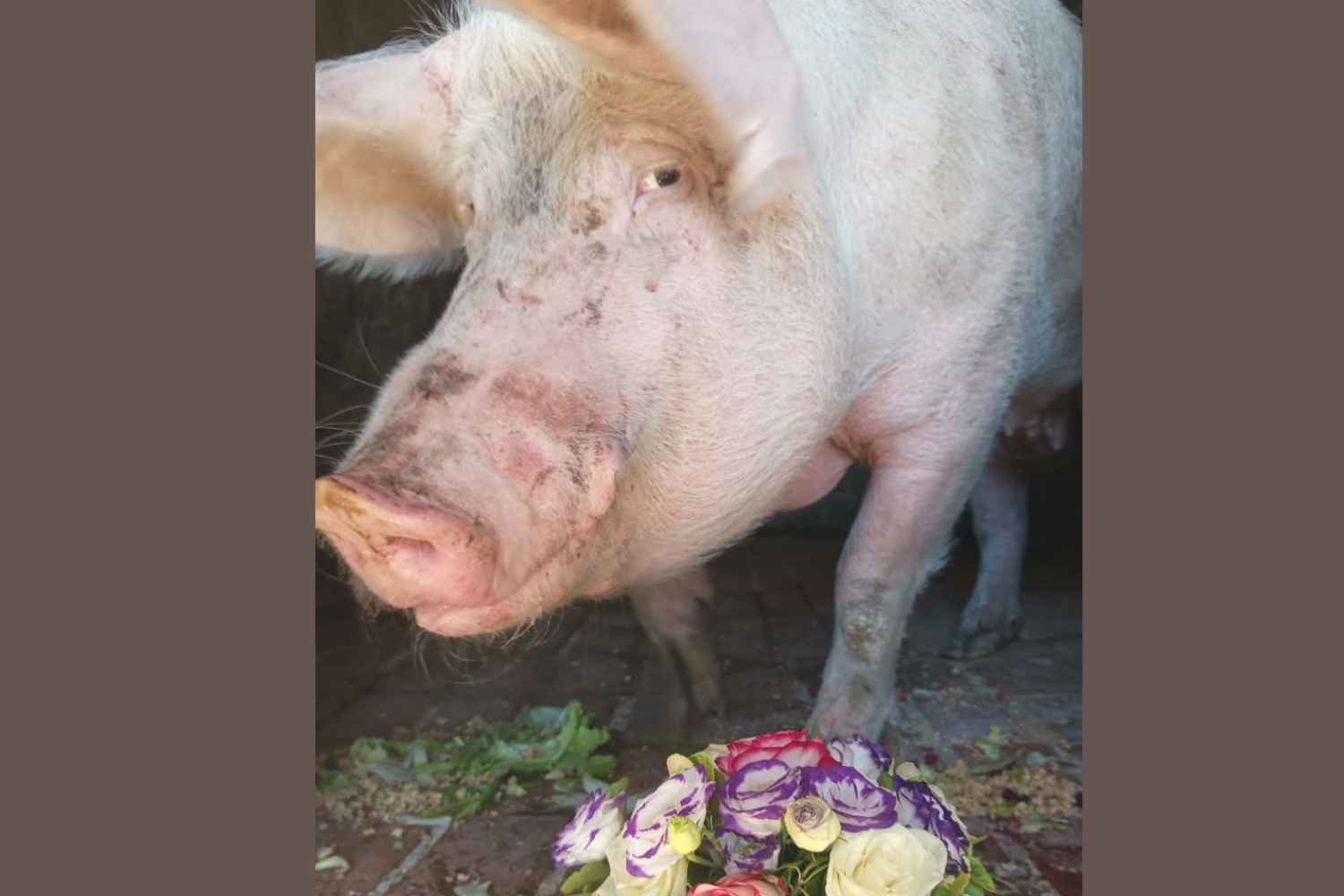
She had been taken to the Meat Center in Rome due to a registration error and risked being slaughtered within a few days. But for Vittoria, a little pig who accidentally ended up at the slaughterhouse, the story had a happy ending thanks to the intervention of the OIPA (International Organization for Animal Protection).
The story began last Saturday, when the animal was transferred to the Meat Center of the capital, where its slaughter was scheduled for the following Monday. What prevented the worst was the timely mobilization of the OIPA, which initiated a series of discussions with the Veterinary Services of the ASL Roma 1, directed by Matteo Fiumicelli, and with the management and veterinarians of the facility.
Thanks to the collaboration between the parties, it was possible to clarify the error and stop the procedure before it was too late.
Vittoria is finally safe
@oipa
On Tuesday, OIPA representatives went to the Meat Center together with the legitimate owner of the pig and Nicole Moscariello to recover Vittoria and take her to safety.
Arianna Fioravanti, head of the Institutional Relations Office of the OIPA, recounts the moment of the rescue:
«We are very happy to have managed to arrive on time, for this we thank all the people who intervened to support us and the Veterinary Services of ASL Roma 1. Vittoria came out alive from a place from which almost no animal returns».
A story which, according to the association, should also become an opportunity to reflect on the fate of animals destined for food production.
A story with a happy ending that invites reflection
If Vittoria managed to escape slaughter, the same does not happen to the millions of animals raised and killed every year for human consumption.
It is precisely on this contradiction that the OIPA invites us to focus: why should the life of an animal have a different value depending on its destination?
The association reiterates the need to recognize animals as sentient beings, capable of experiencing fear, pain and suffering, and not simply as products intended for consumption.
Hence also the invitation to consider a plant-based diet as a concrete choice to help reduce animal exploitation. Vittoria’s story ends with a rescue, but leaves open a broader reflection. As Fioravanti underlines, the hope is that his story can raise awareness among people so that “slaughter is no longer the last act in the life of any animal”.
