
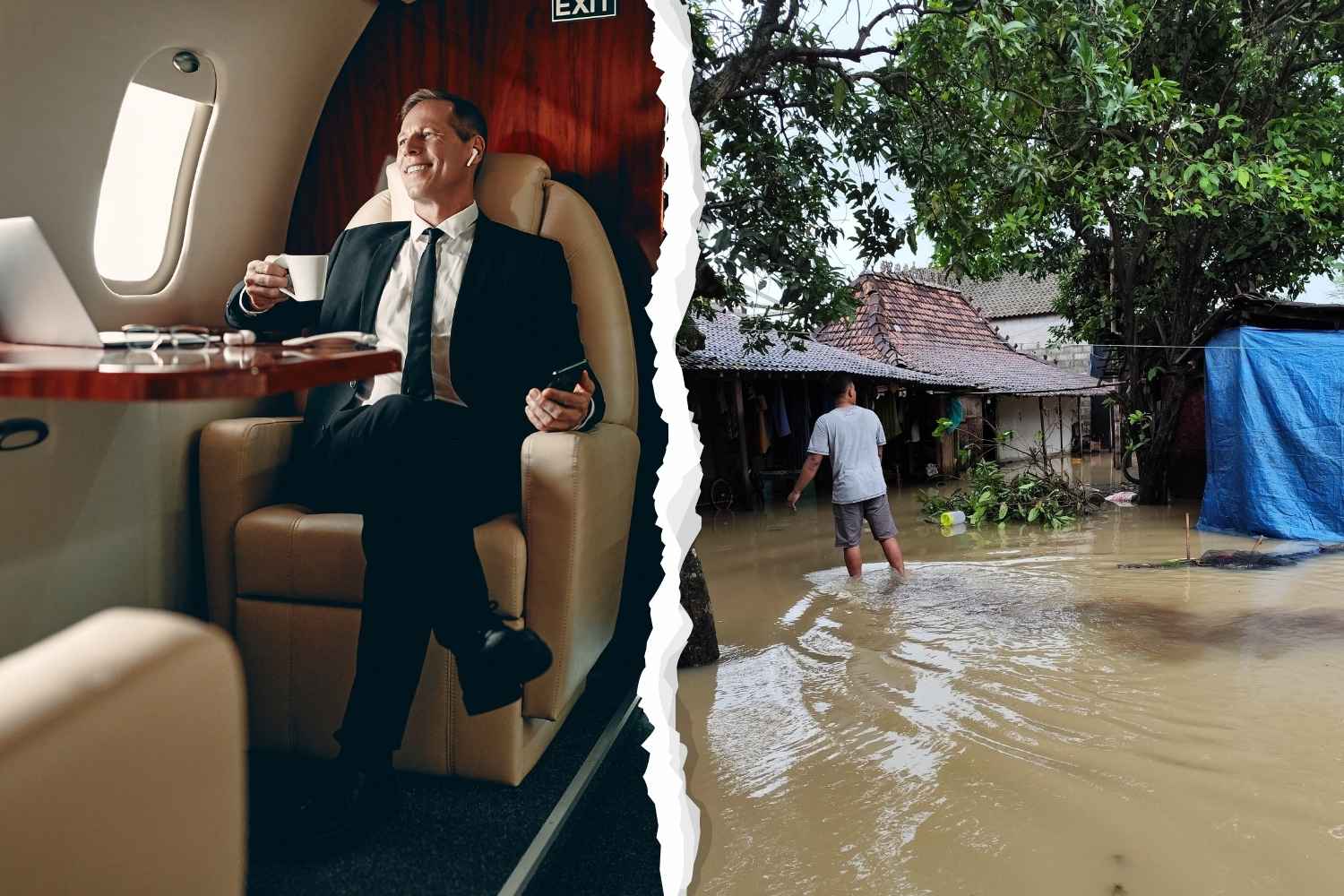
There are those who try to reduce energy consumption by paying attention to their daily habits, and then there are those who, through millionaire assets, properties and investments, have a climate footprint that is enormously higher than that of the majority of the population. The climate crisis affects everyone, of course, but not all of us contribute to it in the same way. And above all, not all of us have the same responsibility for the emissions that cause it.
This inequality is quantified by a new report commissioned by Greenpeace Central and Eastern Europe (CEE) and carried out by the German institute Forum Ökologisch-Soziale Marktwirtschaft (FÖS), entitled Under the Surface: The Hidden Climate Debt of Extreme Wealth in the European Union (the study is the first in Europe to estimate the climate debt of the super-rich, i.e. the value of climate damage associated with emissions produced in excess of a fair per capita share, both in relation to assets and consumption).
From here, a first main impressive figure emerges: the richest 1% of the population of 24 European Union countries is associated with an annual climate debt estimated at 301 billion euros, considering the emissions attributable to the ownership of companies and other productive investments.
A figure that photographs the climate responsibility concentrated at the top of the distribution of wealth and which arrives just as European leaders are discussing the next community budget and possible new sources of financing in Brussels.
But it is when looking at Italy that the disproportion becomes even more evident: the per capita emissions attributed to the assets of the richest 1% are approximately 160 times those of the poorest half of the population.
What is the climate debt of the super-rich
When we talk about the emissions of the richest, our thoughts immediately turn to private jets, yachts, luxury villas and intercontinental travel. All activities that can lead to very high energy consumption. But, according to Greenpeace, this is only the most visible part of the problem.
The most significant share of the climate responsibility of large fortunes emerges by considering the emissions generated by the economic activities owned and by investments.
In fact, the report analyzes the so-called climate debti.e. the estimated economic value of the damage caused by emissions that exceed an individual quota considered fair, compatible with the objective of limiting global warming to 1.5 °C.
To calculate it, the researchers considered two different perspectives:
This last method highlights an often overlooked responsibility: that of those who own and finance high-emission economic activities, even without directly consuming the resulting products. In 2022, the last year for which the data used in the study are available, the climate debt associated with the assets of the richest 1% of the 24 European states analyzed reached approximately 301 billion euros.
Considering instead the emissions linked to the consumption of the 1% with the highest incomes, the estimate was around 80 billion euros.
Two figures that show how important it is to also consider the role of capital ownership to understand climate inequalities. And be careful: the climate debt does not represent a tax already due nor a sum immediately recoverable by the States. It is an economic estimate of the responsibility associated with excess emissions, calculated through the social cost of carbon, which in the study is set at 310.77 euros per tonne of CO₂.
In Italy the richest 1% emits 160 times more than the poorest half of the population
According to the report, in 2022, the richest 1% of Italians were associated with a climate debt of 27.1 billion euros through assets and 11.2 billion through consumption of the highest income group. As regards the overall climate debt attributed to the assets of the richest 1%, Italy occupies third place among the 24 countries analysed, after Germany and France.
As for individual emissions, again in 2022, each person belonging to the richest 1% of the Italian population was attributed on average 150.8 tonnes of CO₂ equivalent per year, considering the assets and production activities owned. For a person belonging to the less wealthy half of the population, however, the value was just 0.95 tonnes. A difference of approximately 160 times.
@Greenpeace
In other words, through this attribution method, a single person from the wealthiest 1% is associated with annual emissions comparable to those of approximately 160 people from the bottom half. The imbalance also emerges by observing how emissions are distributed: the richest 1% is responsible for 27% of those attributed to Italians’ assets, while only 8% is attributable to the poorest half.
And the concentration of responsibility grows further at the top of wealth. The average climate debt per capita of the wealthiest 1% reaches approximately 45,400 euros, almost six times that of the average of the richest 10%, again considering assets.
Whoever pollutes the most is not necessarily who pays the most
Heat waves, droughts, floods and other extreme events produce economic and social consequences that affect the entire community. Those who bear the burden are often also people and families who have contributed much less to global warming.
The report recalls, for Italy, an average annual economic loss linked to climate events of approximately 5.4 billion euros, calculated by the European Environment Agency through a thirty-year moving average referring to 2022.
According to Greenpeace, Europe should direct more resources towards renewable energy, energy efficiency of buildings, climate adaptation and social protection measures, asking for a greater contribution from those who have the greatest wealth and are associated with the highest emissions.
Taxing large fortunes
The report comes at a particularly delicate time for European finances. The Union is discussing the multiannual budget 2028-2034, while financing needs for the energy transition, the protection of territories from extreme climate events and support for the most vulnerable families increase.
One of the proposals examined in the study concerns the introduction of a minimum effective tax of 2% on net assets exceeding 100 million euros. According to an estimate cited by the researchers, such a measure could generate around 67 billion euros per year in the European Union.
In Italy, an effective minimum tax of 2% on net fortunes above 100 million euros could produce, according to estimates cited by the report, around 8.3 billion euros in annual revenue.
Private jets and luxurious lifestyles are just the tip of the iceberg. The climate impact of the super-rich is much larger due to their properties, companies and investments, explains Clara Thompson, tax justice expert at Greenpeace Germany.
For Greenpeace, governments should also use the path of the United Nations Tax Convention to strengthen international cooperation on the taxation of large fortunes and improve the transparency of assets with high climate impact.
The request made by Greenpeace Italia, together with other environmentalist and pacifist organizations, to the Minister of Economy Giancarlo Giorgetti fits in this direction: to adopt a fairer tax system, based on the principle the polluter paysproviding for adequate and permanent taxation of the large fortunes and profits associated with fossil fuels and arms sales.
HERE you can find the full report.
