
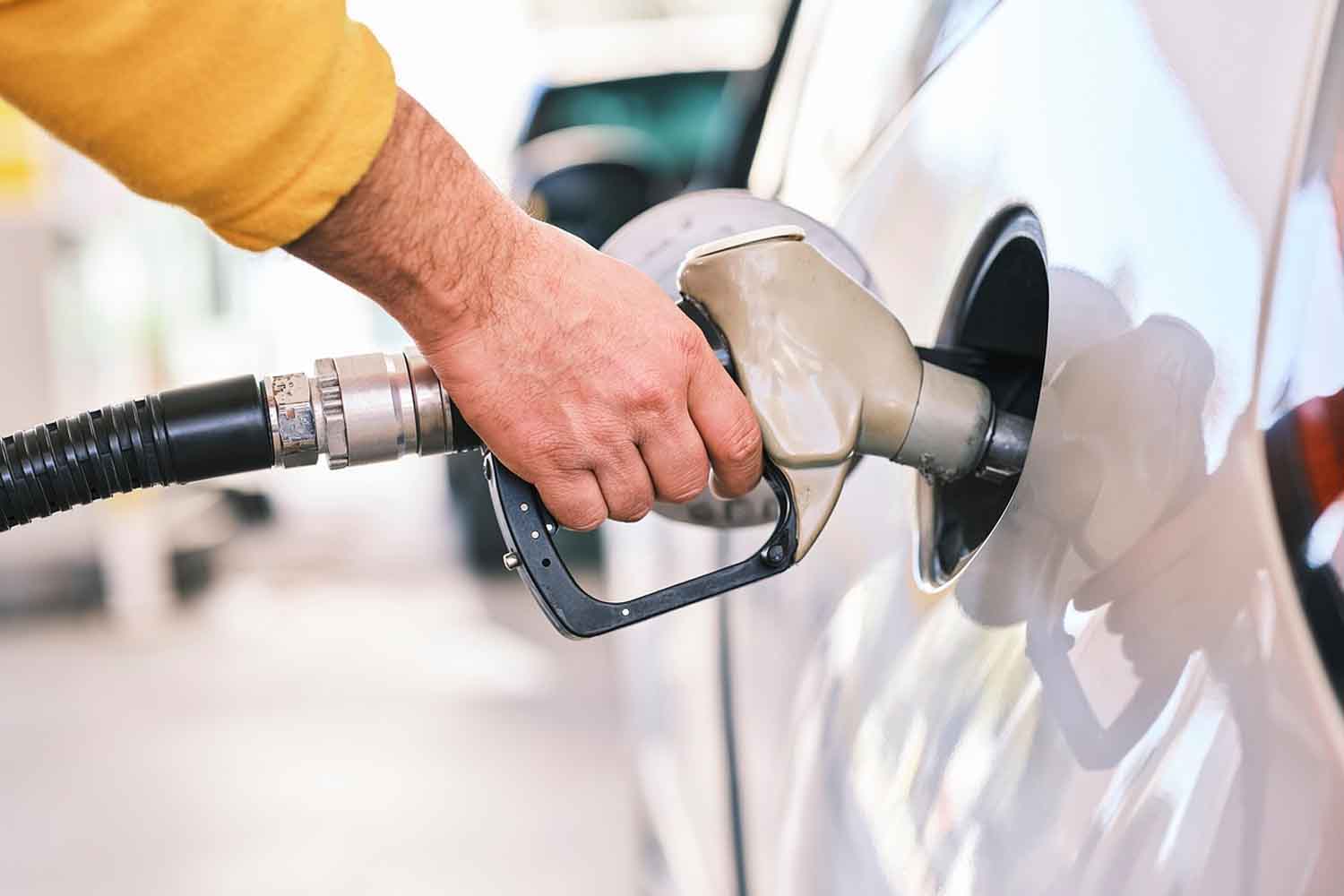
Filling up a 50-litre tank of petrol in Italy today costs 101.75 euros. With diesel it reaches 112.60 euros. These are the figures resulting from the national average prices published on 13 October 2026 by the Ministry of Business and Made in Italy: 2.035 euros per liter for petrol and 2.252 for diesel, in self-service mode on the road network. And while the fuel enters the tank, the euros scroll on the display. Ten, twenty, thirty, fifty. The tank is still half full and the wallet is already making its will.
The annoyance has a rather obvious economic explanation, especially with these prices. But there is also a psychological mechanism that scholars have been analyzing for almost thirty years: seeing the cost of something increase while we are purchasing it can make the expense even more unpleasant. Is called pain of payingliterally “pain of paying,” and helps explain why restocking can weigh more than other purchases of the same amount.
Because looking at the gas meter makes us feel worse
In 1998 Drazen Prelec, of the Massachusetts Institute of Technology, and George Loewenstein, of Carnegie Mellon University, published in the journal Marketing Science a study titled The Red and the Black: Mental Accounting of Savings and Debt.
The two researchers analyzed the relationship between the pleasure we derive from a purchase and the inconvenience that accompanies the payment. Their theory suggests that spending money can reduce the pleasure of consumption, especially when the cost continues to command our attention.
Let’s think about a monthly subscription to a streaming platform. The payment starts automatically, while we are busy doing something else, and when we throw ourselves on the sofa to watch a film we hardly think about the amount we have paid: the film almost seems like a gift. The same goes for a takeaway coffee: we pay at the register and a few minutes later we enjoy it.
At the petrol station it works differently. Strictly speaking, the fuel will only be consumed when we drive again, but during refueling we witness the price formation live. Each liter adds more than two euros to the display, and the numbers run wild.
The mechanism resembles that of the taximeter. We are comfortable in the back seat, we look out the window, then we look down and see how much the journey is costing us. And maybe we’re still stopped at the traffic lights.
The taximeter effect: when we prefer to pay more so as not to see the bill
This reaction was also explored in depth by Anja Lambrecht and Bernd Skiera in a study published in 2006 in the Journal of Marketing Research. The researchers analyzed consumers’ pricing choices, with three data collections and four empirical analyses. An interesting trend emerged: some people preferred a fixed rate even when a pay-as-you-go option would have been more cost-effective. They paid more to avoid the inconvenience of constantly checking how much they were spending.
Scholars also described this behavior with the so-called taxi meter effectthe taximeter effect. Knowing in advance how much we will spend can be reassuring, while watching the bill grow while using a service can create discomfort.
To be fair, this research concerned internet service rates, not fuel stations, so the parallel with petrol is an application of the psychological mechanism, not a result measured at the pump. In both cases the cost remains clearly visible. And when faced with a meter that exceeds one hundred euros, awareness of spending needs no further encouragement.
When petrol increases we all become petrol station experts
There is another peculiarity in our relationship with fuels. When prices rise, interest in offers also increases. We compare the distributors, we sift through the apps, we evaluate whether it is worth changing direction to save a few cents per litre. Let’s all become financial analysts with loyalty cards in our pockets.
Matthew Lewis and Howard Marvel studied precisely this behavior by analyzing the traffic of US sites dedicated to comparing petrol prices. In their work published in 2011 in the Journal of Industrial Economics they observed that people looked for cheap distributors more often during price increases than during periods of decline. An asymmetric reaction: when petrol becomes more expensive we become more attentive to saving, when it costs less we relax and focus on convenience.
The study was conducted on the American market, therefore it does not allow us to quantify the same behavior among Italian motorists. Here, however, to compare prices there is also the Fuel Price Observatory of the Ministry of Business and Made in Italy, which collects the prices communicated by the managers.
With current values, a difference of 10 cents per liter means saving 5 euros on a 50-litre fill-up. It may be worth it if the petrol station is along your usual route. However, if it takes several kilometers more to get there, you also have to take into account the fuel consumed to get there: saving five euros to burn them on empty laps is not exactly a bargain.
In Italy, petrol exceeds two euros while inflation starts to rise again
The supply inconvenience today is part of a particularly delicate Italian economic situation.
According to preliminary ISTAT estimates published on 30 September 2026, Italian inflation rose to 4.2% per year, compared to 3.3% in August. The acceleration is linked above all to energy goods, which increased overall by 22.3% compared to September 2025. The data concerns the entire energy category and should not be confused with the change in the price of petrol alone.
Even the goods purchased most frequently have become more expensive: ISTAT notes an annual increase of 5.3% for products with high purchase frequency, while the so-called shopping cart, which includes food and home and personal care products, records an increase of 1.7%.
Price growth is therefore also measured far from the distributors. Fuel, however, has a particular characteristic: its price is displayed on large billboards along the streets and can become an immediate reference for evaluating how much the cost of living is increasing.
Research published on August 31, 2026 by the Federal Reserve Bank of San Francisco examined the relationship between expectations on gasoline prices and those on general inflation.
Taerin Kim, research associate, and economist Yeji Sung used data from the Survey of Consumer Expectations of the New York Federal Reserve, collected monthly between June 2013 and June 2025. The analysis followed the expectations of the same people over time, considering respondents who had participated in at least eight consecutive monthly surveys.
The result shows another asymmetry: when respondents expected higher gasoline increases, they also tended to expect higher inflation. However, when they revised their fuel forecasts downwards, general inflation expectations did not decrease statistically significantly.
Specifically, a 10 percentage point upward revision in gasoline price growth expectations was associated, on average, with a 0.24 percentage point increase in one-year inflation expectations.
The relationship was stronger among families with lower incomes. For those under $50,000 per year, the same increase in fuel forecasts was associated with a 0.38 point increase in inflation expectations. Above $100,000, the estimated increase fell to 0.12 points. A difference that suggests how much the weight of fuel on the family budget can also influence the perception of other prices.
The authors point out that the average association is moderate and does not demonstrate a causal relationship. Furthermore, these are American data: automatically applying those percentages to Italian families would be incorrect. However, the mechanism also offers a possible interpretation for our country, where increases in fuel, bills and food products weigh on family budgets and contribute, to varying degrees, to inflation.
Petrol is one of the few expenditure items that we can observe simultaneously in three ways: on the billboard at the petrol station, on the meter while we refuel and on the current account balance immediately afterwards. With the Italian prices of October 13th, 50 liters are enough to exceed one hundred euros. Psychological discomfort can amplify the payment experience, but the bill would remain high even if the display was turned off.
