
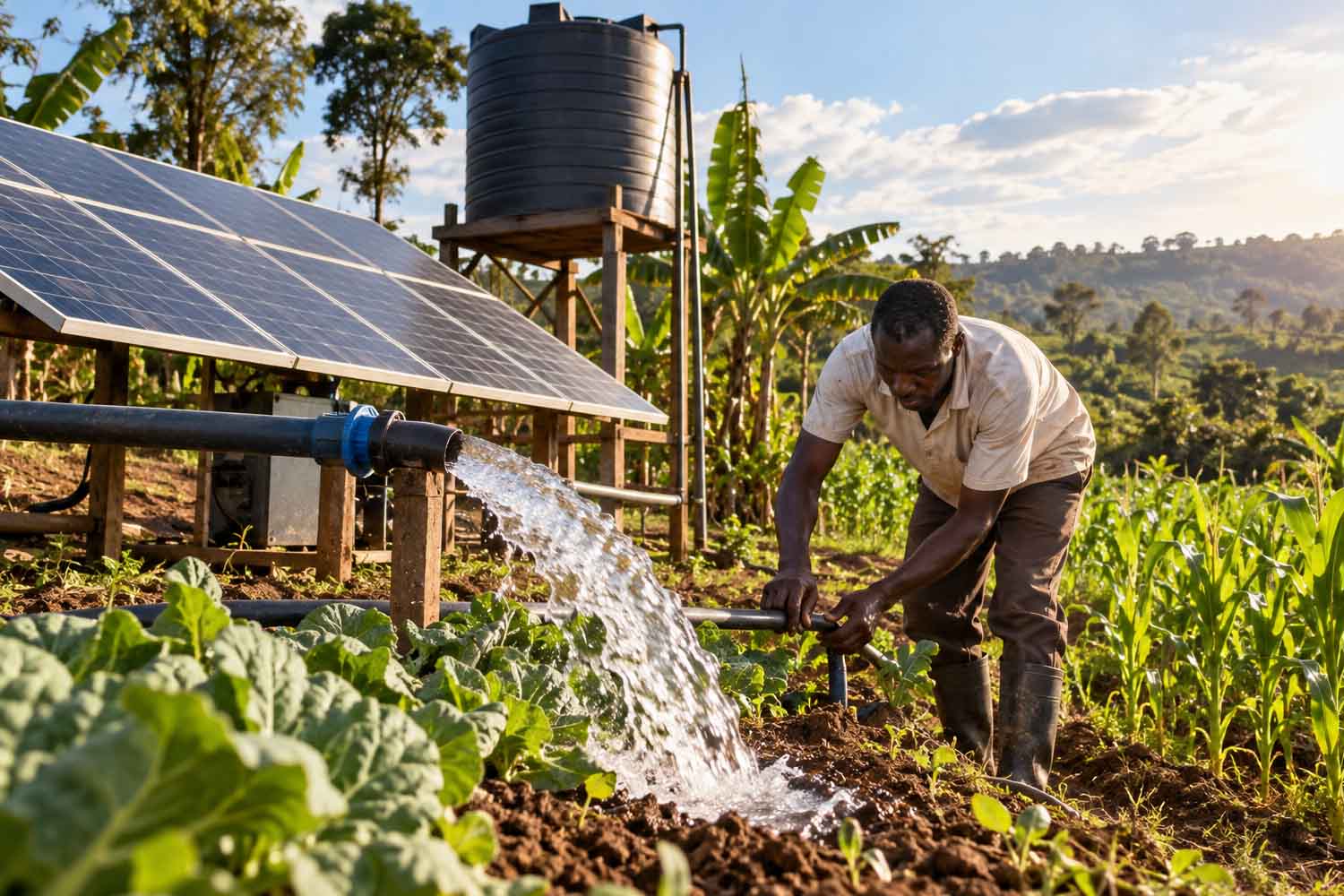
In Mityana, in central Uganda, the rain was long for about three months. From June to the beginning of September, drought caused agricultural production to decline in several areas of the district. Yet around 150 farmers managed to cross it without losing their crops, according to Annet Namayanja, a local agricultural manager.
They had one thing that, when the heavens stop cooperating, becomes quite useful: irrigation. Also supported through public programs and, in several companies, powered by solar panels.
To understand where we are, we put two dots on the map. Mityana is located in Buganda, and its capital is about 73 kilometers west of Kampala. Names like Kikandwa, Butayunja and Ttamu will soon appear, but no trip across half the country: they are all areas of the same district.
It is precisely here that, according to Namayanja, the drought hit hardest. And in Kikandwa, in the village of Nakwaya A, there are two companies that show what happens when water stops depending only on the sky.
A solar pump and a rewritten calendar
Tonny Tenywa mainly grew coffee. In June, when the drought began, he started using an irrigation system powered by solar panels. He has since added cabbage, corn and beans and says he can irrigate the cafe year-round. In short, the camp has changed its menu.
The difference can also be seen on the surface. Previously he worked seven acres, about 2.8 hectares; today the plant serves nine, just over 3.6 hectares. Tenywa also says that the system has reduced the manual labor needed in the company: previously it employed ten workers, now four.
The plant cost him 1.6 million Ugandan shillings and it certainly has its limits. There are only two water points, while according to Tenywa, around six would be needed to reach the entire property. When the pump has a problem he has to turn to private technicians who come from Kampala.
Those 73 kilometers, at this point, cease to be just a geographical datum. A pump can reduce fields’ dependence on rainfall; to keep working it needs spare parts and someone who knows how to do it.
Not far away, also in Nakwaya A, Fred Kagugube runs the Eden Organic Farm. Before irrigation he farmed about six acres, 2.4 hectares, and harvested about seventy bags of coffee per season. Today he works ten, just over four hectares, and declares over 100 bags. He also added tomatoes and bananas, because the water is there even when the clouds go on strike.
The acreage has grown along with the harvest, so those numbers don’t tell us how much the yield per hectare has changed. However, they tell another thing well: Kagugube now cultivates four more acres and manages to maintain other crops even during the drought.
Tenywa and Kagugube recounted their experience during a day organized at the Eden Organic Farm, where other farmers were able to see in the field how solar energy can be used to irrigate and continue producing when the rains become unpredictable.
Irrigation had come before the drought
The approximately 150 farmers cited by Namayanja are part of an irrigation work that has been going on in the district for years. In fact, Uganda has a Micro-scale Irrigation Program aimed above all at small producers, with a co-financing system to purchase pumps, pipes and other equipment.
The mechanism is a kind of Roman account with the State: government and farmer divide the expense. The former can cover from 25 to 75% of the cost of the equipment, within the limits set by the program, while the beneficiary pays the remaining part.
The objective is to make the link between the agricultural calendar and rain less close: more months of production, water available when needed and the possibility of growing products that become much more difficult to maintain without irrigation.
In Mityana, solar pumps were already in circulation before the last drought. An official district evaluation of the interventions carried out in the 2022/2023 financial year documents several micro-irrigation systems installed in the area.
In November 2023, inspectors checked three of them and found them to be functional. In Kikandwa, for example, two acres of coffee, bananas and corn were served by a solar submersible pump, photovoltaic panels, a 10,000-liter tank, pipes and sprinklers. In short, the panel in the fields did not appear with the last drought.
The sun isn’t just for pumping water
DREEM, the Distributed Renewable Energy Ecosystem Model, also entered into this work, a project that tries to bring solar energy directly into agricultural activities.
JEEP, Joint Energy and Environment Projects, together with Heifer International Uganda, inaugurated the DREEM Hub Uganda in April 2025, a demonstration center where farmers can see solar irrigation pumps, dryers and a cold room intended to reduce post-harvest losses.
An irrigation system powered by photovoltaics has also been installed in the center with a water storage capacity of 10 thousand liters and various ways of distributing it in the fields, from dripping to micro-sprinklers.
Here the idea of “model companies” becomes clearer. JEEP reports that it has so far supported six farmers chosen together with local authorities: people who use the technologies and then show them to other producers. The DREEM project is active in Mityana, Mpigi and Mukono and aims to expand to other districts.
The declared objective is to reduce production costs, increase productivity and make agricultural families more resistant to climate shocks. The project also works on training: the DREEM Hub aims to reach hundreds of farmers and give practical experience to university students dealing with agriculture, water and solar energy.
In Nakwaya all this quickly loses the feel of a project written on a document. There are fields, pumps, tanks and farmers who come together to see if those technologies really work.
And when the pump acts up?
Kagugube says a repair can cost around 70,000 Ugandan shillings. Some parts have to arrive from Kampala and there are still few technicians capable of working on the systems in the area. Tenywa has the same problem: when something doesn’t work, he seeks assistance in the capital. The project includes a three-year warranty. Then you need technicians, spare parts and a local market capable of keeping the systems running without continually depending on Kampala.
Meanwhile, during approximately three months of drought, 150 farmers with access to co-financed irrigation avoided the losses that were evident elsewhere in Mityana. In the fields of Nakwaya the photovoltaic does a very simple thing: it produces electricity, the electricity moves a pump and the pump brings water to coffee, corn, beans, tomatoes and bananas when the sky forgets to do so. Then the pump breaks. And the coach, at least for now, has yet to leave Kampala.
