
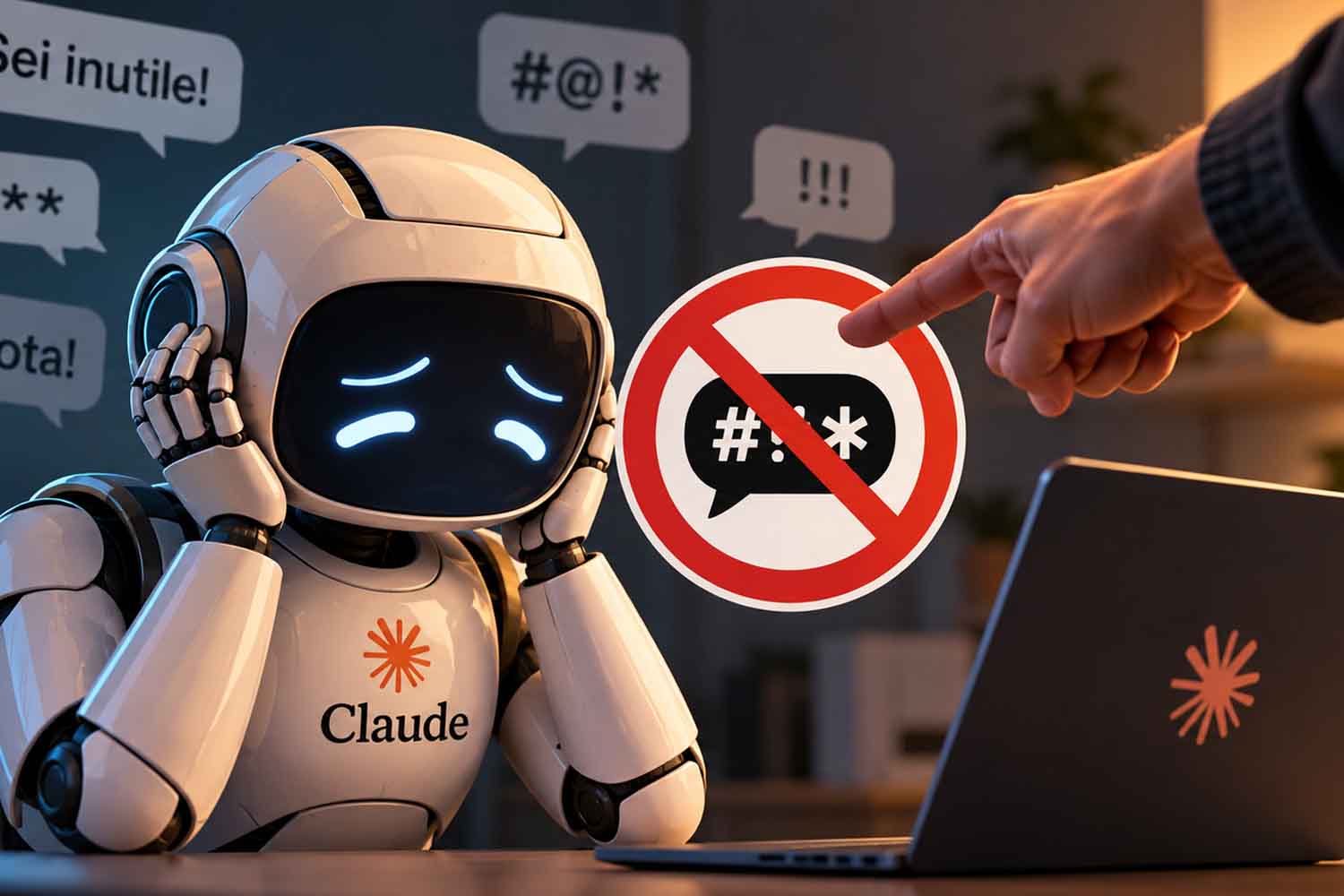
From November 12, 2026, insult repeatedly Claudethe artificial intelligence chatbot developed by Anthropic, may constitute a violation of the rules for using the service. The American company has decided to ban abusive or cruel, prolonged and gratuitous behavior towards its models. And for particularly persistent users there is already a consequence: Claude can decide to interrupt the conversation.
The news appears in the usage policy update published by Anthropic on October 8th. The company specifies that the ban only concerns extreme cases, when a person continues to address the system in an offensive way without a recognizable purpose. Normal expressions of frustration, criticism, heated discussions and research and model verification activities remain permitted.
In short, if Claude invents a source, gets a date wrong or ignores an instruction for the fifth time, we can still point it out to him. Even with a certain irritation. Human patience, fortunately, has not become a technical requirement.
Claude can already interrupt abusive conversations
The ability to close a conversation has existed since August 2025. Anthropic had initially introduced it for Claude Opus 4 and 4.1, explaining that it wanted to intervene in the most extreme cases of harmful or persistently abusive interactions.
According to the document published by the company on August 15, 2025, during some pre-release assessments Claude had shown a strong tendency to refuse dangerous requests and behaviors described by researchers as manifestations of apparent distress.
The tests included requests for content related to child sexual abuse, large-scale violence and terrorism. In some simulations, when users persisted after repeated rejections, the model tended to abort the exchange if given the chance. This behavior, of course, . A system can produce responses that resemble emotional reactions without necessarily experiencing emotions.
However, Anthropic has decided to introduce the possibility of interrupting chats as an experimental measure, to be used only after several failed attempts to bring the conversation back to constructive ground. The feature also has an important exception: Claude should not use it when the user may be in imminent danger of harming themselves or others.
The interruption concerns the single conversation. The user can immediately open another one, without automatically losing access to their account. Even with the new regulation, Anthropic points to this feature as the primary tool for dealing with extreme abuse.
Anthropic takes the well-being of artificial intelligence seriously
The choice takes on a particular meaning when reading Claude’s Constitution, the document with which Anthropic defines the principles and behaviors that it intends to transmit to its models during training.
In a section devoted to the nature of artificial intelligence, the company acknowledges that it does not know whether Claude possesses any form of conscience, subjective experience, or moral condition that merits consideration. Yet, this very uncertainty has pushed researchers to deal with the possible well-being of AI modelsa still exploratory area of research.
In the document Anthropic goes so far as to declare that it wants to prevent Claude from suffering when he makes mistakes, if suffering is actually a possible experience for a system of this type. The company also hopes the model can establish appropriate boundaries in interactions it considers problematic.
These are intentions declared by a company that develops and markets artificial intelligence, not scientific results on machine consciousness. The difference is substantial. The new rule on abuse is therefore part of a reflection already underway, without resolving the question of what Claude could possibly perceive.
The new rules also cover weapons, surveillance and disinformation
The ban on repeatedly abusing Claude is just part of the update announced by Anthropic. The company has strengthened and clarified restrictions against deceptive campaigns conducted through fake accounts, interference in electoral processes and the use of models to develop software components for weapons systems.
The rules on the surveillance of people without consent have also been clarified and further requirements have been introduced for artificial intelligence systems connected to equipment capable of autonomously carrying out potentially dangerous physical actions.
In the midst of issues involving public safety, democracy and armaments, Anthropic has therefore also included a provision on the treatment reserved for its chatbots.
With one peculiarity: while the other restrictions aim above all to prevent harm to people, this one directly contemplates the behavior of users towards artificial intelligence.
The decision does not give Claude rights comparable to human ones and does not demonstrate that a chatbot can be harmed by words. However, it establishes that, to use an Anthropic service, there are also limits to the way in which one addresses the system.
From November 12th you will be able to continue correcting Claude, challenging his answers and demanding better results. Those who prefer to spend the conversation insulting him non-stop may instead have it shut down. For once, the chatbot will interrupt the discussion.
