
Two people receive the same diagnosis of depression. One spends the days brooding, continually thinking about the same problems. The other has trouble concentrating, reading a few pages or even deciding what to eat. Both are sick, both can receive the same antidepressant. Yet, one gets better and the other doesn’t.
Why does this happen? A group of researchers from Stanford University looked for an answer by directly observing how the brain works. And he found something interesting: six different brain activity profiles, some of which also appear to influence the response to therapies.
The study published on Nature Medicine involved 801 people with depression and anxiety disorders. The results suggest that, one day, an MRI could help doctors choose a treatment best suited to the individual patient, avoiding at least some of the attempts that today can take months. For now we are still in the research phase. But understanding what scientists saw is already quite fascinating.
They observed the brain as it worked
Imagine being able to observe the traffic of a city from above. Some streets are crowded, others almost deserted. In some neighborhoods the traffic flows well, in others the cars move with difficulty. The brain is much more complicated than a city, of course. But the principle used by the researchers is similar: studying how different areas communicate and work together, through variations in the signals recorded with a functional magnetic resonance imaging. The scientists observed the participants’ brains both at rest and during some exercises that required attention, control of responses and recognition of emotions. They then compared the results with those of 137 healthy people.
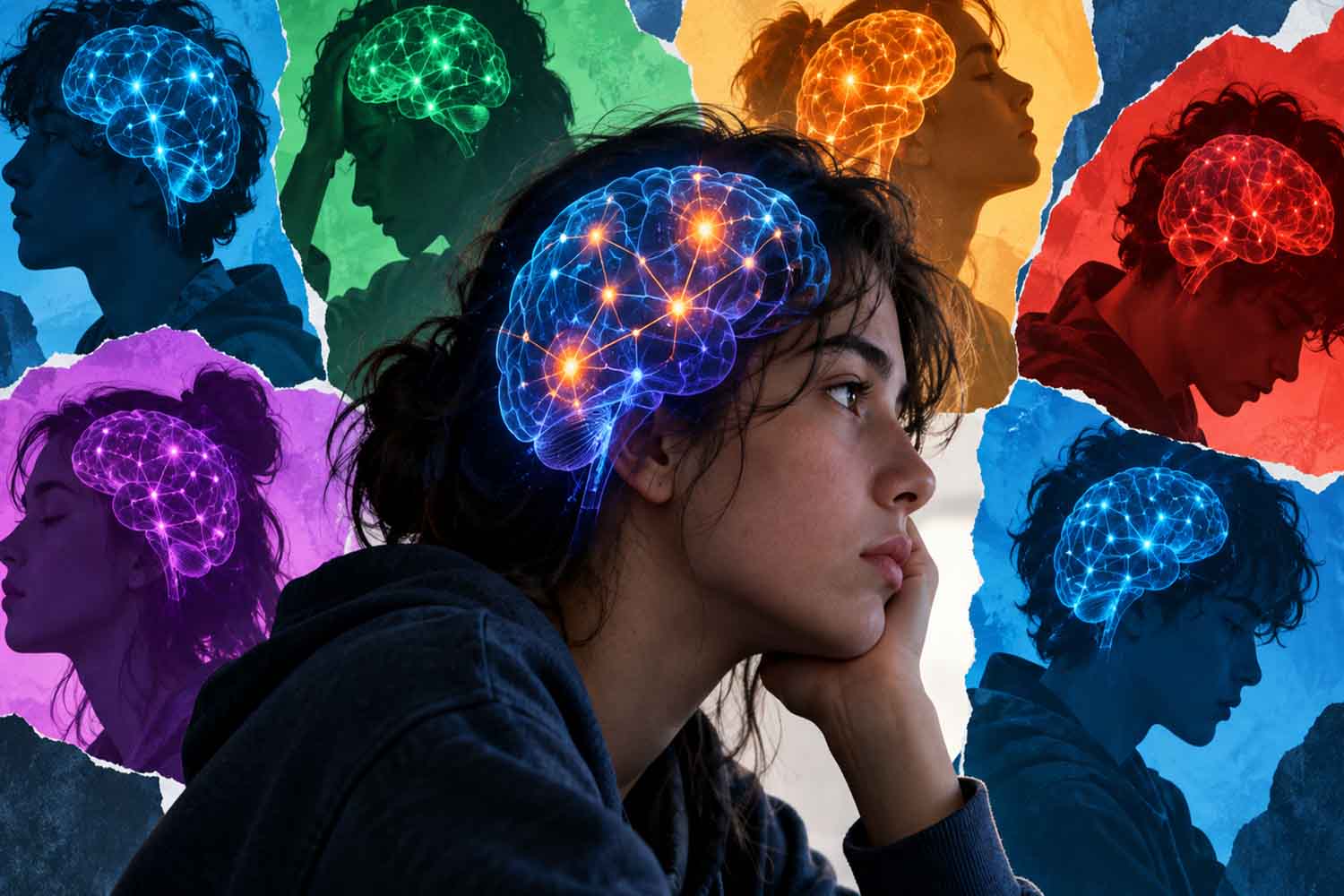
Six biotypes emerged from the analysis, i.e. six groups characterized by different ways of functioning of some brain circuits. It doesn’t mean that there are only six types of depression or that people’s brains can be divided into six rigid categories. They are statistical groupings identified in the people studied.
The six profiles: from thoughts that don’t stop to difficulty concentrating
The first biotype presents greater communication between three brain networks involved in self-directed thinking, attention and the ability to recognize important stimuli. In tests, these people showed slower emotional and attentional responses. It is an interesting setup to study some mechanisms of repetitive thinking, even if brooding does not automatically mean belonging to this group. In the second profile, however, the attention network is less coordinated. Let’s talk about the circuits that help us follow an explanation, stay focused on a book or complete a task without constantly losing the thread.
The third biotype concerns above all emotions. The brain shows a more intense response when observing sad faces, but also happy faces. An important detail: the increased activity affects both emotions, so it doesn’t simply mean being more sensitive to sadness. The fourth presents higher activity in cognitive control circuits, those that allow us to slow down an impulsive response, change strategy or stay focused on a goal.
In the fifth, however, the activity of these circuits is reduced, together with the communication between some areas involved in processing threats. However, it is a group of just 15 people, too small to draw solid conclusions without further verification. The sixth is perhaps the most surprising: in the measures studied, the brain did not show particularly marked differences compared to healthy people.
This does not mean that participants were making up their symptoms. It means that psychological suffering may involve mechanisms that a given measurement cannot identify. And there is another important clarification: it is not enough to recognize yourself in one of the descriptions to know which biotype you belong to. Being distracted, anxious, or emotionally sensitive can result from many different conditions.
The most interesting discovery concerns drugs
So far we might think that scientists have simply found six different ways the brain can work. The research, however, went further. For 250 participants, the results obtained after some treatments were also available. The researchers then checked whether people belonging to the different biotypes responded to the treatments in the same way. And the surprises arrived. People in the first group, the one with greater communication between certain brain networks, had achieved better results with a behavioral intervention based on practical activities and problem solving.
Those in the second group, characterized by lower connectivity of the attention network, responded less well to the same intervention. The fourth group, however, showed a better response to venlafaxine, an antidepressant drug. Three profiles, three different answers. The others did not show equally clear associations with the treatments examined.
Of course this does not mean that the first group should do psychotherapy and the fourth should take venlafaxine. The results concern a specific study and will need to be confirmed by new experiments. Furthermore, the behavioral intervention used by researchers does not represent all forms of psychotherapy. But the idea is interesting: If we could first understand how certain brain circuits work, perhaps we could better predict which treatments are most likely to help a person.
One day will an MRI be enough to choose an antidepressant?
Today, those dealing with depression may need to try different treatments before finding the one that works. Some drugs take weeks to show their effects and sometimes it is necessary to modify the dosage or change therapy, always under medical supervision. In the meantime, we must continue to live, study, work and face days that can become extremely tiring. A medicine capable of better predicting individual response could make this path less long and uncertain.
To get there, however, a fundamental verification is still missing: demonstrating that choosing the treatment on the basis of brain biotypes really brings better results compared to current treatments. It is also necessary to understand whether these profiles remain stable over time and whether they are recognizable in people other than those involved in the study.
Stanford University, presenting the research, described this approach as a possible step towards more personalized psychiatry. Today, therefore, no MRI can automatically establish which antidepressant will work for a particular person. And recognizing yourself in the symptoms described does not mean having a diagnosis.
But the research offers a concrete perspective: people who share a diagnosis can have measurable differences in how their brains function. Some also seem to matter when it comes to responding to treatment. More trials will be needed before the six biotypes can be used to choose a treatment. For now, scientists have found six possible clues. They have yet to demonstrate how to use them.
