
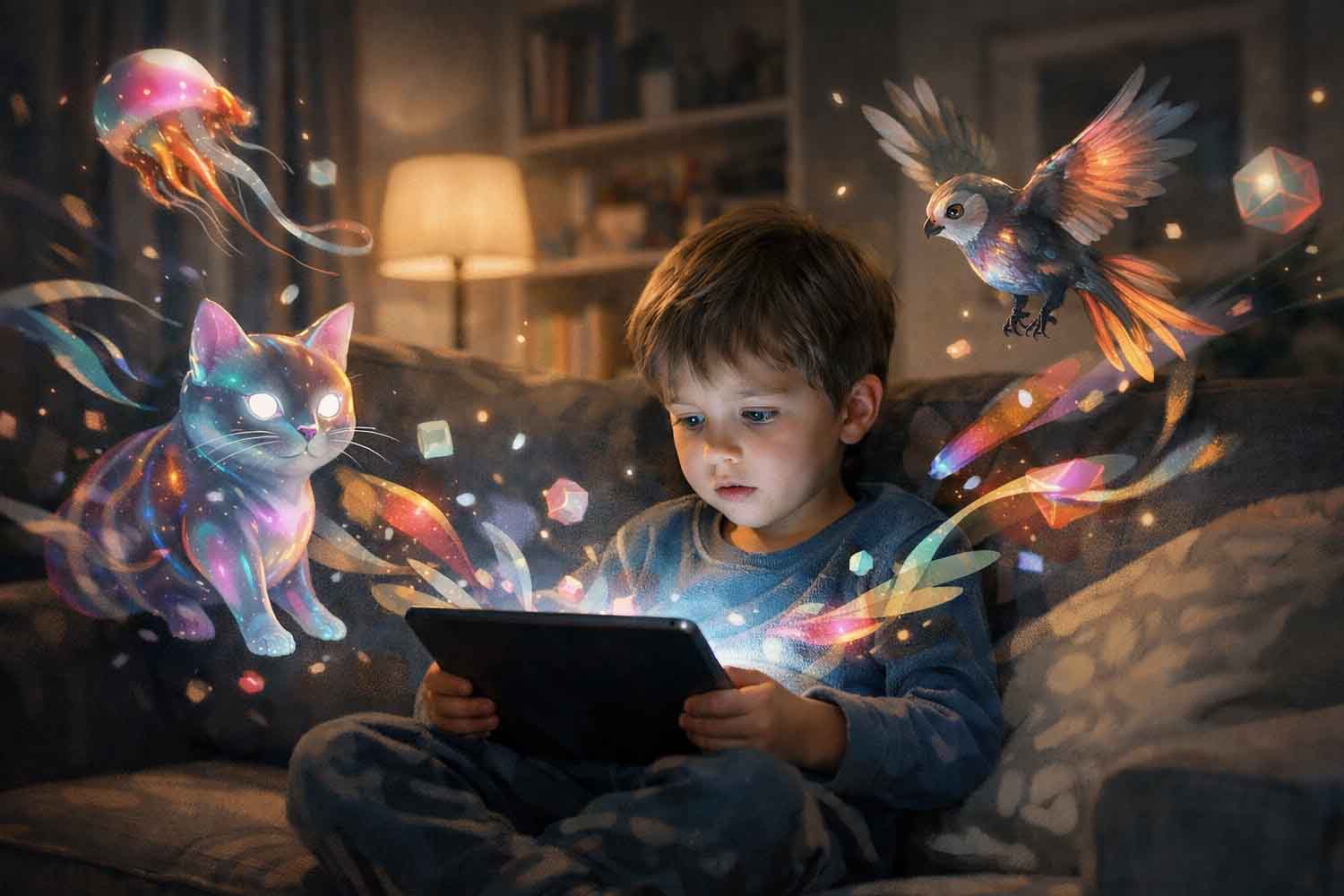
In recent years, childhood has changed place. It is no longer just the backyard, the park or the living room at home. More and more often it is a screen. Tablets and smartphones have become daily tools in families. They serve to entertain, calm, distract, fill those moments of waiting that multiply in everyday life. One video after another, often chosen directly by the algorithm.
And precisely within this apparently harmless flow, a phenomenon is developing that psychologists and researchers are observing with growing attention: the spread of AI videos for children, content automatically generated by artificial intelligence software and published in ever-increasing quantities on video platforms.
At first glance they seem like other animations. Bright colours, catchy music, characters reminiscent of cartoons. In reality, behind these clips there is often a completely automatic production, created by programs that assemble images, sounds and synthetic voices in the space of a few minutes.
The result is a very different type of entertainment than we were used to. Very short videos, scenes that constantly change, stories that have no real beginning or conclusion.
According to an investigation by New York Timeswhich analyzed over a thousand videos suggested to young children on YouTube, the platform’s algorithm tends to promote precisely this content generated with artificial intelligence, often presented as educational even when it offers no real educational value.
And the point is not just about the quality of the videos. The risk, explain psychologists and developmental researchers, concerns above all the way in which these videos stimulate children’s brains, a cognitive machine still under construction.
AI video for children among impossible animals and surreal scenes
Just look at one of these contents for a few seconds to understand what we are talking about. A horse diving off a trampoline, a pink elephant twirling past the letters of the alphabet, buses sliding down giant slides, or animals with duplicate limbs and huge eyes appearing and disappearing in unlikely settings.
To an adult these images may seem simply absurd or grotesque. For a very young child, however, they represent extremely intense and difficult visual stimuli to interpret.
The American newspaper’s investigation revealed a recurring element: almost all of these videos last less than thirty seconds. Too short a time to build an understandable story, to repeat a concept or to offer a context that really helps you learn something.
The result is a continuous sequence of rapid scenes, saturated colors and fast-paced sounds that keep your attention glued to the screen without offering any logical path.
In a fifteen-minute session following an episode of the popular children’s channel CoComelon, more than forty percent of the suggested videos contained AI-generated elements. In many cases it wasn’t just the images: the narrative voice and music were also created by automatic software.
The phenomenon does not only concern the “adult” version of the platform. YouTube Kids also hosts a lot of content of this type, although the stated goal is to offer a more controlled and child-friendly environment.
Why experts fear cognitive overload caused by video AI
The concerns of scholars do not arise from a simple distrust of new technologies. The central point concerns the very design of this content.
Behavioral pediatrician Jenny Radesky of the University of Michigan describes many of these videos as tools designed to capture children’s attention without giving back anything in terms of learning. The goal is not to teach something, but to keep your gaze fixed on the screen for as long as possible.
A bus falling over a slide or an animal performing impossible actions do not stimulate curiosity or understanding. They simply create a form of passive entertainment that immobilizes attention.
Developmental psychologist Rachel Barr, of Georgetown University, highlights an even more delicate aspect. In children under five years of age the distinction between reality and fantasy is not yet fully formed. When realistic elements are inserted into impossible situations, the child’s brain must make an interpretative effort that is much more complex than imagined.
This discrepancy between what appears plausible and what violates the laws of the real world can generate cognitive confusion and mental overload, especially in a phase of life in which attention systems are still fragile.
The American Academy of Pediatrics guidelines suggest a very different path. Content aimed at children should have slower pace, clear narrative structure, and intentional repetition of concepts, which facilitate learning and understanding. AI-generated videos, on the other hand, aim for exactly the opposite: continuous scene changes, intense visual stimuli and a narrative that often doesn’t exist at all.
The automatic video industry
Behind this phenomenon there is not only an educational problem, but also a huge economic mechanism. In the digital world, this content is often called AI slop, a term that refers to videos that are mass-produced with artificial intelligence and posted online solely to attract clicks.
With a few tools accessible to anyone, it is possible to generate dozens of videos a day. The more content you upload, the more likely it is to end up in the algorithm’s suggestions.
An international analysis has identified over 15 thousand channels publishing automatically generated videos, accumulating more than 63 billion views and over 221 million subscribers. Behind these numbers lies a huge advertising market that continues to grow.
Many of these profiles remain completely anonymous. They do not provide information about the creators, publish content serially and exploit the functioning of algorithms to reach millions of viewers.
Very short videos and “dopamine effect”
Another key element concerns the format. Much of this content follows the logic of short videos, very quick clips similar to those spread on TikTok and YouTube Shorts.
These videos are designed to generate short, repeated stimuli that activate the brain’s reward system. Some researchers talk about a real dopamine effect: small peaks of immediate gratification that push you to continue watching new content.
Several studies link the intensive consumption of short videos to difficulty concentrating, reduced self-control and decreased attention span. In some cases, associations also emerge with sleep disorders and greater anxiety in younger people.
Even Steve Chen, one of the founders of YouTube, said he was cautious about letting his children watch videos of this type. According to Chen, content designed to offer instant gratification risks accustoming the brain to superficial and continuous entertainment.
Those who observe this phenomenon closely remember a precedent that caused much discussion a few years ago. In 2017 the Elsagate case exploded, when thousands of videos apparently intended for children used famous characters such as Elsa from Frozen or Peppa Pig, but inserting disturbing or inappropriate scenes.
At the time, content was produced manually. Today the difference is substantial: artificial intelligence allows videos to be generated in enormous quantities and very quickly, making the phenomenon much more difficult to control.
Artificial intelligence can also become an educational tool
The debate among experts is not entirely negative. Many researchers point out that artificial intelligence can become a very useful tool in children’s education, if used with clear pedagogical design.
Professor Ying Xu, from the Harvard Graduate School of Education, studies applications of AI for language development. In some projects related to the PBS series Elinor Wonders Why Interactive characters capable of communicating with children and offering personalized feedback have been developed.
In these contexts, artificial intelligence does not generate random content, but becomes a tool that supports the learning and understanding of scientific concepts.
Many scholars agree on one point: the problem is not artificial intelligence itself, but the absence of educational planning. When the production of content is driven exclusively by the search for views, the risk is that very short and hyper-stimulating clips take the place of fundamental activities for children’s growth.
Shared reading, free play, exploration of the real world remain irreplaceable experiences. And it is precisely there that attention, imagination and the ability to truly understand what surrounds us are built.
You might also be interested in:
