
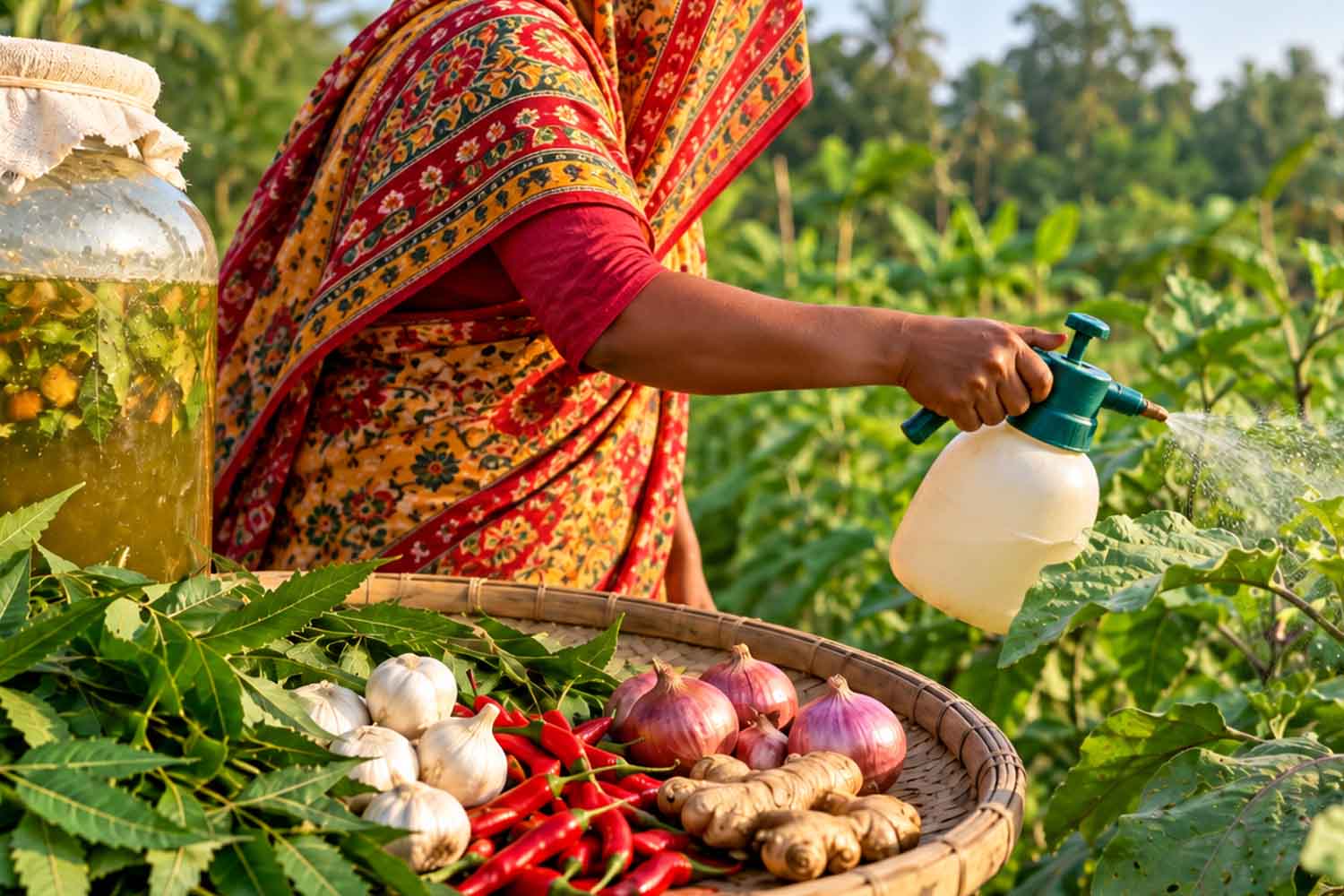
Hanufa Begum puts together neem leaves, chilli, ginger, garlic and onion and takes the mixture to the fields. For this Bangladeshi farmer, homemade pesticide has become a very concrete way to buy fewer commercial products and lower production costs. The push also came from the crisis in the Middle East, which in 2026 made it more complicated and expensive to get fertilizers and other agricultural inputs into the country.
His is an individual case, told in the field, so it would be risky to transform it into the ready recipe for millions of farms. Inside that bottle, however, lies a problem much bigger than its plot: Bangladesh depends heavily on foreign countries for what it needs to feed its crops. In June, the World Bank approved emergency financing for the country’s food security, indicating that Bangladesh imports more than 85% of its fertilizer needs. The project will finance, among other things, the purchase of 600 thousand tons of fertilizers for the Aman and Boro rice growing seasons.
Vulnerability comes from two sides. On the one hand there are imports; on the other, the internal production of urea, which requires large quantities of gas. In its 2026 report on Bangladesh’s agricultural spending, the World Bank notes that national capacity remains held back by gas shortages, aging plants and supply bottlenecks. For urea alone, imports cover approximately 75% of national demand.
Neem, garlic and chilli did not arrive in the fields yesterday
The solution chosen by Hanufa Begum has a domestic, almost pantry-like appearance, but the agricultural use of plant extracts has a lot of research behind it. We are talking about botanical pesticides: substances obtained from plants and used to repel, limit or control certain parasites.
Neem, in particular, is far from an unknown in Bangladeshi agriculture. The national agrometeorological service BAMIS includes neem seed extracts among the interventions that can be used against some aphids and mites, always within specific indications for crop and infestation.
The Bangladesh Agricultural Research Institute has also field-tested plant-based solutions. In an experiment on Naga pepper, BARI researchers compared neem oil, garlic extract, mahogany seed extract and conventional pesticides. Botanical treatments gave better results than untreated plants; neem was the best among the vegetal ones. The chemical treatment used by farmers, however, produced the highest marketable yield. A quite useful difference to avoid turning an interesting alternative into a miracle potion.
Bangladesh’s national policy for integrated pest management has for years aimed at reducing dependence on pesticides through different techniques combined, including practices developed locally by farmers. The stated objective is to keep parasites under control by reducing risks, costs and use of chemical products.
View this post on Instagram
Natural, however, does not mean harmless by definition
Chilli, garlic, onion and neem grow from the plants. This does not automatically make any mixture safe, effective or suitable for any crop. FAO recalls that botanical pesticides can also affect beneficial organisms and that their effectiveness depends on the substance, concentration, parasite and the way in which they are applied.
Hanufa Begum’s blend, therefore, should not be read as a universal formula to be replicated by eye. We have no controlled trial on its specific preparation nor published data on the yield of its field before and after the switch. We know what you report: you spend less on commercial pesticides, and some customers are willing to pay more for produce grown without synthetic fertilizers and pesticides.
They are two different pieces of information. The first concerns the cost incurred by the farmer; the second describes the response of some of its customers and does not measure the existence of a real price premium in the Bangladeshi market.
Then there is a distinction that risks being lost between neem and chili peppers: a plant pesticide serves to control certain harmful organisms, it does not automatically replace the nutrients provided by fertilizers. Reducing dependence on urea, phosphates and other fertilizers requires different agronomic practices and nutrient sources.
Hanufa Begum’s story is interesting without needing to inflate it. In the country that is spending hundreds of millions of dollars to secure the fertilizers needed for the next harvests, a farmer has begun to remove at least a few items from her agricultural shopping list. Its pesticide “smells” like garlic, onion and neem. Dependence on imports, however, is much more difficult to shake off.
