
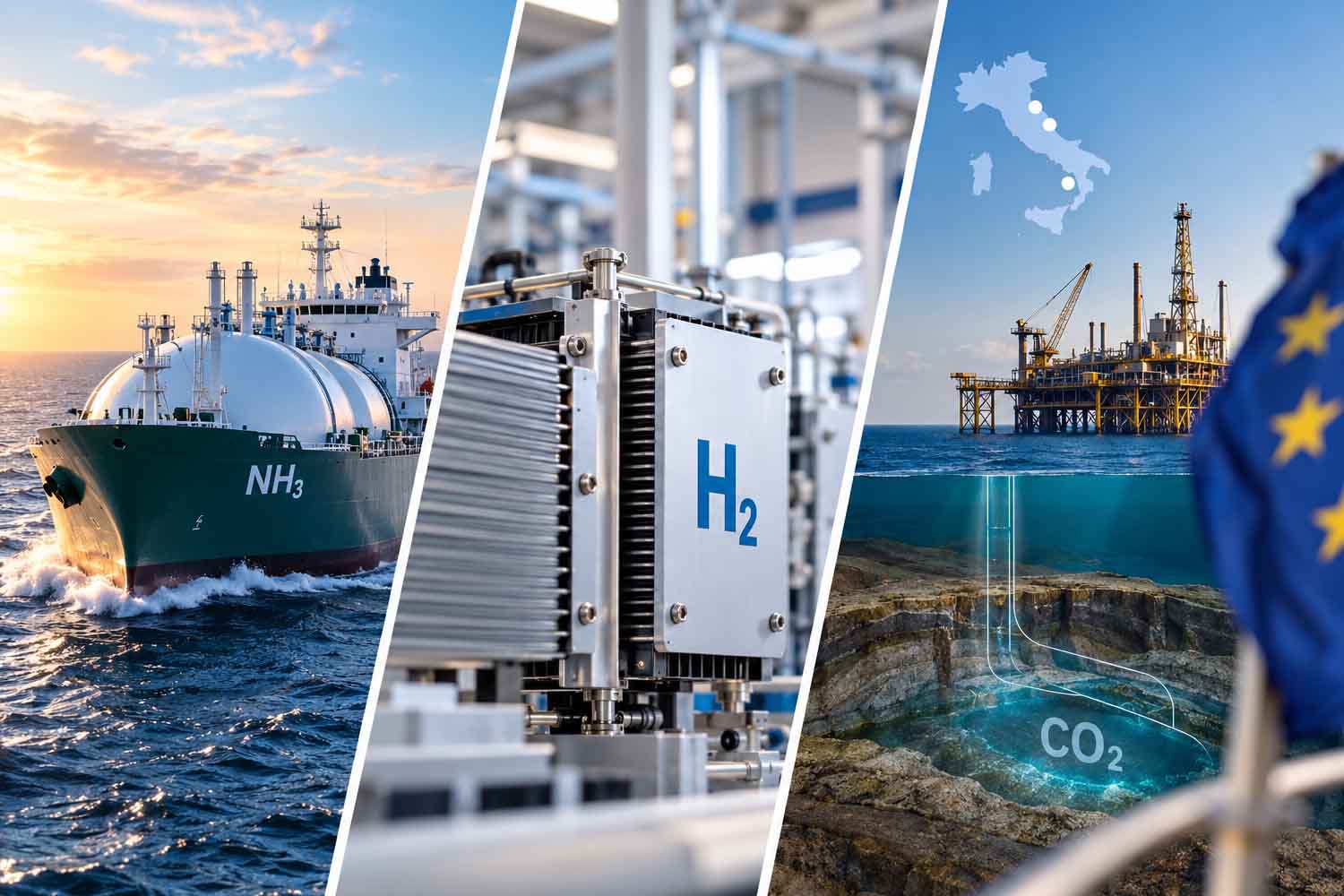
Ships that carry green ammonia and can also use it for navigation. Devices capable of producing hydrogen from water and, when needed, transforming it back into electricity. And old gas fields under the Adriatic intended to host carbon dioxide from industries. These are three of the projects selected by the European Union as part of a program from 3.4 billion euros to support clean technologies and reduce emissions.
They are called GAFF, SPRINTER and Ravenna CCS Phase 2. They appear in the official list published by the European Commission on 19 October 2026, as part of the Innovation Fund, the program that finances industrial innovation for decarbonisation.
The 3.4 billion concern the entire European selection, not just the three projects located in Italy. The three projects passed the European selection. Now the financing agreements will have to arrive. Meanwhile, the selected technologies tell three very different aspects of the energy transition.
Ships that carry green ammonia and also use it as fuel
A ship loaded with green ammonia that uses that same fuel to cross the sea. That’s what he predicts GAFF, Green Ammonia Fueled Fleeta project dedicated to one of the most difficult sectors to free from fossil fuels: maritime transport.
The initiative aims to create a fleet of gas transport ships, equipped with engines capable of running on ammonia, LPG and marine diesel. Three different fuels, to be able to operate even while the international ammonia supply network is still under construction.
The vessels are expected to connect India, the Gulf of Mexico and northwestern Europe, carrying up to one million tons of green ammonia per year. They will also be able to refuel other ships directly at sea, an important possibility for developing the use of this fuel without waiting for each port to have the necessary infrastructure. According to estimates presented to the Commission, GAFF could avoid further 1.2 million tonnes of CO₂ equivalent in the first ten years of activity.
Ammonia is interesting because its molecule does not contain carbon: using it as a fuel does not directly generate carbon dioxide. If it is produced from hydrogen obtained with renewable electricity, it can help reduce emissions from maritime transport. The project is coordinated by Færder Tankers Norway ASa Norwegian company. The Commission classifies it among those located in Italy, even if the published sheet does not clarify which activities will be carried out on Italian territory.
SPRINTER, the Italian project to produce more hydrogen technologies
Hydrogen can be used to store energy, but to produce and use it requires devices that have yet to become more widespread and accessible on an industrial scale. It is on this passage that he works SPRINTER, the project coordinated by the Italian SolydEra Spa. The company wants to expand an existing pilot plant and increase production of stackthe components in which the reactions that allow us to produce hydrogen or obtain electricity by using it take place.
The expected production capacity goes from 8 to 50 megawatts per year in the fuel cell configuration, with an equivalent capacity of 150 megawatts per year in the electrolyzer configuration. The two figures refer to different configurations of the same industrial capacity.
Electrolyzers use electricity to separate hydrogen from oxygen in water. Fuel cells take the opposite path from an energy point of view: they use hydrogen to produce electricity. Some solid oxide technologies, such as those developed by SolydEra, can operate in both modes.
When photovoltaic systems produce more electricity than is needed at the time, that energy can be used to obtain hydrogen and store it for later use. Hydrogen can then power a fuel cell, albeit with the energy losses inherent in each conversion. SPRINTER intervenes in the production of the devices necessary to make these applications possible. The objective is to move from a still limited capacity to a significantly larger industrial production.
In Ravenna the CO₂ from the industries will end up in depleted gas fields
Off the coast of Ravenna, depleted gas fields could be used to store carbon dioxide captured by industrial plants. It’s the project Ravenna CCS Phase 2coordinated by Eni, which provides an infrastructure capable of receiving, transporting and storing up to 4 million tons of CO₂ per year.
Carbon dioxide will be able to reach Ravenna through pipelines, ships, trains and trucks. Once it arrives, it will be transferred to the storage sites identified under the Adriatic seabed. The possibility of using different means of transport would also allow industrial plants that do not have a direct connection with Ravenna to access the service.
The technology is known as CCS, from English Carbon Capture and Storagei.e. carbon capture and storage. It is designed above all for sectors in which eliminating emissions is particularly difficult, such as some processes in the cement production and chemical industry. A first phase of the project has already been started in 2024 by Eni and Snam. The CO₂ coming from a natural gas treatment plant in Casalborsetti is destined for storage in the depleted field of Porto Corsini Mare Ovest.
The second phase is much larger in size and aims to serve various industrial activities, even outside the Ravenna area. The 4 million tons per year indicate the expected storage capacity, which will require new infrastructure and the completion of authorization procedures. A second industrial life is envisaged for the Adriatic deposits: after having supplied natural gas, they could become deposits for part of the carbon dioxide produced by industries.
Where does European funding come from?
The funding is part of the Innovation Fund, one of the main European instruments for supporting innovative low-emission technologies. The program is financed mainly through revenues from the European emissions trading system, the ETS. Companies in the affected sectors must have quotas to cover their greenhouse gas emissions. A part of these is purchased through auctions and the proceeds contribute to financing interventions for the energy transition.
Part of the money paid by companies for emissions is thus used to develop technologies capable of reducing them. There were numerous nominations. According to data published by the European Commission, the ban has arrived 358 proposals from 27 countrieswith financing requests for a total of 17.5 billion euros. The initial budget was 2.9 billion.
GAFF will have to build and put the fleet into service, SPRINTER will expand the production of its devices and Ravenna CCS will build the infrastructure planned for the second phase. For all three, the European selection is the first step. The next one will be played between shipyards, production lines and industrial plants. Where technologies will have to start working and avoided emissions can be measured.
