
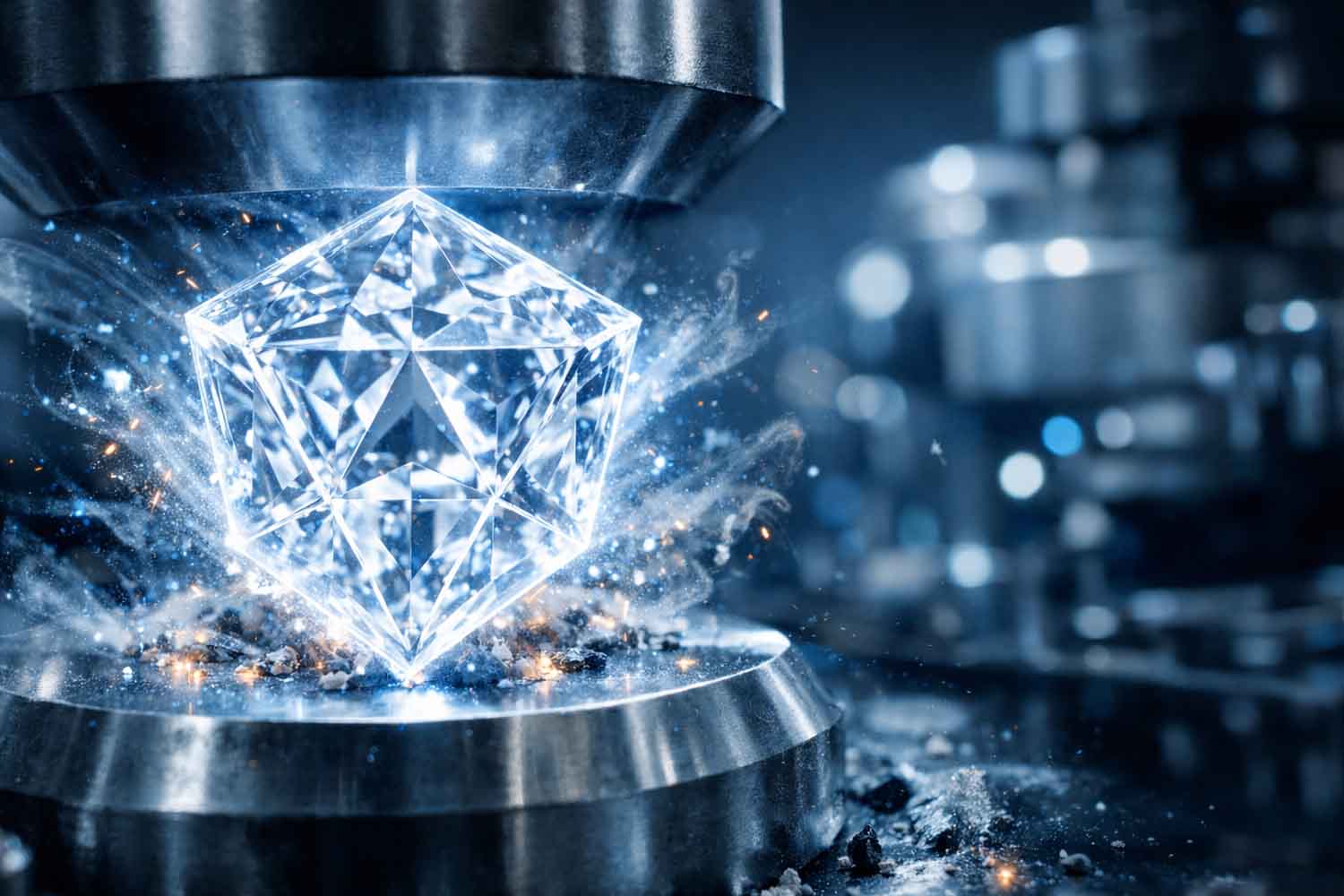
For years it remained suspended between science and legend. The hexagonal diamondalso known by the name of lonsdaleitisis one of those materials that fascinate researchers precisely because they escape the most common rules of mineralogy. Tiny traces of this carbon structure have been identified only in extreme conditions, almost always in sites where a meteorite hit the Earth with a violence capable of transforming matter.
Precisely for this reason, many scientists have long wondered whether it was really a distinct form of carbon or just a traditional diamond deformed by the shocks of the cosmic impact. A doubt that has gone through decades of studies and which could now finally find a concrete answer.
A group of Chinese physicists have in fact announced that they have succeeded in synthesize millimetric crystals of hexagonal diamond in the laboratorybringing to light one of the rarest and most discussed structures in materials science. A result that opens up new scenarios not only for research, but also for possible future technological applications.
The atomic structure that could make it even more resistant
When we think of diamond we immediately imagine the hardest natural material that exists on Earth. Diamonds used in jewelry or industrial tools have a cubic crystal structurein which the carbon atoms organize themselves according to an extremely stable lattice.
The hexagonal diamondhowever, tells a slightly different story. In this variant the atoms are arranged according to a six-sided geometrya difference invisible to the naked eye but capable of significantly modifying the properties of the material.
Precisely this atomic arrangement has fueled the interest of the scientific community for years. Some theoretical models suggested that the lonsdaleite could be even harder than classic diamondthanks to bonds between the shorter and stronger carbon layers. In some simulations one even went so far as to hypothesize one up to 50% higher resistance.
There was only one problem: the natural samples always turned out extremely smalloften reduced to tiny particles generated during meteorite impacts. Really studying this structure therefore proved to be very complicated.
So the researchers created the hexagonal diamond in the laboratory
To achieve this feat, the research team recreated environmental conditions very similar to those that develop during cosmic impacts. The researchers used graphite compressed between tungsten carbide anvilssubjecting the material to a pressure of approximately 20 gigapascalsequivalent to two hundred thousand times the Earth’s atmospheric pressure.
At the same time the temperature rose to approximately 1,930 degrees Celsius. In this extreme environment, carbon atoms have rearranged their structure to form the hexagonal diamond. The result surprised the scholars themselves. The obtained crystals reach dimensions of approximately one millimetera remarkable achievement considering that lonsdaleite had so far only been observed in microscopic fragments.
To test the purity of the crystal structure, the team used X-ray diffraction analysis and atomic-scale microscopyinstruments capable of revealing the arrangement of atoms with extreme precision. Subsequently they were also performed mechanical testswho showed how hexagonal diamond is stiffer and more resistant to oxidation compared to the cubic diamond.
The hardness, however, did not reach the values hypothesized by the most optimistic simulations. The advantage exists, but it has revealed itself less spectacular than expected. Despite this, the potential remains enormous.
Scientists already imagine different fields of application. The hexagonal diamond could be used in the making of advanced cutting toolsin the processing of extremely hard materials, in quantum sensors and even in systems designed for manage heat in technological devices.
If the production of these crystals becomes simpler and more scalable, lonsdaleite could transform from a mineralogical curiosity to strategic material for the industry of the future.
