
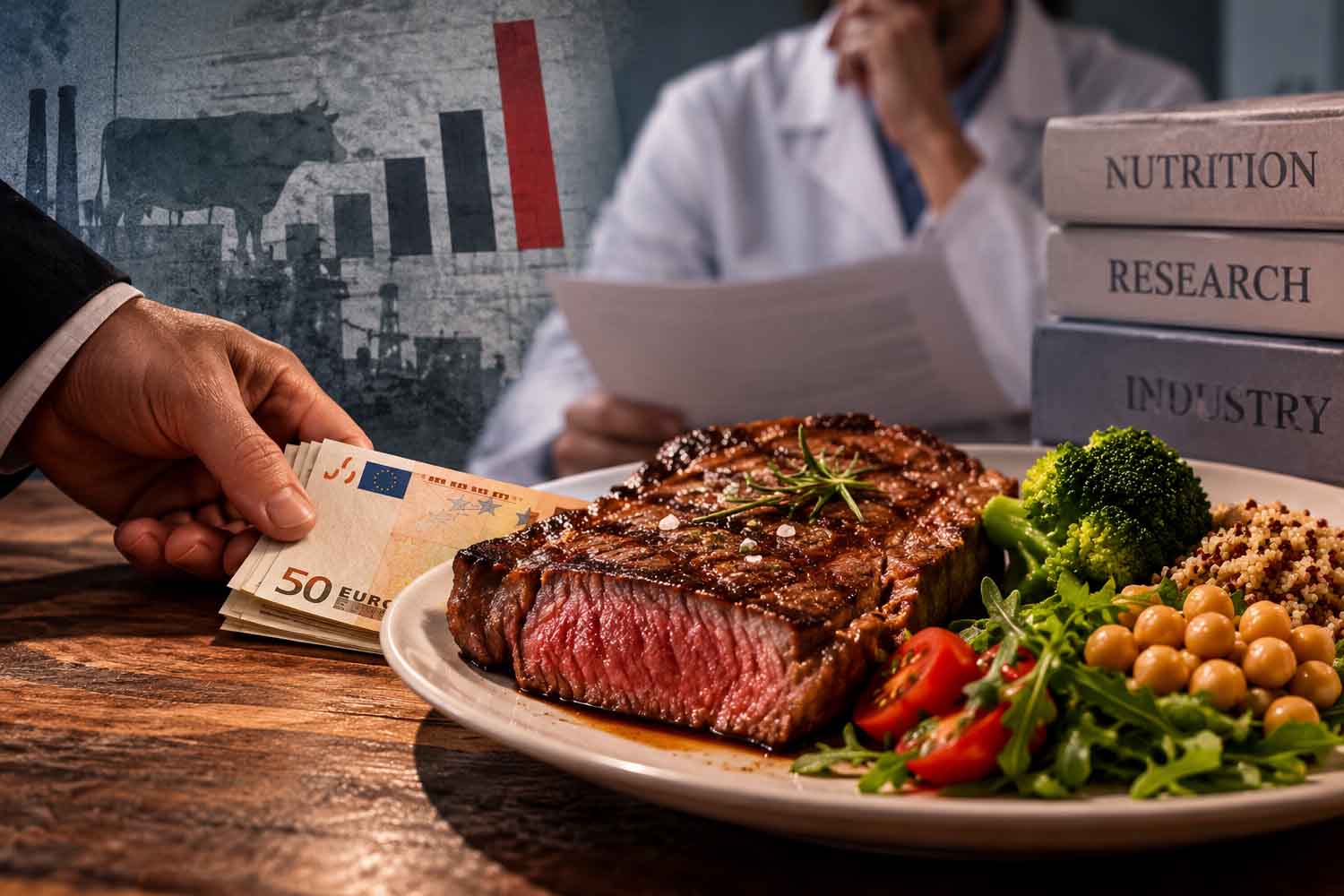
Red meat seems to do much less harm when it is studied by researchers who have relationships with the industry that sells it. At least judging from 29 clinical trials: six found results favorable to meat, the other 23 found no important differences. Unfavorable results? Not even one. In independent studies, however, the situation changes considerably: eleven out of fifteen found negative effects on the values linked to cardiovascular risk. The 44 pieces of research were brought together by a scientific review published inAmerican Journal of Clinical Nutrition.
Looking more closely at the studies, a possible explanation emerges. In industry-related research, red meat was mostly compared to other meats or refined foods. Legumes appeared much less. And a steak compared to chicken can give different results than one compared to a dish of lentils. Before even starting an experiment, someone has to decide what to put on the other plate.
The studies mainly measured cholesterol, blood pressure and other risk factors, so it would be wrong to talk directly about heart attacks caused by meat. No one has proven that the researchers falsified the results. And the review warns that, for many of the indicators analyzed, the evidence was of low or very low quality. Indeed, the industry-related experiments were on average no worse than the others due to the way they were conducted. An interesting circumstance, in the usual debate about whether meat is good for you, bad for you, good for you or will kill us all by Thursday. To get different answers, sometimes, you just need to change the question.
A steak versus another meat fares quite well
The difference between the research results was statistically significant, but attributing it all to funding would be a shortcut. Researcher Deirdre Tobias, in an editorial published in the same journal, noted that comparing red meat and chicken or red meat and vegetable proteins can be scientifically correct in both cases.
However, different questions are answered. Research comparing steak to refined grains may say the results are similar. He can’t tell us whether replacing that steak with lentils or whole grains would bring any benefits. And when a study becomes a headline about meat “being good for you”, the detail of what was in the other dish tends to disappear. Even research done well, therefore, can be very convenient for those who finance it. Without needing to make up numbers.
When sugar needed a culprit
In the 1960s, in the United States, there was discussion about the dietary causes of heart disease. Under observation were fat, cholesterol and sugar. In 1965 the Sugar Research Foundationlinked to the sugar industry, funded a review published two years later in the New England Journal of Medicine. The work placed a lot of weight on fats and downplayed the possible risks of sugar. For those who produced and sold sugar, this was not an unpleasant conclusion.
So far, a scientific controversy. It’s a shame that in 2016 three researchers from the University of California in San Francisco recovered very interesting documents. The reconstruction published in JAMA Internal Medicine shows that the foundation had helped define the objectives of the review, suggested which studies to consider and received drafts before publication.
The funding and that involvement were not disclosed to readers. In practice, those who sold sugar had participated in the preparation of research that reduced the risks. A circumstance that would have been at least useful to know while reading the study.
According to the authors of the reconstruction, the intervention contributed to shifting scientific attention to fats. We cannot attribute all the subsequent dietary recommendations to him alone, but the documents tell of a precise attempt to guide the research. And to leave the economic signature out of the publication. The case is historical, but the mechanism remains very current: directing the question can be more effective than intervening on the data collected.
Are drinks good for you? It also depends on the sponsor
In 2007, research published in PLOS Medicine examined 206 articles on the health effects of milk, juice and soft drinks, published between 1999 and 2003. Studies funded exclusively by the industry were four to eight times more likely to reach conclusions favorable to its products than those without industry funding.
Among sixteen trials paid for entirely by the companies, none reported unfavorable conclusions. Among nineteen others, financed by different or mixed sources, seven yes. And only 54% of the articles stated who paid for the research. For almost half, therefore, they even lacked the information necessary to ask themselves some questions. The number of articles examined was larger than that of clinical trials alone: one more reason not to confuse the two samples.
The findings were about those drinks and that time period, not all of food science. A review published in 2016 in JAMA Internal Medicine, examining twelve papers, found a higher frequency of conclusions favorable to sponsors, but the overall difference was not statistically significant. A clue, therefore, without definitive proof of how much funding affects the conclusions. Suspicion is not resolved by deciding that all studies paid for by companies are unreliable; you have to read how they were built.
Food councils also have their funders
The money also reaches professional organizations. In 2022, a study published in Public Health Nutrition examined documents from 2014-2020 on the relationships between the Academy of Nutrition and Dietetics, a US organization of nutrition professionals, and some large companies.
The researchers identified financial contributions, professional positions and investments in companies such as Nestlé and PepsiCo. They also interpreted some of the organization’s public positions as favorable to industrial interests. The Academy contested the study, reporting errors and omissions.
Documented economic relationships are one thing; demonstrating that they determined a specific dietary recommendation is another. And the organization disputes the very conclusions drawn by the authors on those reports. It’s still a pretty reasonable request: when someone tells us what to eat, knowing who they’re getting money from can be helpful.
Can we still trust the studies?
Marcia Angell, former editor of the New England Journal of Medicine, expressed strong doubts in 2009 about the credibility of some of the clinical research, speaking above all of the links with the pharmaceutical industry. In 2015 Richard Horton, editor of The Lancet, hypothesized that perhaps half of the scientific literature was unreliable, discussing the problems of biomedical research. That 50% was a critical judgment, not the result of a census on food studies.
Nor do documented cases of industrial flu warrant throwing away all nutritional research. The World Health Organization continues to recommend a varied diet, rich in fruit, vegetables, legumes and whole grains, limiting salt, free sugars and less healthy fats. In Italy, the CREA guidelines refer to the Mediterranean model. Indications based on the evaluation of many studies, not on a single steak that ended up being examined. What matters is the repetition of results, the methods, possible conflicts of interest and the foods that are chosen as alternatives. This is how an isolated result can find its place, without becoming a ruling on our dinner.
And we return to steaks. Of the 29 studies with industry ties, none compared red meat with whole grains. Only one had compared it with vegetable proteins, involving 21 men. Whole grains, therefore, don’t even have a place at the table. For vegetable proteins, just one.
