
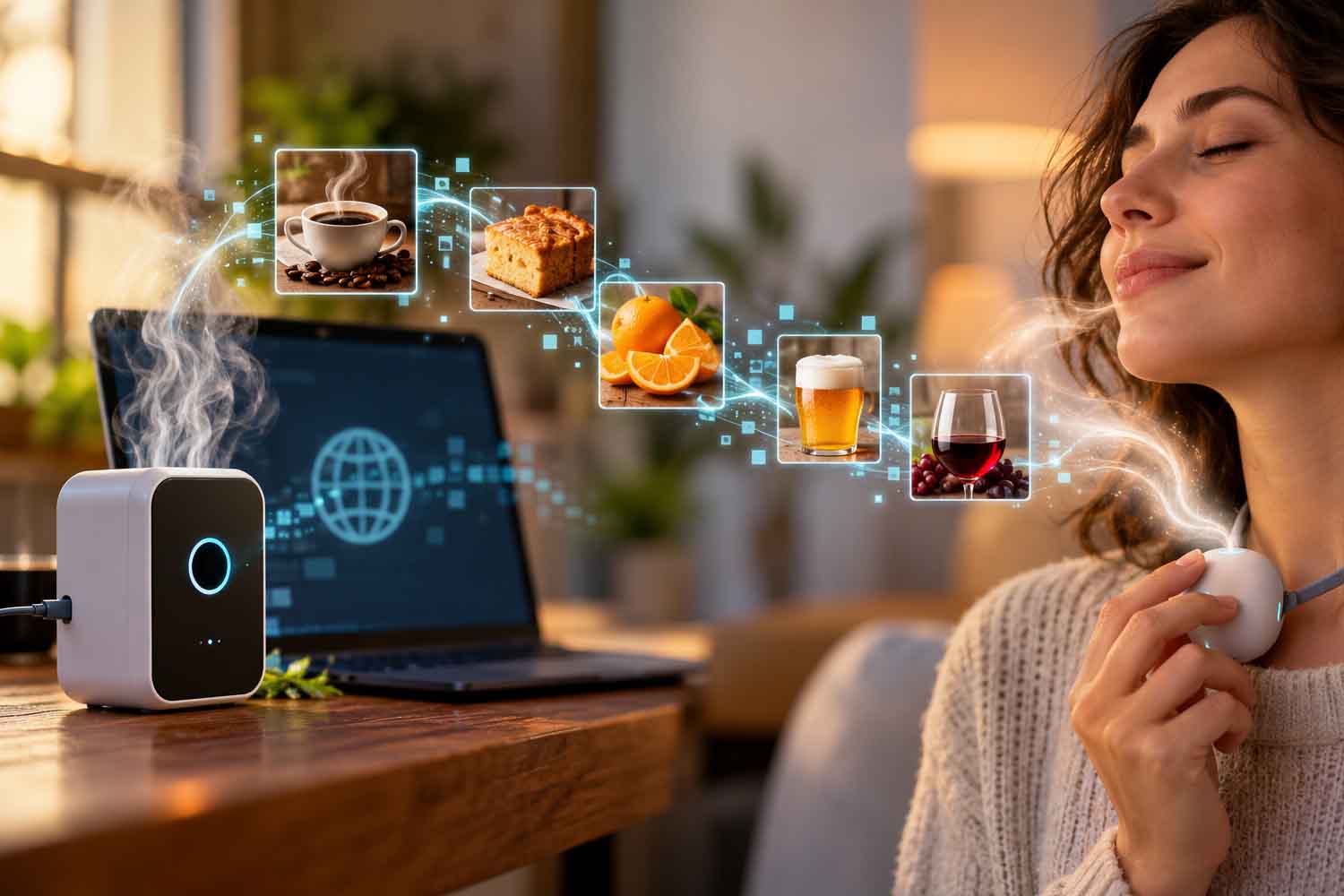
An electronic nose recognizes the scent of coffee, transforms it into a digital signal and sends it over the internet. On the other end of the connection, a small device releases an aroma similar to the original one into the air. The same process works with cake, oranges, beer and red wine. Five smells in total, for now. Researchers at Ohio State University, in the United States, have developed a system that allows odors to be recognized and recreated remotely, without anyone having to manually choose which fragrance to diffuse.
The device is called Scentronic and is described in a study published in Science Advances. The research team, led by Chunyu Yang, combined chemical sensors, artificial intelligence and small nebulizers. The result is a sort of olfactory messaging: someone exposes a sensor to the scent of coffee and another person, even very far away, can smell a similar one.
However, there is one condition. The receiving device must already have a supply of the aroma to be diffused. Only data travels through the internet. In short, to taste the coffee of someone thousands of kilometers away, you need to already have some available.
How the electronic nose that recognizes odors works
The first step is through an electronic nose, or e-noseequipped with six sensors that react to volatile substances in the air. They are those molecules that are released from foods, drinks and other materials and which, reaching our nose, allow us to recognize their smell.
When the sensors come into contact with these substances, they produce different electrical signals. The researchers trained an artificial intelligence system to recognize them by repeatedly exposing the sensors to the same five odors. A rather patient job: hundreds of exposures were needed to collect enough data. Once the fragrance has been identified, the system sends the information through a Wi-Fi connection and a remote server. The recipient is Scentronic, which contains small tanks of scented liquids and nebulizers capable of transforming them into tiny droplets dispersed in the air.
Researchers have created several versions, including a bracelet, a necklace and a device to hold in your hand. The necklace has five aroma channels, while the bracelet uses two.
Of course, the reproduced perfume is not a chemically identical copy of the original. If the electronic nose recognizes coffee, the receiver releases a fragrance associated with coffee. It cannot establish whether we have just prepared an espresso, a cappuccino or a particular blend and faithfully recreate all its nuances.
In the tests, the volunteers recognized the odors 73% of the time
To verify whether the system also worked with the human nose, the researchers organized some tests involving a total of 16 volunteers. In one of the tests, conducted with the portable device on 14 people, the participants correctly recognized the aromas reproduced on 73% of attempts, on average.
An interesting fact, especially because there were five odors to choose from and random recognition would have had a 20% chance of success. But it also means that about one in four attempts was unsuccessful.
And you have to consider what was actually being measured. The volunteers had to identify aromas already selected by the researchers, within a very limited repertoire. It has not been demonstrated that the device can recognize and reproduce any odor encountered in the environment. Furthermore, the 73% test concerns the portable model. We cannot automatically attribute the same precision to the bracelet or necklace.
After all, smells pose a problem that images and sounds have already overcome some time ago. To reproduce a color we can combine different amounts of red, green and blue. A perfume, on the other hand, can depend on numerous molecules present in different concentrations. We do not yet have a universal equivalent of the pixel that allows us to record and reconstruct it with the same simplicity.
From perfumes purchased online to possible medical applications
The system could find application in online purchases. Let’s think about perfumes: rather than relying on the description of a fragrance, a customer could smell a sample through a device connected to the store. Always on the condition that that fragrance is already available in the receiver.
Another possibility involves video games and virtual reality. Smells capable of making the reproduced environments more recognizable could be added to images and sounds. The scent of a forest, that of a kitchen, perhaps the less inviting smell of a busy road.
The researchers also envision healthcare applications. A system capable of diffusing pre-established aromas and regulating their intensity could be used, after further checks, to evaluate the olfactory capacity of people who have partially lost their sense of smell or perceive odors in an altered way.
The group also tested a device to simulate taste, using a container of water and small dispensers of flavored liquids. By associating taste and smell, multisensory experiences could be developed even from a distance. Among the hypotheses considered there are applications to improve the perception of foods in particular conditions, such as during space missions.
However, these are possibilities still to be developed. Scentronic remains a laboratory prototypenot a ready-to-purchase product or a medical device with proven effectiveness.
To approach daily use, it will be necessary to expand the repertoire, verify precision with more complex odors and understand how to manage fragrances in small receivers. Recognizing five scents is already an experimental result. Recreating that of rain on asphalt, freshly cut grass or bread coming out of the oven still requires a lot of work. For now, in short, the scent of the cake can arrive through the internet. As long as there is already the right bottle on the other side.
