
Other than Italians disinterested in the climate crisis. More than three out of four people ask to intensify actions against global warming, while 74% of companies consider the energy transition too slow.
These are some of the results of the Ipsos Doxa survey carried out on the occasion of the 29th edition of Ecomondo, scheduled from 3 to 6 November at the Rimini Fair, and the 15th edition of the States General of the Green Economy, scheduled for 3 and 4 November.
An investigation that questions the narrative according to which sustainability has lost importance in the eyes of public opinion. And which, above all, tells of a growing gap between what citizens and businesses are asking for and the speed with which the climate crisis is being addressed.
@IPSOS
Italians are asking politicians to intervene
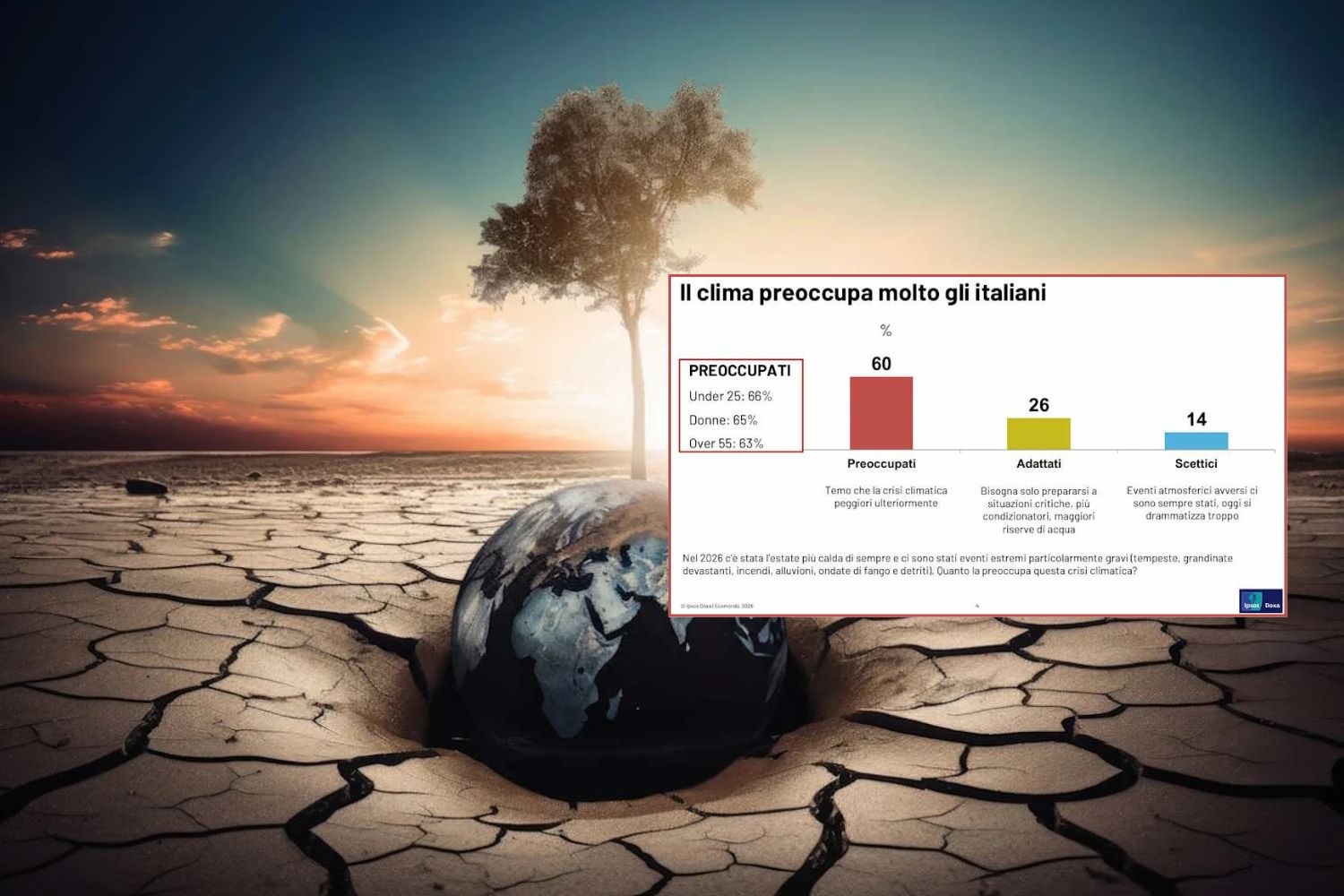
The first fact that emerges is that climate change is not perceived as a niche issue, nor as an exclusively youth battle.
Six out of ten Italians are worried about global warming and fear that the situation could worsen further. A particularly widespread concern among women, those under 25 and those over 55. Only 14% of those interviewed express skeptical positions on climate and environmental issues. A minority, therefore, compared to a large part of the population who recognizes the problem and asks for interventions.
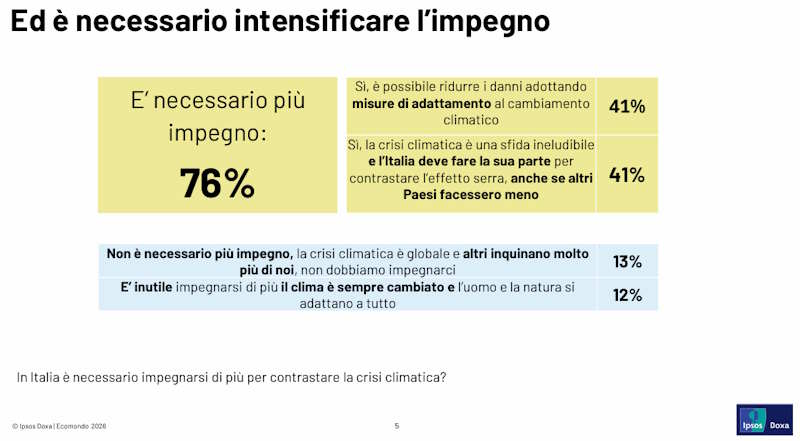
40.8% believe adaptation measures are necessary to address the consequences of the climate crisis. An identical percentage says that action should be taken even if other countries do not make similar commitments.
@IPSOS
An element that is anything but secondary: for a significant part of Italians, the climate inaction of other states cannot become a justification for not intervening.
And there is also a personal willingness to change: over seven out of ten Italians declare they are ready to adopt more sustainable lifestyles and consider the energy transition a priority for the country.
Less fossil fuels and more renewables
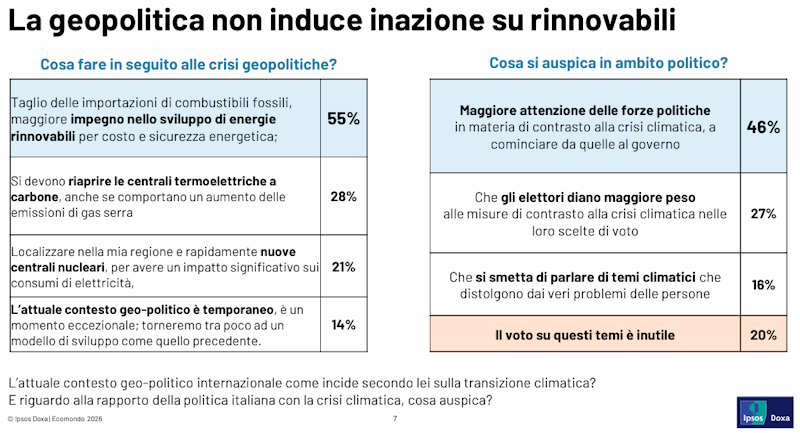
But what are, concretely, the actions considered most important to combat climate change? The answers indicate a precise direction: reduce dependence on fossil fuels and invest in a more sustainable energy system.
According to the survey, the priorities are:
@IPSOS
Furthermore, 55% of Italians believe it is necessary to cut imports of fossil fuels and accelerate renewables, not only for environmental reasons, but also to reduce costs and strengthen national energy security. However, different orientations remain: 28% would like to reopen coal-fired thermoelectric power plants and one in five Italians is in favor of relaunching nuclear power.
Businesses are also asking to accelerate the energy transition
64% of companies believe the path towards the ecological transition is too slow, while the percentage rises to 74% when talking specifically about energy transition. A request for acceleration that is accompanied by a different perception of the relationship between environmental protection and economic competitiveness.
In fact, one in two Italians asks to invest more quickly in technologies capable of simultaneously guaranteeing competitiveness and effective measures for the climate and the environment. Only one in four believes that environmental investments can reduce Italy’s competitiveness.
In other words, for a significant part of public opinion, protecting the climate and supporting the economy are not necessarily incompatible goals.
A perspective that shifts the debate from the contrast between environment and growth to the need to identify solutions capable of responding to both needs.
The UN report
The request to speed up comes just as the new United Nations Environment Program (UNEP) Emissions Gap Report 2026 issues a warning: exceeding the 1.5°C global warming threshold is now inevitable and, continuing with current policies, temperature increases could reach 2.8°C within this century.
To limit exceeding 1.5°C as much as possible, global emissions should decrease by 45% by 2035 compared to 225, well beyond the commitments made by governments so far. A fact that makes the acceleration of climate policies requested by Italians even more urgent.
We talked about it here: We shouldn’t have exceeded 1.5°C of global warming, now we risk reaching 2.8°C (by the end of the century)
HERE you can find the complete report.
