
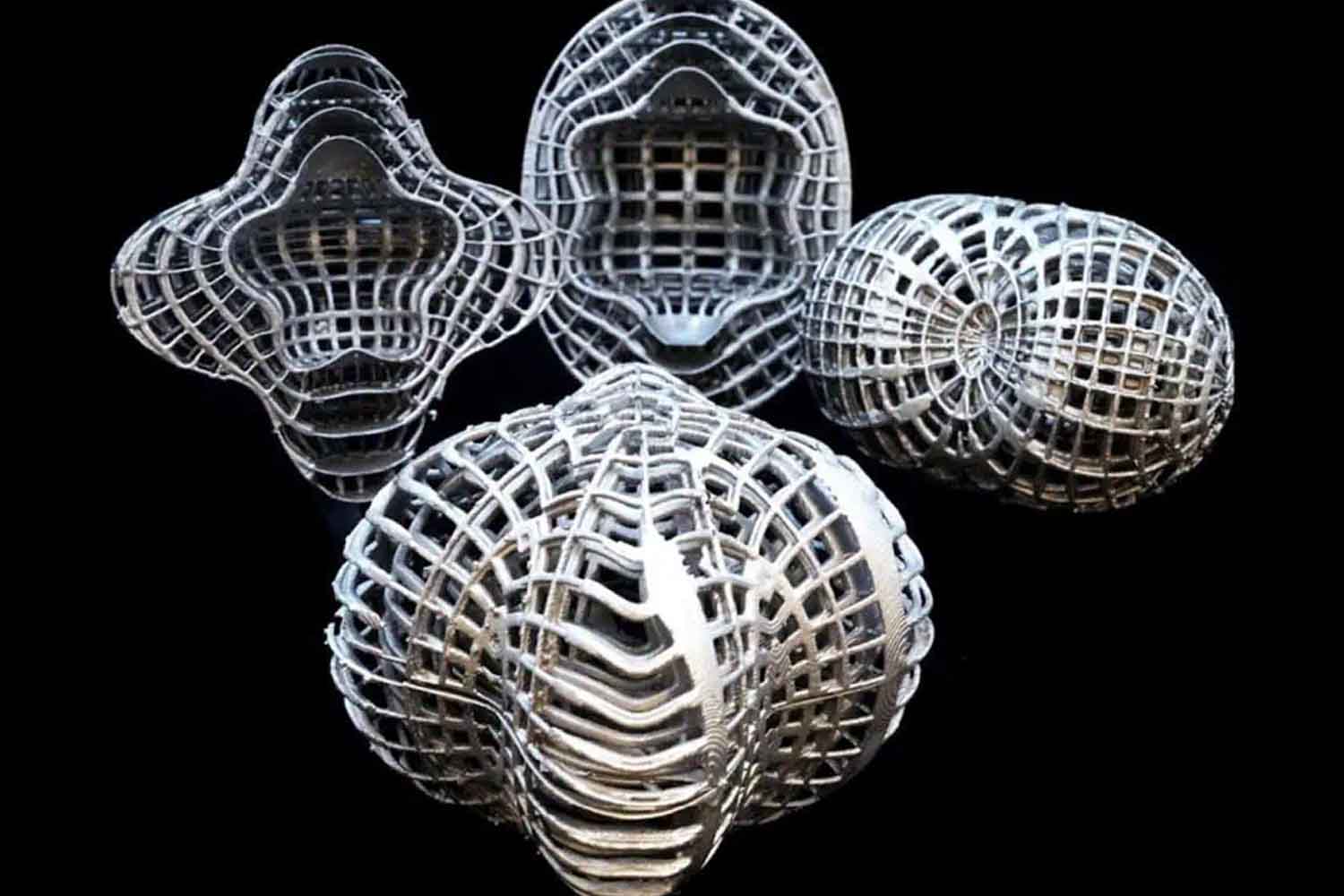
A group of researchers from the University of Illinois and the Technical University of Denmark created a 3D thermal cloak capable of making objects almost invisible to thermal imaging cameras. The device deflects heat around the hidden object, without significantly altering surrounding temperatures. To prove this, scientists hid an apple-shaped structure inside a pear-shaped shell.
The technology, described in the study published on Nature Communicationsmanages to keep the temperature distribution around the hidden object almost unchanged, even when the heat arrives from different directions. A result that could find application in the protection of electronic components, in the thermal management of microchips and in infrared detection systems.
How the heat-deflecting mantle works
When heat passes through a material, it tends to move from hotter to colder areas. If it encounters an obstacle along the way, the flow changes direction, creating alterations in the temperature distribution. It is precisely these differences that make the presence of an object recognizable during a thermal analysis.
The researchers found a way around the problem by building a structure that guides the heat along a predetermined path, making it flow around the region to be protected. To achieve this they combined two materials with very different properties: an aluminum alloy, an excellent conductor of heat, and polydimethylsiloxane (PDMS), a silicone that conducts heat much less.
The aluminum forms a three-dimensional lattice of very thin interwoven bars, while the silicone fills the empty spaces. By changing the thickness and orientation of the bars, the researchers are able to control the passage of heat to every point of the structure. The lattice was created through metallic 3D printing, a technique that allows the reproduction of particularly complex geometries and very small details.
The real novelty concerns precisely the three dimensions. Previous thermal blankets were developed primarily for two-dimensional surfaces or heat flows from specific directions. The new device can instead adapt to irregular shapes and work independently of the orientation of the heat flow. As he explained Shelly Zhangan engineering professor at the University of Illinois and head of the research, a true thermal blanket must function regardless of the direction from which the heat comes. And that’s exactly the property his team sought to reproduce.
The apple hidden inside a pear experiment
To put the device to the test, engineers built a structure with an apple-shaped core, enclosed inside a pear-shaped casing. Naturally these were artificial geometries, chosen to verify the behavior of the mantle around curved surfaces. The sample was placed between two aluminum plates: one heated to 40°Cthe other cooled with water and ice.
After an hour, a thermal imager recorded the distribution of temperatures. The results showed that the heat was able to bypass the central region, leaving the surrounding thermal distribution almost undisturbed. The lines connecting points at the same temperature remained essentially straight and regular, as if the hidden core did not interfere with the passage of heat.
Inside the mantle, however, the temperature variations were much more limited. The structure was therefore able to perform two functions simultaneously: hide the thermal presence of the object and protect it from external temperature variations. The experiment was repeated by changing the direction of the heat flow, obtaining results consistent with the mathematical simulations. The researchers also built and tested a second device, this time with a heart-shaped geometry.
From human faces to the most complex shapes
The research also went beyond the geometries used in the first experiments. Engineers have designed thermal cloaks with surfaces that mimic human faces, including noses, features and glasses. Through computer simulations they verified how the lattice could adapt even to these extremely irregular shapes, maintaining the properties necessary to deflect heat.
To achieve this, they used particular mathematical models, called spherical harmonics, which allow them to describe complex three-dimensional surfaces. Some of the structures have also been physically reproduced through 3D printing. The ability to thermally hide faces was evaluated in the simulations, while the experimental checks with a thermal camera concerned the other geometries made of metal and silicone. The result expands the possibilities of the so-called thermal metamaterialsartificial structures designed to obtain properties that depend mainly on their internal geometry.
From microchip protection to thermal shielding systems
The applications hypothesized by the researchers concern different technological sectors. One of the most interesting is that of electronics. Microchips and other sensitive components can be affected by temperature variations, especially when they are inserted into compact devices and pass through heat flows that are difficult to manage. A material capable of directing heat along specific paths could help protect certain areas, maintaining more stable thermal conditions.
Another area concerns the shielding of equipment and the control of information detectable through heat, with possible developments also in security systems. In the official presentation of the research, Zhang explained that any industry where there is a need to precisely control heat or protect something from thermal detection could benefit from the technology.
The group is already working on the next phase: developing intelligent cloaks, capable of also managing the heat produced by the objects hidden inside them, rather than simply deflecting the heat coming from the outside. For now, the device has shown that it’s possible to build a three-dimensional path around an object and let heat flow as if that obstacle weren’t there. The apple is still inside the pear. It’s the heat that has learned to revolve around her.
