
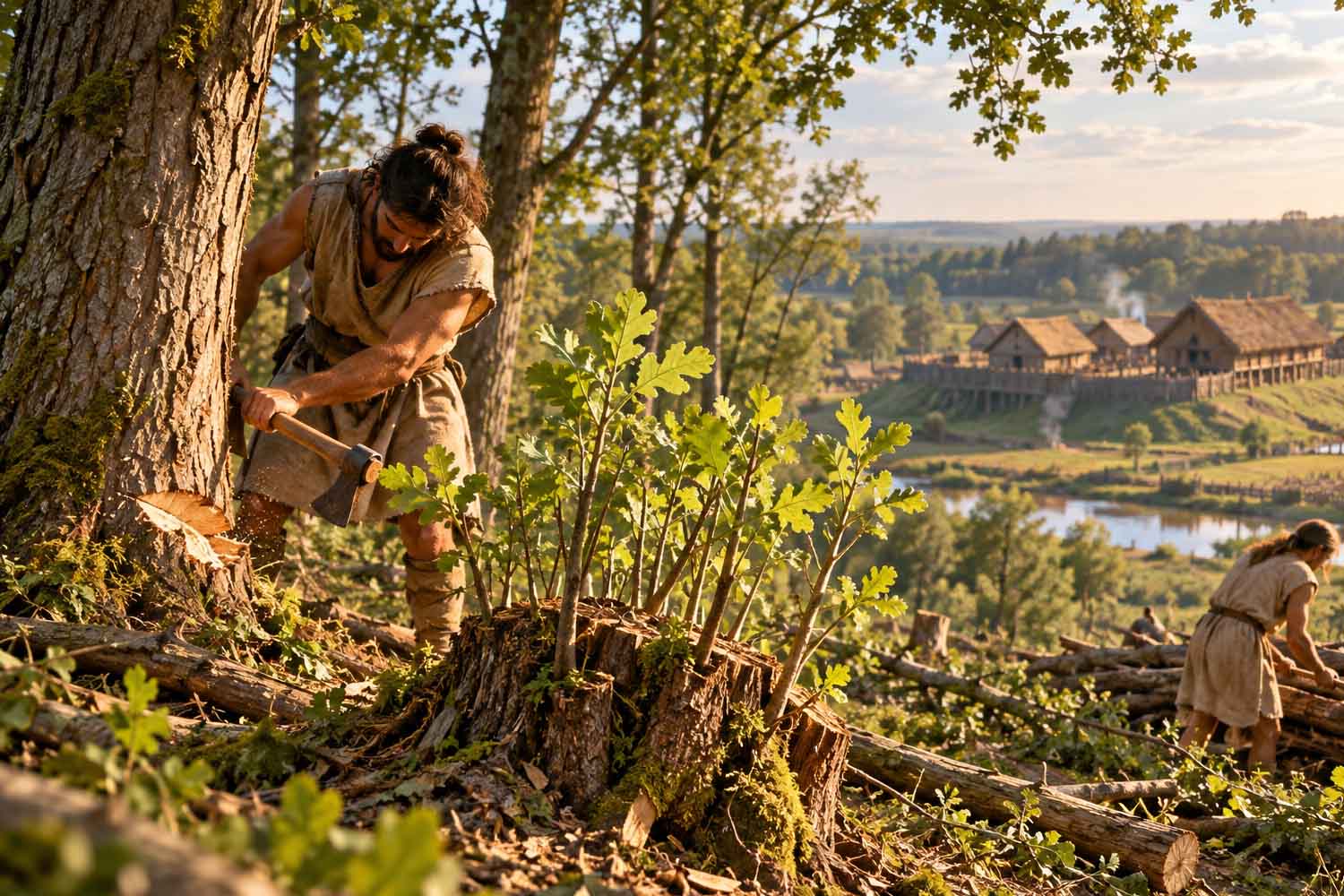
About 3,600 years ago, in the Po Valley, oaks, hornbeams and hazel trees were cut down so that the woods could regrow. The inhabitants of the ancient villages already knew a technique that we still use today: the selective cutting of trees, capable of encouraging the growth of new trunks from the stumps. A precious resource for those who needed wood for practically everything, from homes to cooking fires.
A study published on reconstructs this ancient management of the woods Nature Plantscoordinated by researchers Anna Maria Mercuri and Assunta Florenzano of the University of Modena and Reggio Emilia. The discovery comes from the analysis of tiny grains of pollen that have remained preserved for millennia in the soils of the settlements of the Terramare civilization.
Those grains allowed scholars to reconstruct something that archaeological excavations alone would hardly have been able to tell: the way in which entire generations used the woods around the villages, choosing which trees to cut and exploiting their ability to regrow.
When wood was as important as oil
Between 1650 and 1150 BC, much of present-day Emilia was occupied by the Terramare, a civilization that built organized villages, often surrounded by ditches, embankments and palisades. Wood was used to build homes, strengthen defenses and fuel fires. In Montale, near Modena, archaeologists found charred trunks at the base of the ancient village. In Noceto, in the Parma area, even a large votive basin built entirely of wood was discovered, one of the most extraordinary testimonies of the technical skills of these communities.
In short, wood was everywhere. So much so that the authors of the research propose to consider that society also as a civilization of the “Wood Age”, because this resource had an economic and energetic importance comparable to that of oil in modern societies. The problem was getting enough.
The more the villages grew, the more wood was needed. Meanwhile, around the inhabited areas, the woods also had to give way to cultivated fields and pastures. Continuing to cut down trees without waiting for them to grow back would have meant looking further and further away for wood. A big problem for a company that built practically everything with that material.
According to the researchers, the Terramare communities had developed a solution: to use certain species of trees, allowing them to produce new trunks after cutting. In this way they could return to collect wood in the same woods, following cycles of exploitation and regeneration.
How they made trees grow back after cutting
The technique reconstructed by scholars resembles coppice management, a forestry practice still widespread in Italy. Some trees, when cut near the base, have a particular characteristic: new shoots can develop from stumps or roots, destined to become other stems.
The kernel, for example, rapidly produces new shoots. Hornbeams, ash trees and some oaks can also regenerate, although with different times and methods. By taking advantage of these characteristics, it is possible to obtain lumber at successive intervals without having to wait each time for a new tree to grow from a seed.
The inhabitants of the Terramare seem to have followed precisely this principle, alternating the cutting of some species with the regrowth of others. It was probably a still ancient form of selective management, different from the forestry techniques perfected in subsequent centuries. And to reconstruct it, after millennia, scholars had to look for traces much smaller than a trunk or a stump.
Traces of the cuts remained in the pollen
The researchers compared 218 pollen spectra, i.e. analyzes of the pollen present in the archaeological deposits of various sites in the Terramare, focusing mainly on the villages of Santa Rosa di Poviglio, in the province of Reggio Emilia, and Montale, near Modena.
Pollen produced by trees can be preserved in sediments for thousands of years. By analyzing it, scholars are able to reconstruct which plants grew in a certain area and how their presence changed over time. A particular trend appeared in the Terramare samples: in some phases the pollen from oaks decreased while that from hornbeams and hazelnuts increased. Subsequently the proportions changed again.
This trend repeated itself over the years and was compatible with the selective cutting of trees. When part of the forest was cut down, other species could take advantage of the greater availability of light to develop. As time passed, the oaks grew again and the composition of the vegetation changed again.
A grain of pollen, of course, does not tell who wielded an axe, nor when he did so. The reconstruction arises from the repetition of these changes in multiple archaeological sequences, compared with the remains of wood, coal and the characteristics of the different species. According to the authors, all the evidence constitutes solid proof of the existence of recurring cycles of cutting and regrowth, recognizable over intervals of several decades.
And the woods didn’t just provide building material. Evidence of the presence of hazelnuts, acorns, berries and vines has also been found in archaeological deposits. Some tree-lined areas were probably also maintained to continue harvesting these food resources. The forests, therefore, were also a pantry.
For five centuries the system worked, then came the difficulties
This organization helped sustain Terramare communities for approximately five centuries. Forests were used in conjunction with cultivated fields, pastures and water management systems. Crops also probably followed forms of alternation: cereals, legumes and land intended for grazing occupied different spaces over time. Resources, however, were not unlimited. With the growth of settlements, the pressure on the territory also increased. The data collected shows a progressive reduction in the presence of trees in the areas occupied by the villages.
In Montale, for example, the pollen indicators of the arboreal vegetation go from 42% in the pre-settlement levels to 12% in the Bronze Age layers. A considerable transformation, which shows how much human activity had modified the landscape around the homes. In the meantime, cultivated areas and soil modifications increased. The availability of lumber was becoming more difficult to maintain.
Around 1200 BC, the Po Valley also went through a phase of increasing aridity. The combination of resource exploitation, land impoverishment and climatic difficulties may have contributed to the crisis of the Terramare civilization, whose settlements were progressively abandoned. In the most recent archaeological layers of Santa Rosa di Poviglio, scholars have observed that the pollen oscillations associated with cutting and regrowth cycles become less regular, to the point of attenuating.
The woods of the Po Valley were already modified by man
The research also allows us to look at the woods we know today with different eyes. We often imagine the forests of the past as large natural spaces, which remained undisturbed until the arrival of agricultural and industrial transformations. But many European landscapes have a much longer history of human intervention.
In the Po Valley of the Bronze Age, communities chose which trees to use, encouraged the regrowth of certain species and maintained some wooded areas to harvest fruit and other resources. These activities contributed to modifying the composition of the vegetation and could leave effects that would last well beyond the existence of the villages. The research therefore shows that organized forest management already existed thousands of years ago, when Terramare communities depended on wood for a large part of their economy.
For generations they managed to use the same woods, following the times of their regrowth. Then the demand for resources increased, environmental conditions worsened and that system began to lose effectiveness. In the last levels studied in Poviglio, the regularity of the cutting and regeneration cycles weakens. After centuries of exploitation, the forests could no longer sustain the same pressures.
