
Seven thousand years ago, in what is now the east ofHungaryan elderly woman was buried with objects that her community reserved for men. No shell beaded belts, none of the symbols that accompanied the other women at that site. Only tools made of polished stone, robust, concrete, for work. And his bones, those toes worn down by years of kneeling, more similar to the men of the village than to his contemporaries, told of a life consistent with that choice.
A study published onAmerican Journal of Biological Anthropology analyzed 125 skeletons found in two ancient cemeteries on the Hungarian plains, and what he found significantly undermines the idea of a prehistory rigidly divided between immutable male and female roles.
The discovery about flexible gender roles that comes from two Neolithic cemeteries
The research team, led by anthropologist Sébastien Villotte of the French National Center for Scientific Research, worked on two separate sites. The first, Polgár-Ferenci-hátdates back to the period between 5300 and 5070 BC and has returned a fairly uniform funerary picture: few significant differences in the way men and women were buried. The second site, Polgár-Csőszhalomdated between 4800 and 4650 BC, has instead opened up much more interesting scenarios.
Scholars have identified seven burials that do not follow the usual pattern: two male and five female skeletons placed in positions that contradict the funerary norm documented in the rest of the cemetery. As a rule, the men were placed on their right side, accompanied by polished stone tools that recall hunting or manual labor activities. The women, on the left side, with belts adorned with shell beads. These seven individuals tell something different.
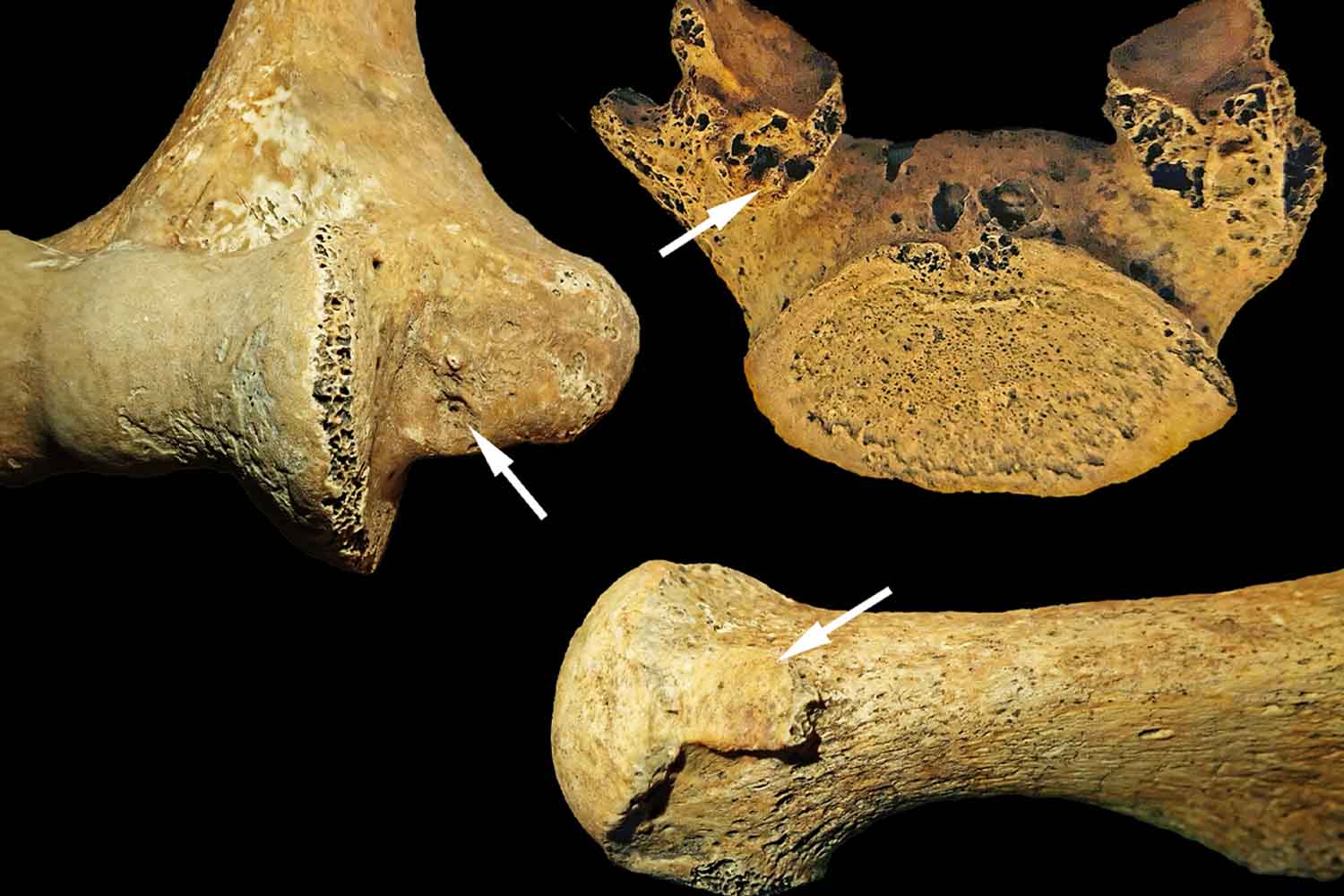
Anthropologists read the body as a archive. The bones preserve the physical habits of an entire life: the men from these sites often showed a clear elongation of the right upper limb, a bone adaptation identical to that observed today in professional tennis players, compatible with repeated movements of throwing sticks or spears. In women, the most common feature was hyperextension of the toes, produced by long hours in a kneeling position grinding cereals, a central activity in the Neolithic agricultural economy.
The old woman buried with men’s tools
The most eloquent case among the seven anomalous burials concerns an adult woman, elderly at the time of death. Next to her, the polished stone tools typical of male trousseaus. And in his bones, a pattern of physical wear closer to that of the men on the site than to that of the other women. The toes displayed the same kneeling posture documented in male skeletons, in a different way and to a different extent than their contemporaries.
This set of elements suggests that that community recognized individual paths that went beyond the expected patterns. Villotte and his colleagues urge caution in interpretation, because funerary practices are always complex and multifaceted. Reading margins remain open. Yet, the data is there, concrete, engraved in the bones and confirmed by the kit.
The populations who inhabited these plains were of Anatolian origin and had brought the Neolithic model of life to Central Europe: agriculture, livestock farming, permanent settlements, ceramics, polished stone tools, weaving techniques. A radical transformation of the way of life, which had created structured communities, with recognizable roles. And within these structured communities, someone lived differently from the norm, and was buried in a way consistent with that life.
According to the researchers, the social construction of gender in the Early European Neolithic, between 6500 and 5500 BC, it varied enormously from community to community and from region to regionproducing a variety of practices that escapes any fixed pattern. Gender categories were already present and culturally recognisable. However, they left room for individual variations, for personal stories that did not entirely fit into the collective norm.
That old woman, with her stone tools and her bones worn by unconventional work, passes through seven thousand years with remarkable discretion. And it does so by reminding us that the complexity of social roles has its roots much further than we tend to imagine.
