
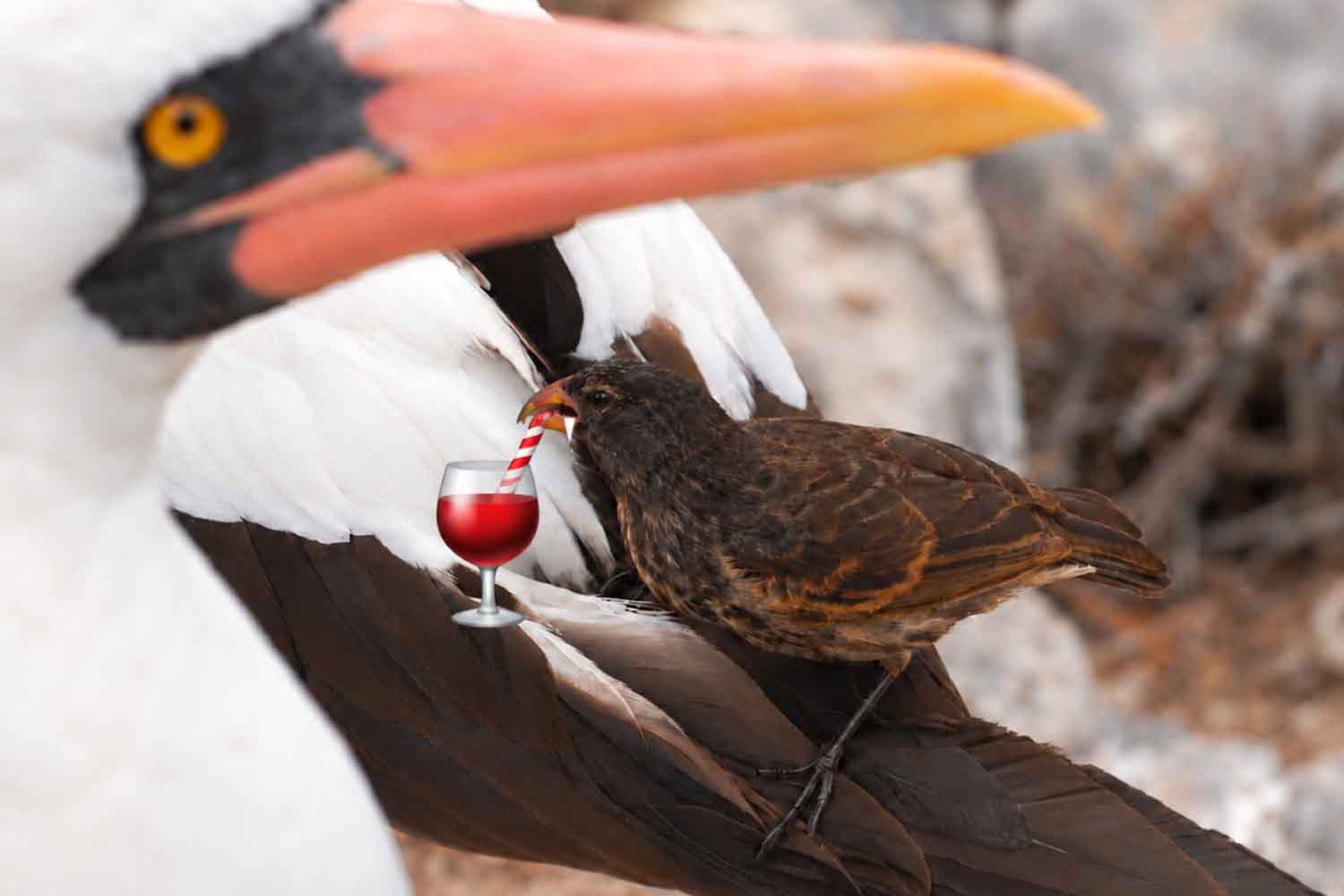
It sits on the back of a gannet, buries its beak at the base of the feathers, opens a small wound and waits for blood to come out. Then he drinks. It’s not a scene constructed for a horror documentary: it really happens on the islands of Darwin and Wolf, in the far north of the Galápagos, where he lives Geospiza septentrionalisthe vampire finch.
It weighs just 20-25 grams, according to the Charles Darwin Foundation’s guide to land birds, and is endemic to these two small islands of Ecuador. The name, for once, doesn’t need much marketing: this bird actually drinks the blood of other birds, especially Nazca boobies and red-footed boobies.
When researchers Daniel Baldassarre and Jaime Chaves reached the two islands to study it, they found entire groups of finches clinging to the backs, wings and tails of the gannets, intent on opening wounds with their beaks. Some had visibly swollen throats and red-stained beaks. To get there they had to approach the cliffs with a small dinghy, wait for a respite in the waves and jump on the lava rocks. At least, once landed, the birds were found.
Gannets let themselves be bitten, at least for a while
The curious thing is that gannets often seem to tolerate these small assaults. Some even continue to court each other. Friedemann and Heide Koster already told it in 1983, authors of a report published by the Charles Darwin Foundation after twelve days spent on Wolf Island. The courting pairs appeared almost unaware of the finches moving on their backs, piercing their growing feathers to reach the blood. Evidently, for some boobies, romantic matters take precedence.
The solitary specimens instead showed signs of annoyance. They walked nervously, shaking their wings to get rid of the intruders, but the finches continued to follow them. Sometimes five or six little vampires took turns on the same animal, one after the other.
Baldassarre and his colleagues, in their report of field observations, also described behavior similar to that of parasites: the finches draw blood and generally leave the gannet in a position to continue its activities. A relationship that is reminiscent of that between mammals and mosquitoes, although here the mosquito has a beak and can weigh more than twenty grams.
Gannets that brood or protect their young are particularly exposed, because abandoning the nest can mean leaving eggs and chicks unattended. And for the little ones, still unable to fly, getting rid of the attackers is much more complicated. Historical observations describe chicks surrounded by finches, with bloody wounds on their necks or tails, as they try in vain to escape.
Why did these finches start drinking blood?
Wolf and Darwin are two isolated volcanic islands, surrounded by cliffs and with very little fresh water available. During the dry season, seeds, insects and other food resources can also become difficult to find. The vampire finch has a rather opportunistic diet. It eats seeds, invertebrates, nectar and, when it happens, seabird eggs. It can even feed on regurgitated fish residue and guano. Blood represents an additional resource, especially in the most difficult periods.
According to a preliminary estimate by Baldassarre and his colleagues, based on data not yet published, it could constitute about a tenth of the diet. A percentage that requires further verification and which may vary depending on environmental conditions. The researchers also hypothesize that blood may help provide water in an environment where fresh water is extremely rare. This explanation also has yet to be directly demonstrated.
The most accredited hypothesis on the origin of the behavior starts from something much less macabre: the cleaning of the feathers. The ancestors of these finches may have begun to frequent the gannets to eat the small parasites present on the skin and in the feathers. A useful service for both: the seabirds got rid of unwanted guests and the finches found something to eat.
During this activity, however, some pecks may have caused injuries, allowing the finches to come into contact with blood. Over time, individuals capable of exploiting this resource would have an advantage in the most difficult seasons. It is a plausible evolutionary reconstruction, supported by the ecological and morphological characteristics of these birds, even if no one has been able to directly observe the transition from feather cleaning to blood consumption.
The blood also left traces in the intestine
Drinking blood brings some difficulties. It is a food rich in proteins and iron, poor in some essential nutrients and rather difficult to metabolize. Vampire finches, however, seem to have developed particular characteristics at the intestinal level as well.
A study published in the journal Microbiome analyzed fecal samples from 114 finches belonging to 12 species, collected on nine Galápagos islands. The result showed that the intestinal microbiome of vampire finches is significantly different from that of the other species examined.
Bacteria that are absent or very rare in other finches and are also present in the digestive system of carnivorous birds and reptiles have been identified in their intestines. The analyzes of the feathers also revealed particularly high nitrogen-15 values, compatible with a diet that includes resources coming from high levels of the food chain.
Other research published by the Royal Society compared the microbiome of vampire finches to that of blood-feeding bats. Some similarities emerged in the bacterial composition and metabolic functions predicted by the analyses, although the differences between the two animals remain much greater. These are interesting clues of a possible adaptation to the diet, yet insufficient to establish exactly what role these microorganisms play in blood digestion.
A distinct species, confined to two small islands
For a long time the vampire finch was considered a subspecies of the sharp-beaked ground finch. Geospiza difficiles. A genetic study published in Evolution However, it has contributed to clarifying the evolutionary differences between these populations, supporting the recognition of Geospiza septentrionalis as a distinct species. The separation is based on genetic, ecological and morphological characteristics, as well as differences in song. The classification now adopted by the Charles Darwin Foundation recognizes the vampire finch as an autonomous species, present only in Darwin and Wolf.
Its limited distribution makes it particularly vulnerable. In fact, the Red List of the International Union for Conservation of Nature classifies it as a vulnerable species, especially due to the risk linked to the introduction of diseases and invasive organisms in such an isolated environment. As for gannets, living with these little bloodsuckers can become quite exasperating.
The Kosters said they had observed specimens that, after trying in vain to shake off the finches, took flight from the cliffs and reached the sea. They would dive briefly, then remain in the water to shake their wings, clean their feathers and wash away traces of blood. Once back on the rock, they could enjoy some tranquility. At least until the finches decided to start again.
