
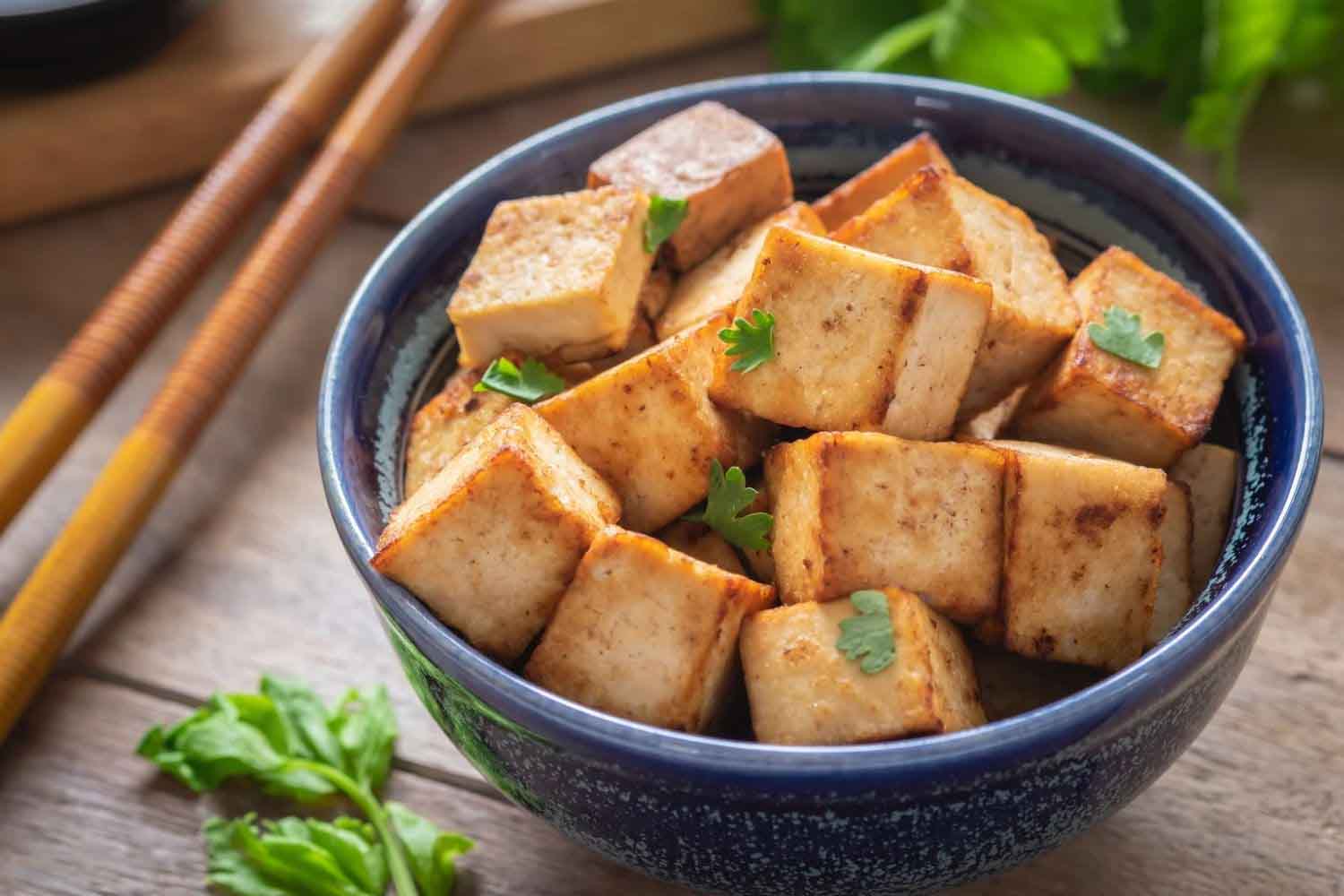
Tofu is in first place in the ranking of 20 protein sources drawn up by Chris Macdonald, a researcher at the University of Cambridge, with 36 points out of 40. Chicken stops in seventh place, tuna in eighth, while cheddar cheese closes the ranking with just 13 points. The result comes from research published on Frontiers in Sustainable Food Systemswhich proposes a new index to compare foods based on nutritional value, price and the environmental impact of their production. The winner, therefore, is precisely that white block obtained from soy, often viewed with a certain distrust by meat lovers.
The index is called BPI Score, from the Better Protein Institute, an organization founded by Macdonald himself to promote more sustainable protein sources. The peculiarity is that it also considers the resources necessary to produce food, from greenhouse gas emissions to water and land consumption. And the results reward vegetables above all: they occupy all the first six positions, while to find beef you have to go down to seventeenth place.
The protein ranking: tofu first, chicken seventh and cheddar last
The top four positions are occupied by tofu, chia seeds, beans and quinoa. Sunflower seeds and lentils follow, while chicken breast is the first food of animal origin, in seventh place, followed by tuna. Then the vegetables return, with peanuts, chickpeas, common walnuts and Brazil nuts. Salmon comes thirteenth, eggs fourteenth, followed by pork and cod. In the last four places we find beef, lamb, mozzarella and cheddar.
In practice, all ten plant foods examined occupy the top twelve positions, interrupted only by chicken and tuna. The last four places, however, belong exclusively to animal products. A rather clear distribution, especially considering that many of the foods finishing in the lower part of the ranking are commonly appreciated precisely for their protein content.
The explanation lies in the method chosen by Macdonald. The researcher divided the score into two categories: the Planet Score, which assigns up to 16 points considering greenhouse gas emissions, water pollution, fresh water consumption and land use, and the People Score, which is worth up to 24 points and evaluates saturated fats, cholesterol, sodium, protein completeness, price and availability in supermarkets.
To make such different foods comparable, Macdonald used 100 grams of protein as a reference, rather than 100 grams of product. In fact, different quantities of tofu, meat or legumes are needed to obtain the same protein intake. This way it is also possible to compare how many resources are needed to produce it.
Because the tofu beat the meat
Tofu obtained the maximum environmental score, 16 points out of 16, to which another 20 points are added for its nutritional and economic characteristics. A combination that brought it to the top of the ranking, ahead of all the other foods analyzed.
The environmental data used by Macdonald, derived from research published in PNAS in 2022, show notable differences. Producing 100 grams of protein through tofu involves emissions equivalent to approximately 0.61 kilograms of CO₂, while for beef the figure is 64.19 kilograms. Over a hundred times as much. The land needed also changes a lot: 2.16 square meters for tofu versus 211.38 for beef. As for fresh water, tofu requires approximately 14.23 liters for the same amount of protein, a value lower than that of many other foods examined.
On the nutritional side, then, tofu contains all nine essential amino acids, those that our body must obtain from food. It is therefore a complete protein source, a characteristic shared with meat, fish, eggs and dairy products, but less common among plant foods. Furthermore, like other products of plant origin, it does not contain cholesterol. In short, tofu offers complete proteins and, according to the data considered in the research, requires much fewer resources than beef. A combination that allowed it to obtain the highest score in both categories of the index.
Because cheddar came last, despite being rich in protein
Cheddar provides complete protein, just like meat and eggs, but finished the ranking with just 13 points. What penalizes it above all is the high content of saturated fats and the environmental impact of dairy production. According to the nutritional data used by Macdonald, for every 100 grams of protein, cheddar provides approximately 84.74 grams of saturated fat. Cod, for comparison, just 0.47 grams. A significant difference, even for a cheese that is rarely chosen for its lightness.
The penultimate mozzarella, on the other hand, has particularly high sodium values: around 2,550 milligrams per 100 grams of protein, compared to 11 milligrams for the beans considered in the database. Beef and lamb are penalized above all by the emissions and land use associated with farming, while chicken and tuna perform better thanks to a more favorable combination of nutritional characteristics, costs and environmental impacts.
However, not even all vegetables obtain the maximum score in the individual categories. Lentils are the cheapest protein source among those analyzed, while quinoa is the most expensive, considering the price needed to purchase 100 grams of protein. Brazil nuts, on the other hand, are penalized by their saturated fat content and water consumption. Tofu manages to maintain a good score in almost all parameters, thus taking first place in the overall rating as well.
How the scores were calculated
To construct the BPI Score, Macdonald used scientific data already available on the nutritional and environmental characteristics of the twenty foods. For each indicator it assigned a score, generally between zero and four, then adding the results obtained in the two main categories.
As regards prices, the researcher took the Aldi chain in the United Kingdom as a reference, where costs may be different from those in Italy. Commercial availability was also assessed on the British market: all twenty foods examined were available in supermarkets and therefore obtained the maximum score expected for this item.
Macdonald considers the BPI Score a first experimental version, which he intends to expand to include other factors, such as animal welfare, antibiotic resistance associated with livestock farming and the indirect effects of land use. The index takes into account some nutritional, economic and environmental characteristics, therefore it does not represent a ranking of protein quality alone.
However, the results show an important difference between the food sources considered: obtaining the same quantity of proteins can entail very different environmental costs, especially when cattle farming comes into play. Tofu, for example, requires about one hundred times less land than beef to produce 100 grams of protein. A gap that exists independently of the points awarded by Macdonald and which explains a good part of his lead.
