
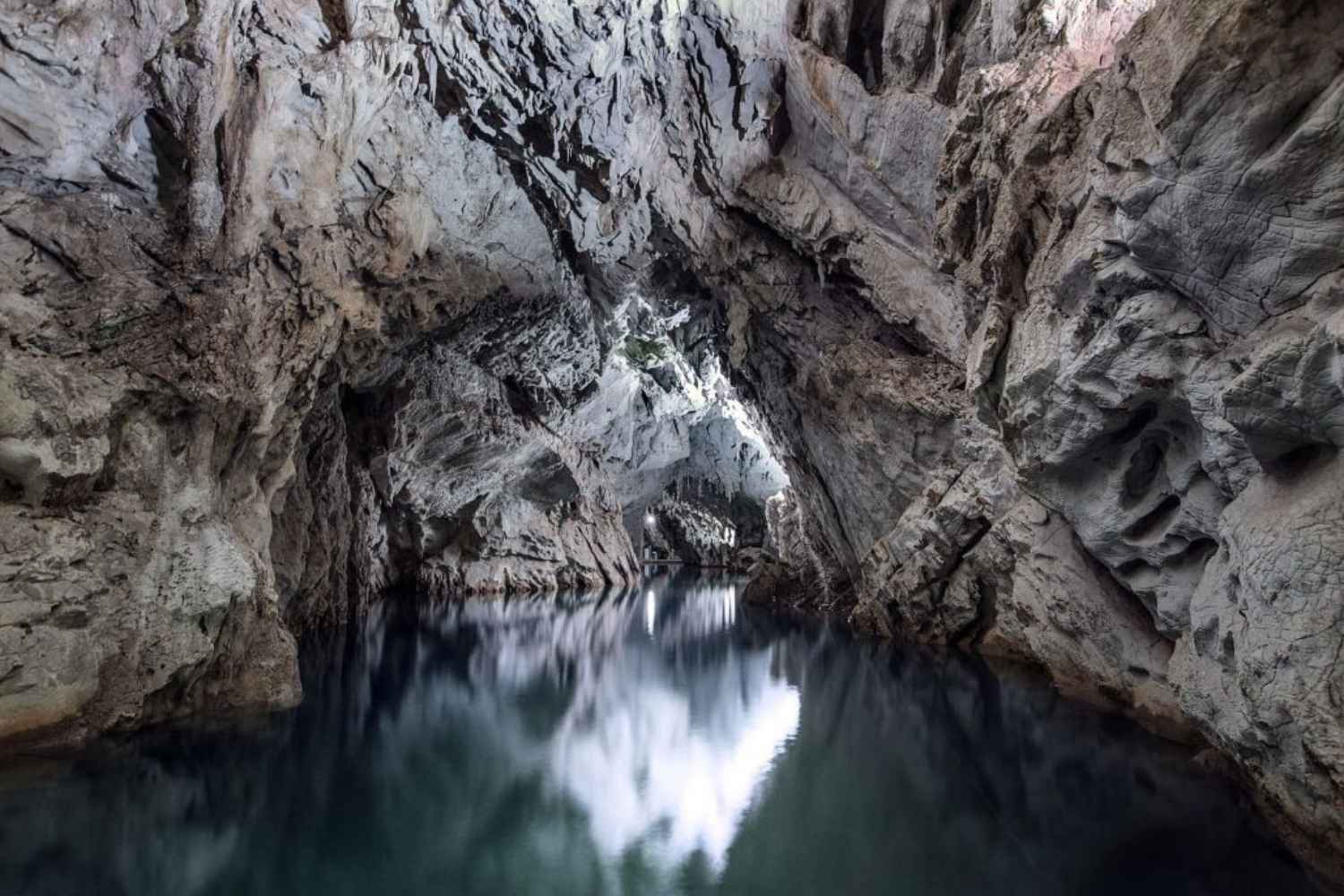
In Campania, in the province of Salerno, there are the only caves in Italy where it is possible to navigate an underground river. They are the Pertosa-Auletta Caves, in the territory of the Alburni Mountains, and offer a route that begins by boat, crosses environments rich in stalactites and stalagmites and continues on foot up to rooms tens of meters high.
In addition to the naturalistic interest, these caves contain important archaeological evidence: the remains of a pile-dwelling village dating back to the Bronze Age, approximately 3,500 years ago. It is a unique find in Europe, which tells how prehistoric communities used underground environments.
From 4 November 2026 there will be one more reason to visit them. On the occasion of the hundred years since the first complete speleological exploration, the MIdA Foundation inaugurates a free exhibition with period photographs, maps and documents that reconstruct the history of the caves before the creation of the current tourist routes.
A boat trip along an underground river
The visit to the Pertosa-Auletta Caves begins on board a boat that crosses a stretch of the Negro river, the underground watercourse that crosses the cavity. The boats are moved by guides through a system of ropes, allowing visitors to observe the rocky walls, limestone concretions and environments crossed by the water.
During navigation you also reach an underground waterfall. The route then continues on foot, through walkways and equipped paths that allow you to explore some of the most characteristic rooms.
Among these are the Throne Room and the Great Hall, a room that reaches 24 meters in height. Another peculiarity is the so-called “kiss in the rock”, the point where a stalactite and a stalagmite joined together after a formation process that lasted about 20,000 years.
The Sala del Paradiso and the Sala delle Spugne have also recently been reopened, after a renovation of the lighting which allows you to better observe the characteristics of the rock formations.
The entire underground system extends for approximately three kilometres, although only a part is open to the public. Inside the temperature remains around 15 degrees throughout the year.
A 3,500 year old village hidden in caves
The Pertosa-Auletta Caves are also important from an archaeological point of view. Inside them, the remains of a pile-dwelling settlement dating back to the 2nd millennium BC, during the Bronze Age, were discovered.
These are the only caves in Europe where evidence of a village built on stilts has been found. The wooden structures show how the populations of the time had organized living spaces in an environment characterized by the presence of water.
The first archaeological investigations date back to the end of the nineteenth century, when Giovanni Patroni and Paolo Carucci started research in the entrance area. Subsequent excavations made it possible to identify further evidence of human presence, demonstrating that the cavity was frequented in different eras.
Today part of the remains of the settlement is located in submerged areas and is not directly visible during the normal tourist visit.
To learn about this part of history you can visit the Speleo-Archaeological Museum of Pertosa, located in the historic center of the town, about five minutes’ drive from the caves. The museum displays archaeological finds and reconstructions of daily life during the Bronze Age, also using life-size models, three-dimensional reconstructions and interactive tools.
The new archaeological discoveries
Archaeological research in the Pertosa-Auletta Caves is still ongoing and continues to provide information on the use of the cavity in the past.
In November 2025, a new excavation campaign brought to light other wooden structures attributable to the Final Bronze Age, together with materials from subsequent periods. Some finds also testify to the use of the cave as a place of worship between the 4th century BC and the 1st century AD
The investigations have made it possible to study new traces of the ancient pilings and to delve deeper into the ways in which prehistoric populations occupied the spaces close to the water.
A new research campaign was also announced in 2026 in a normally submerged area, located approximately 40 meters from the cave entrance.
To carry out the excavations, the temporary emptying of an artificial water basin was planned, so as to allow archaeologists to reach structures and deposits that usually remain underwater.
The objective is to reconstruct with greater precision the organization of the settlement and the different phases of use of the cavity.
One hundred years of exploration: a free exhibition from 4 November
The modern history of the Pertosa-Auletta Caves is linked to the expedition organized in 1926 by the Cave Commission of the Alpine Society of the Julian Alps of Trieste, now named after Eugenio Boegan.
On 27 October of that year, a group of eight speleologists led by Mariano Apollonio reached the Alburni Mountains to systematically examine the cavity. Among the participants there was also Bruno Boegan and the expedition received the support of the Italian Touring Club of Salerno.
The works ended on 4 November 1926 and led to the creation of the first complete speleological exploration of the caves, with topographical surveys and photographic documentation of the environments.
Those photographs are particularly important today because they show the conditions of the cavity before the construction of the tourist routes and the interventions that made it possible for the public to visit it.

One hundred years later, from 4 November 2026, the MIdA Foundation is offering an open-air exhibition with free entry, set up in the square in front of the entrance to the caves.
The exhibition presents archive photographs, maps and documents from the 1926 expedition. Visitors will be able to observe how the underground environments appeared at the time of the first explorations and learn about the work of the speleologists who contributed to their valorisation.
During the exhibition period, the volume will also be available free of charge via QR code The Angel Caves in Pertosa. The underground system and the archaeological depositwritten by Felice Larocca, director of the Speleo-Archaeological Museum of Pertosa.
How to visit the Pertosa-Auletta Caves
The Pertosa-Auletta Caves are located in the municipality of Pertosa, in the province of Salerno, in the Cilento, Vallo di Diano and Alburni National Park, an area that is part of the UNESCO Geoparks network.
The visits take place with a guide and include different itineraries, which include navigation on the Negro river and a visit to the underground environments on foot. The routes vary based on duration and accessible rooms.
To organize the visit it is advisable to check in advance the times, availability and booking methods through the official channels of the MIdA Foundation. It is advisable to wear closed shoes and a jacket, even in the summer months, because inside the cavity the temperature is significantly lower than outside.
The visit to the caves can also be combined with two museums managed by the same Foundation: the Speleo-Archaeological Museum, dedicated to the human presence in the cavity, and the Soil Museum, which illustrates the characteristics of the terrain, its formation and the importance of its protection through installations and interactive activities.
The centenary exhibition therefore offers the opportunity to learn not only about the natural environments of the Pertosa-Auletta Caves, but also their history: from the communities that frequented them during prehistory to the speleologists who, one hundred years ago, created the first complete documentation.
