
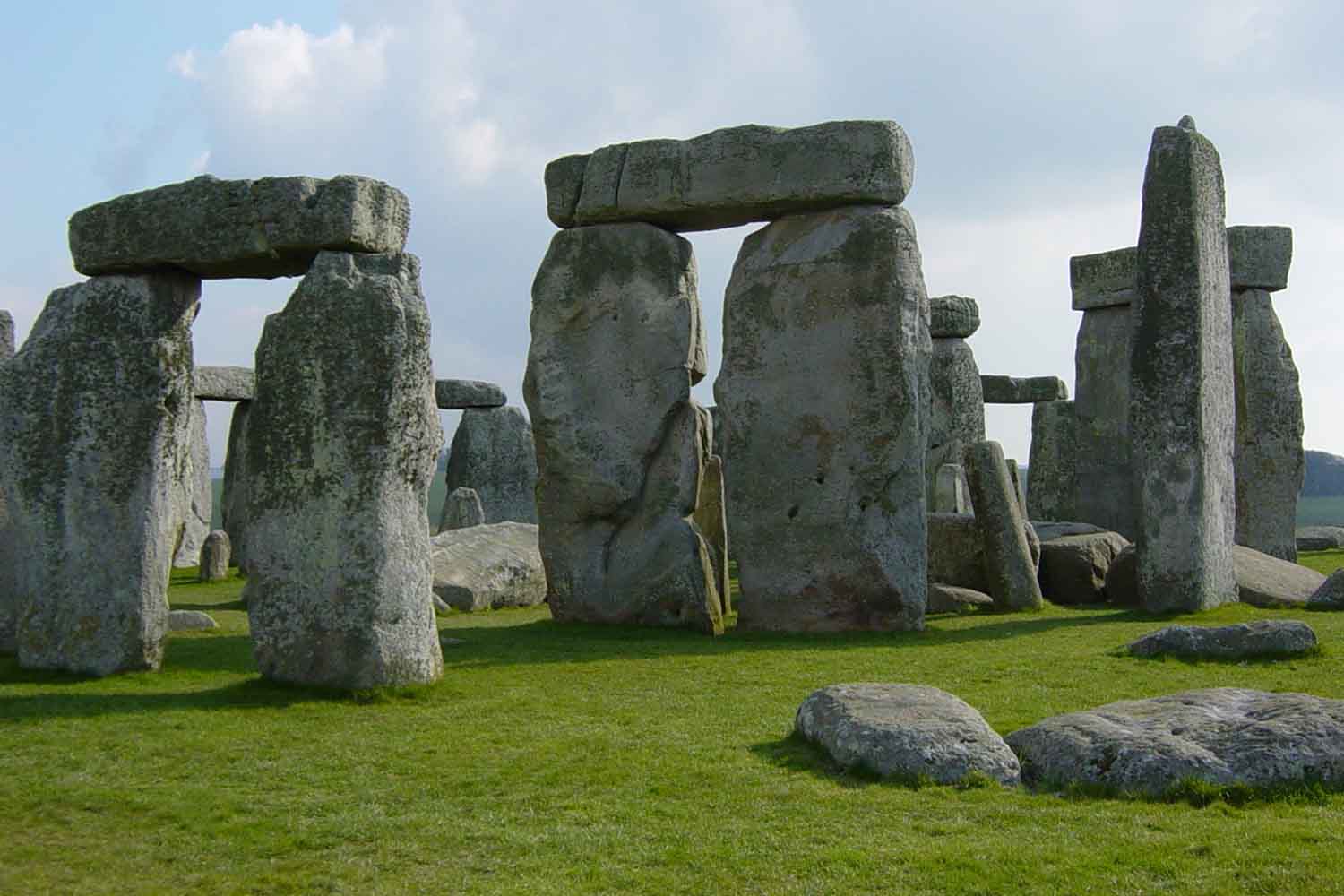
For two years we imagined a six-ton stone crossing a good part of Great Britain, perhaps on a boat, perhaps dragged by means that today we are struggling to even reconstruct. His journey would begin in the north-east of Scotland, around 750 kilometers before reaching Stonehenge. It seemed like one of the most fascinating archaeological discoveries of recent years. Too bad geologists have just discovered a problem: in the Scottish localities examined so far, that stone does not find a convincing match.
A new study published in the journal calls its origin into question Journal of the Geological Societycoordinated by the geologist Duncan Pirrie, professor emeritus of the University of South Wales. The researchers analyzed the composition of the so-called Altar Stone, one of the most enigmatic blocks of the famous English monument, comparing it with that of the rocks present in the regions considered most promising.
The result is rather uncomfortable for a theory that seemed to have now found the right path. None of the places examined possesses all the geological characteristics of the stone. And so, after more than a century of research, we still know where this enormous block arrived, but not where it started from.
A stone of almost five meters and a journey 750 kilometers long
The Altar Stone is approximately 4.9 meters long, one meter wide and weighs six tons. It is located in the central part of Stonehenge, lying on the ground and partially hidden under two large collapsed blocks. It’s not even the most eye-catching of the complex: the gigantic vertical monoliths that we all know tend to steal the show. Yet, from a geological point of view, it is one of the most interesting.
It is composed of a particular sandstone, different from the large stones of Stonehenge, called sarsen. Even many of the smaller stones, known as bluestoneshave a distant origin: some were transported from west Wales, about 225 kilometers from the monument.
For almost a century, scholars have thought that the Altar Stone also came from that region. Then the analyzes began to tell a different story. In August 2024, research published in Nature had identified a striking similarity between the minerals of the Altar Stone and those of the sandstones of the Orkney basin, a vast geological region of north-eastern Scotland.
The researchers had studied tiny crystals of zircon, apatite and rutile present in the stone fragments, reconstructing their age through isotopic analyses. These minerals preserve information on the geological history of the rocks, a sort of natural archive that can help identify their provenance. The correspondence with the north-east of Scotland seemed convincing. So much so as to move the research by hundreds of kilometers compared to the old Welsh hypotheses.
From that moment, however, it was necessary to explain how such a heavy block had reached the Salisbury plain, where Stonehenge was built in various phases starting from around 3000 BC. One of the possibilities was transport by sea, along the British coast. Another contemplated the involvement of ancient glaciers, which could have moved the rock before human intervention.
A further study attempted to narrow down the possible areas of origin and evaluate these routes. The precise place from which the stone had been taken was still missing. A detail that was anything but secondary, considering that the reconstruction of the entire journey depended on that position.
Why geologists have called Scotland into question
To verify the Scottish lead, the international group led by Pirrie investigated the characteristics of the Altar Stone through observations on the monument and analysis of fragments preserved in museums. The scientists examined the structure, minerals, chemical composition and isotopic characteristics of the rock. The comparison also involved the sandstones present in the Scottish locations already identified as possible sources. And the surprise arrived.
Rocks can share a similar geological history and contain minerals of the same age, despite being formed in different locations. To establish a provenance, other clues are therefore needed, from the composition of the clay to the presence of certain minerals. Important differences emerged in the new analyses. The characteristics of the clays and some heavy minerals, in particular, do not coincide with those observed in several formations in the Orkney basin.
The similarity that had directed researchers towards the north-east of Scotland, alone, is no longer enough. As the University of South Wales explains, none of the locations examined so far exhibit the full combination of characteristics identified in the Altar Stone.
Pirrie calls the work the most comprehensive geological survey ever conducted on this block. The team obtained a much more detailed description of the stone, useful for guiding future research. There is also an interesting detail: the authors include Richard Bevins and Rob Ixer, already involved in the investigations that supported the Scottish origin. The new review therefore also comes from those who contributed to building that track.
Naturally, the result does not mean that the Altar Stone could not have come from Scotland. Certain locations were weakened or excluded based on available samples and comparisons. There remain areas that are still insufficiently studied, in Scotland and elsewhere. The search could then move to other regions of Scotland, northern England or even Ireland.
The mystery of Stonehenge also concerns the people who built it
Understanding where this stone came from would allow us to learn more about the people who built Stonehenge thousands of years ago. The monument’s large blocks of siliceous sandstone come predominantly from an area about 25 kilometers away. For other materials, however, archaeologists have reconstructed connections with much more distant regions. The Altar Stone may tell an even different story.
If it had been transported from the north of Great Britain, it would be necessary to consider the ability of Neolithic communities to organize extremely demanding movements, across territories and perhaps stretches of sea. If it came from Ireland, the routes and possible relationships between the populations involved would change. They are reconstructions that depend on a premise yet to be demonstrated: identifying the origin of the rock and understanding how it was transported.
Nick Pearce, emeritus professor of geochemistry at Aberystwyth University, noted that ruling out a possible source area is as important as identifying a new one. Each location eliminated allows you to narrow the search and concentrate your efforts where the clues are most promising.
According to Aberystwyth University, the new study provides just that: a more precise geological description against which to compare rocks that will be examined in the future. The work will continue by searching for outcrops capable of simultaneously satisfying all the identified requirements. And other samples will be needed, other analyses, probably more days spent among rocks and laboratories.
Meanwhile, at the heart of Stonehenge, the Altar Stone remains lying beneath the other monoliths. Thousands of years have passed since its arrival on Salisbury Plain and more than a century since investigations into its provenance began. Geologists know stone better and better. Its address of origin, however, is not yet available.
