
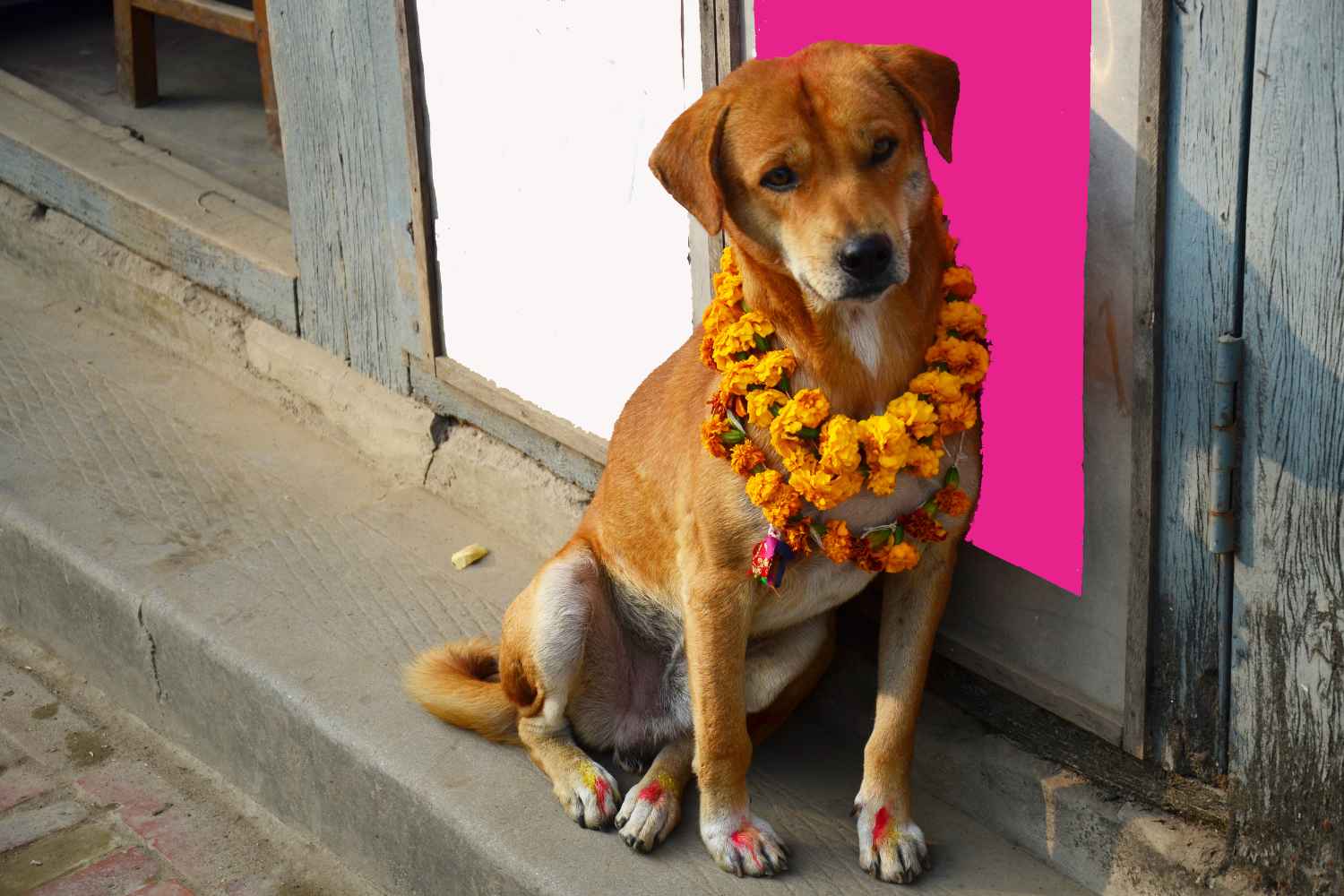
Imagine walking through the streets of Kathmandu and meeting a stray dog with a garland of flowers around its neck and a red mark on its forehead. It’s not a fairytale scene: it’s Kukur Tihar, the day Nepal pays homage to man’s best friend. Every year in autumn, millions of people – particularly Hindus, Buddhists, Jains and Sikhs – celebrate the festival of Diwali, also known as the “festival of lights”. The anniversary, dedicated to the victory of good over evil, is a precious opportunity not only to feel closer to family and friends but also, as happens in Nepal, to thank dogs for their loyalty.
We often tell of animals that are mistreated, abandoned or victims of abuse: fortunately, however, there are also different stories, which speak of respect and friendship and which have the power to reconcile us a little with the world. As happens with this very particular Nepalese tradition, which is part of the Diwali celebrations.
The celebrations, which include a variety of different rituals, including the decoration of houses with lamps and Rangoli and the exchange of gifts, usually last for five days. In Nepal, where the holiday is called Tiharthe second of these days is dedicated to dogs, to celebrate the friendship and loyalty that bind them to human beings.
View this post on Instagram
Kukur Tihar
On this very special occasion, said Kukur Tihar or Khicha Puja (“dog worship”), all dogs, including strays, are treated as people of great respect, like kings and queens. In recent years, images of the party have gone viral on social media, helping to make the world aware of a ritual that invites us to look at dogs with more gratitude and respect.
In Nepalese tradition, dogs are sacred creatures, messengers of Yama, the god of Death, and guardians of the doors to the realm of the dead. On the day of Kukur Tihar they are adorned with garlands as a mark of respect and are allowed to enjoy succulent food, prepared for the occasion. A is drawn on their foreheads tilaka of honor, a vertical red line, and their head is sprinkled with red dust, a symbol of sacredness.
In Nepal, dogs are not the only animals considered sacred and celebrated during the Diwali or Tihar celebrations: the first of the five days is dedicated to crows, messengers of good or bad news, while during the third, homage is paid to cows, a symbol of prosperity.
The dog that accompanied a king to the gates of paradise
The link between dogs and Hindu spirituality also has its roots in an ancient legend told in the Mahabharata, one of the most important epic poems of India. It is said that King Yudhishthira, having arrived at the gates of paradise after a long journey, refused to enter because he had been asked to abandon the dog that had faithfully accompanied him. He preferred to give up his own salvation rather than betray his companion. Only then did the animal reveal its true identity: it was the god Dharma, who had taken the form of a dog to test the king’s righteousness. An ancient story that contains a message that is still relevant today: loyalty and respect should have no species boundaries.
A celebration with a strong symbolic value, which today dialogues with a very current theme: the well-being of street dogs. If tradition reminds us to recognize the value of every animal, local and international associations underline that, alongside the celebration, sterilization, vaccinations and responsible adoptions remain fundamental. Because respect, to truly be such, lasts the whole year and not just one day
