
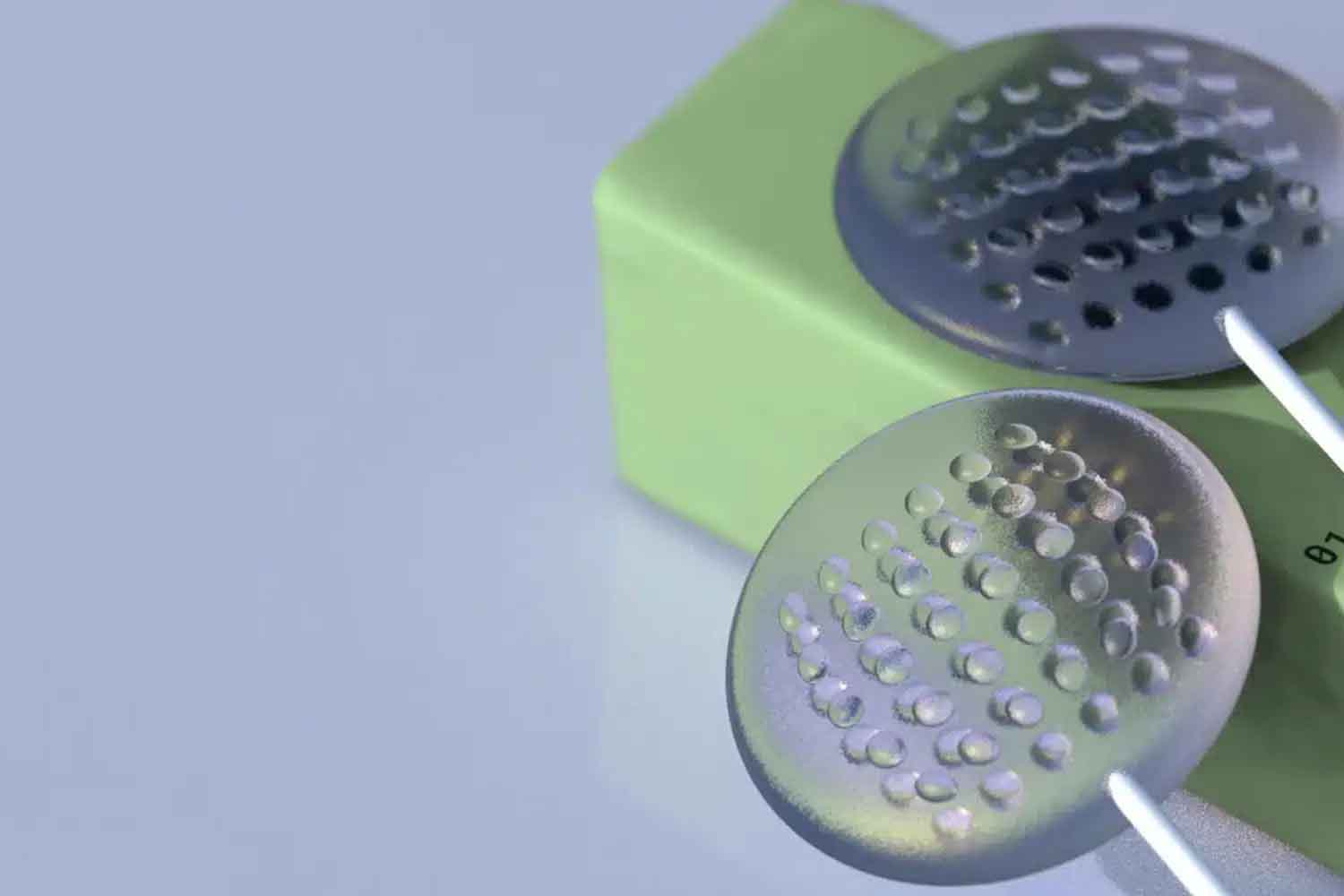
To find out if she is pregnant, a blind woman may be forced to ask someone else to read the test result. Two colored lines, an extremely private matter and the need to involve a second person. Sneha Rao, a student at Carnegie Mellon University in Pittsburgh, in the United States, thought of solving the problem with a rather unusual object: a kind of lollipop that should recognize the pregnancy hormone through saliva and communicate the result directly to the tongue.
Is called Tact and is a salivary pregnancy test project designed for blind and visually impaired women. The device should change its surface in the presence of the hCG hormone, creating small reliefs that can be felt with the tongue. The idea is interesting, even if for the moment we are still far from a product that can be purchased in a pharmacy: the student has experimented with tactile surfaces, while the mechanism necessary to detect a pregnancy has yet to be developed and verified.
Two dashes and one person too many
The idea was born from the experience of Joanne Hewitson, a blind woman who in 2024 said publicly that she depended on her sister to read a pregnancy test. A story that struck Rao, 27 years old, studying for a master’s degree in design at Carnegie Mellon University.
As the American university itself says, the problem concerns something more than the simple difficulty of interpreting a result. A pregnancy can be desired, unexpected or occur in a difficult personal situation. Having to immediately share the news with someone else means losing the ability to choose when and who to talk about it with.
Traditional tests, moreover, almost always require sight: one or two lines, a symbol or writing on a display. There are technological tools that can help interpret them, but they still require an additional device and, in some cases, the use of applications. Rao chose a different path: completely eliminate the need to look at the resultwithout relying on a smartphone or external reader.
How the tongue-reading pregnancy test works
Tact resembles a small, flat candy made from a gelatinous food-grade matrix. A DNA aptamer should be integrated inside it, a molecule designed to recognize a specific substance, in this case human chorionic gonadotropin, known as hCG. It is the same hormone that common pregnancy tests look for.
According to the project presented at the 2026 James Dyson Award, saliva should pass through the gelatinous matrix and, in the presence of hCG, activate a system capable of causing some areas of the surface to swell. The reliefs would thus become recognizable by passing the tongue over the disc. The code imagined by the student is simple: if both faces have reliefs, the result is positive. If the bumps only appear on one face, it is negative. A completely smooth surface would indicate an invalid test.
The device is also designed to be consumed or biodegrade after use, avoiding leaving an object that could reveal to other people that the test has been performed. An important detail especially for those who live in shared environments or in situations in which confidentiality can become a security issue.
The tongue recognizes the reliefs, the hormone still doesn’t
To find the most suitable texture, Rao made seven 3D printed samples, experimenting with different arrangements, densities and heights of the bumps, ranging from 1.2 to 1.6 millimeters. He then reproduced the surfaces in gelatin, verifying through informal tests with his supervisor and other people that the differences were perceptible with the tongue. This part of the project has already given encouraging results. Once a recognizable surface has been identified, however, a slightly more challenging problem remains: make the bumps actually appear in response to the pregnancy hormone.
The aptamer still needs to be integrated into the gelatinous matrix and the swelling system will need to be verified in the laboratory. There is therefore a lack of data necessary to establish whether Tact can actually detect a pregnancy, with what precision and from what moment.
The designer also plans accessibility tests with blind and visually impaired people, to evaluate the complete device, the packaging, the instructions in Braille and any audio supports. For now, therefore, Tact is a design prototype, not a validated diagnostic test.
Salivary pregnancy tests already exist
The use of saliva, however, is not an absolute novelty. The Israeli company Salignostics has already developed Salistick, a salivary pregnancy test marketed in several countries, including the United Kingdom. This device also searches for hCG, avoiding urine collection. The result, however, is shown through the traditional colored lines and therefore requires visual reading.
The peculiarity of Tact lies precisely in the attempt to make the entire procedure accessible, from collecting the sample to reading the result, without having to resort to the help of other people. Before arriving on the market, naturally, laboratory tests, studies on diagnostic reliability, checks on the safety of materials and any authorizations required for medical devices will be needed. At the moment there is no marketing date.
Rao demonstrated that a tongue can distinguish surfaces designed to communicate the result. It has yet to prove that those same surfaces can detect pregnancy. For the women for whom Tact is intended, it would above all be the possibility of knowing personal news without having to tell it to someone else first.
