
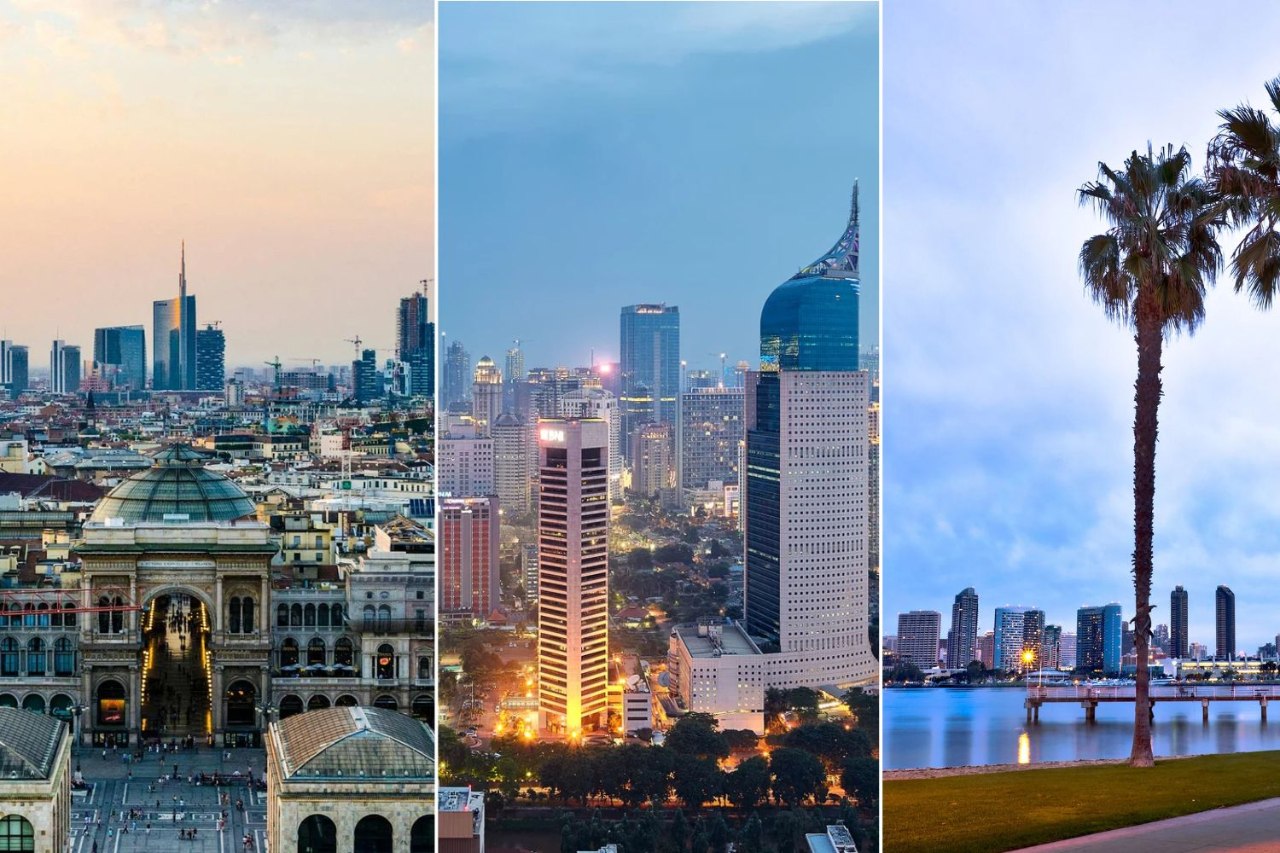
There are those who plant trees to make the streets less hot, those who try to recover every drop of water and those who even go so far as to build a new capital to relieve the pressure on a metropolis that is slowly sinking.
The climate crisis is already changing the face of our territories. And as governments discuss how to reduce global emissions at COP31 in Antalya, there is another increasingly pressing question: how can we continue to live in cities in a world that is getting hotter? An in-depth analysis of three possible answers explains LiveSciencepublished in 2024 and rescheduled for the 2026 climate conference.
The protagonists are the cities of Milan, Jakarta and San Diego. Three very distant realities, united by the need to adapt to climatic conditions that the existing infrastructures were not designed to face. And their experiences also tell something less reassuring: there is no solution capable, alone, of making a city safe.
Milan tries to defend itself with 3 million trees
In Milan the problem is not just the summer heat, but the way in which the city retains it. Asphalt, concrete, buildings and impervious surfaces absorb the sun’s energy and slowly release it, making urban areas noticeably warmer than the surrounding countryside. It is the phenomenon of urban heat islands, which can aggravate the effects of heat waves, especially for the elderly, children and people with chronic pathologies.
The Milanese response is called Forestami, the project born from research by the Polytechnic University of Milan with an ambitious objective: to plant 3 million trees by 2030 in the metropolitan area, contributing to increasing tree cover and recovering urban spaces currently dominated by artificial surfaces.
View this post on Instagram
We talk about it here: Forestami, double recognition for the project that is redesigning the green future of Milan
Trees don’t just make the landscape more pleasant. Their foliage creates shade, the transpiration of the leaves contributes to cooling and the permeable soils can favor the absorption of rainwater, reducing surface runoff. How much can they really do? A study published in 2023 on The Lancetwhich analyzed 93 European cities, estimated that increasing tree cover to 30% could lower urban temperatures by an average of 0.4°C and avoid approximately 2,644 premature deaths in a summer, compared to the scenario analyzed.
The Milanese project has also received international recognition: at the end of October 2026 the United Nations included Forestami among the World Restoration Flagships, the initiatives considered reference for the restoration of ecosystems. It was the only European project awarded in the 2026 edition.
Jakarta is sinking and the answer is to build a new capital
The Indonesian metropolis is crossed by thirteen rivers and is exposed to floods that are increasingly difficult to manage. The rise in sea levels and, above all, the sinking of the land, caused largely by the excessive extraction of water from underground aquifers, contribute to making the situation worse.
In some areas of the city the ground has subsided at a rate of ten centimeters per year. A phenomenon that makes coastal areas even more vulnerable to storm surges and floods.
The government has tried to respond through embankments, coastal protection interventions and projects to improve water resource management. But the most radical decision was another: to build a new capital over a thousand kilometers away.
It is called Nusantara and is located in eastern Borneo. The project, announced in 2019 and launched in 2022, aims to progressively transfer administrative and political functions out of Jakarta. A new city designed with walkable neighborhoods, public transportation, modern infrastructure and expansive green areas.
But the transfer is not yet complete. In May 2026, the Indonesian Constitutional Court clarified that Jakarta formally retains the role of capital until the presidential decree ordering its transfer is issued. The government’s stated goal is to make Nusantara fully operational as a political center by 2028.
Then there are the environmental issues. Building a city in Borneo means intervening in an ecologically delicate area, with the risk of compromising ecosystems and biodiversity if the works are not managed adequately. And, furthermore, moving ministries and government offices will not make the problems of millions of people who will continue to live in Jakarta disappear. To stop the sinking, it will be essential to reduce the withdrawal of underground water, strengthen aqueducts and improve existing infrastructure.
San Diego and wastewater
In San Diego, California, the problem is almost the opposite: not the water that invades the streets, but that which risks running out. The city is located in a region characterized by relatively little rainfall and also depends on water resources from distant territories. With rising temperatures and the risk of drought, ensuring a stable supply becomes increasingly complicated.
For decades, San Diego has been investing in reducing consumption, improving infrastructure efficiency and diversifying sources. But one of the most interesting projects involves something we normally consider waste: wastewater.
The Pure Water San Diego program aims to recover already used water, subject it to advanced purification treatments and transform it into a new resource for drinking water supply.
The goal is not simply to reuse water to irrigate parks or gardens. Through advanced purification processes, the treated water can be introduced into the city supply system, after further checks and steps envisaged by the project. The first phase involves a treatment capacity of approximately 30 million gallons per day, equivalent to over 113 million liters.
The project, however, is not yet fully operational. In 2026, the city reported delays in the construction and testing of some infrastructure, while the overall program aims to locally cover almost half of the city’s water needs by 2035.
This is an important investment, as well as not being a solution automatically suitable for every territory. But it shows how much water management can change when the water used stops being considered just waste and becomes a resource to be recovered.
But can we really adapt to the climate crisis?
Three cities, three different problems and three answers that tell us about as many ways of rethinking the relationship between the environment and urban infrastructures. The lesson that comes from Milan, Jakarta and San Diego is precisely this: the future of cities will not only depend on their ability to adapt to the climate crisis, but also on our ability to prevent it from getting worse.
