
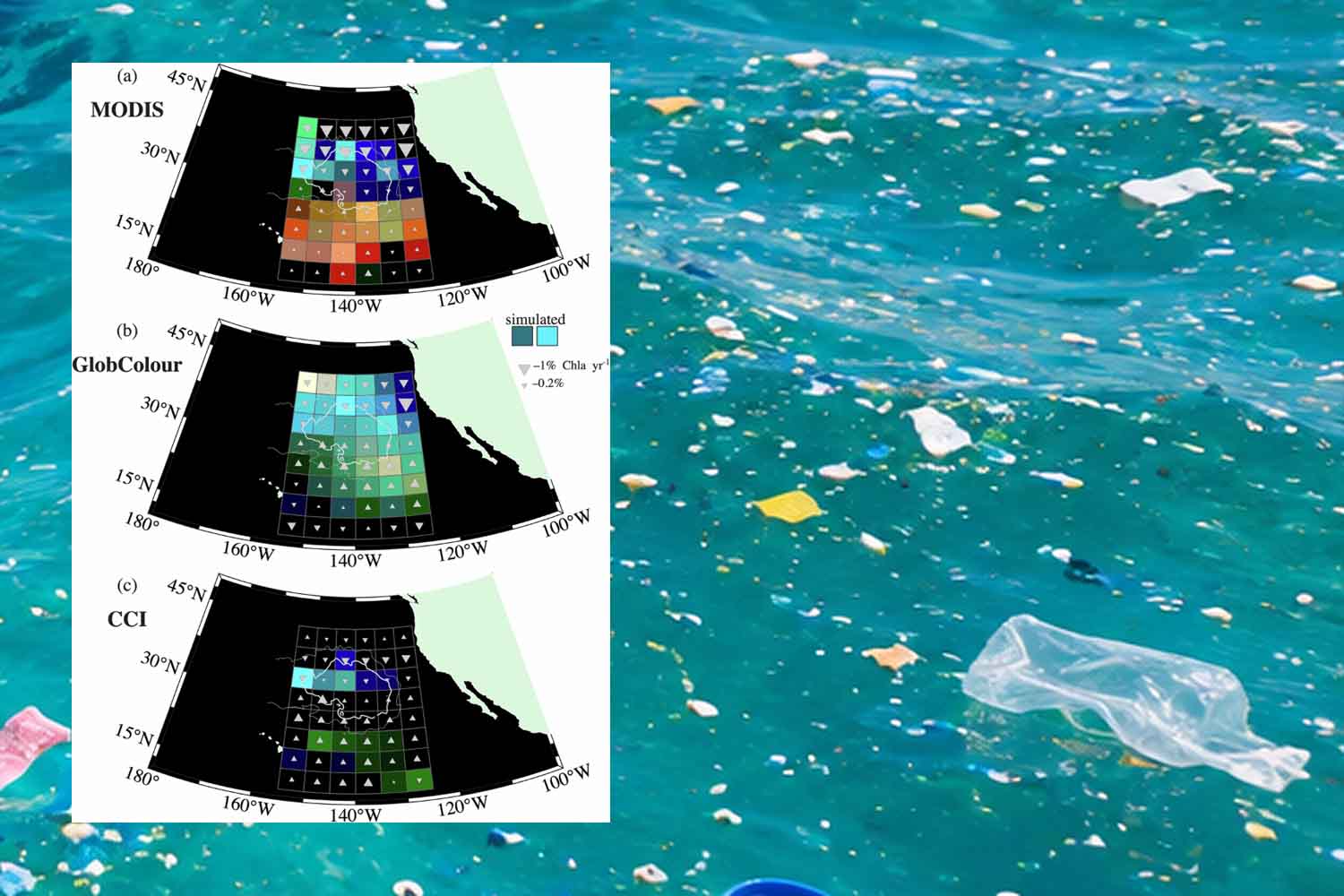
A part of the Pacific Ocean, between California and Hawaii, is becoming increasingly cyan, that shade halfway between blue and green. The change was recorded by satellites, which over the course of twenty years detected an increase in blue and green light reflected by water. The affected area coincides with that of the Great Pacific Garbage Patch, the enormous area in which ocean currents accumulate tons of plastic waste. And among the possible causes of this change are microplastics.
This is suggested by a study published in Communications Earth & Environment by researchers at the University of Bergen, Norway. By analyzing three sets of satellite data collected between 2002 and 2022, the researchers identified a change in the optical characteristics of the water compatible with the accumulation of tiny plastic particles. Small enough to escape normal observation, yet potentially enough to change the way the ocean reflects light.
The giant Pacific blob of plastic is leaving another trace
The Great Pacific Garbage Patch, also known as the Pacific Trash Vortex, is often called the “plastic island.” An evocative name that risks making us imagine a compact expanse of bottles, bags and waste on which, if we wanted, we could even walk. The situation is quite different. The waste is distributed over a huge surface, dragged and concentrated by the currents of the North Pacific. Some float, others remain suspended in the water, and many are so small that they are invisible to the naked eye.
The dimensions give an idea of the problem. According to research published in Scientific Reportsthe accumulation area occupied approximately 1.6 million square kilometers, almost three times the size of France, and contained an estimated quantity of 79,000 tons of plastic. Most of the weight was made up of larger waste, especially nets and fishing equipment. Microplastics represented just 8% of the total mass, but made up 94% of the estimated 1.8 trillion fragments.
And we are only talking about the particles that the researchers were able to sample, starting from half a millimeter in size. Those even smaller were essentially left out of the count. It is precisely the latter that attracted the attention of the Norwegian group: fragments smaller than 300 micrometres, less than a third of a millimetre, capable of remaining suspended in water and interacting with sunlight.
5 milligrams of microplastics are enough to modify the light reflected by the water
The color of the ocean depends on several factors. Water absorbs some wavelengths of light and scatters others, while phytoplankton, sediments and dissolved substances contribute to changing its appearance. Plastic can also intervene in this process. The smaller particles scatter light differently than many natural materials and can increase the amount of radiation that returns to the surface, eventually reaching satellite sensors.
Researchers Shea Cheatham, Daniel Koestner and Børge Hamre compared three archives of satellite observations covering the North Pacific. All showed, in some areas near the Great Pacific Garbage Patch, a significant increase in reflected light in the blue and green bands.
@AI generated – ©Communications Earth & Environment
The combination produces a variation towards cyan, a shade that in scientific studies appears more marked than that of the surrounding waters. These are variations measured by the instruments, of course, and not a giant turquoise spot visible to the naked eye. To understand how much plastic could have an impact, the group reconstructed the behavior of light in water through mathematical models, introducing different concentrations of microplastics.
The result is surprising: around 5 milligrams of microplastics per cubic meter of water may be sufficient, in simulated conditions, to produce an increase in brightness detectable by satellite sensors. Five milligrams distributed in a thousand liters of water. A tiny amount, at least on paper, which could already be enough to leave a recognizable signal from space.
Simulations indicate that microplastics can explain the change
Of course, the color of the ocean can vary even without the intervention of plastic. Phytoplankton changes distribution and composition, organic materials move and environmental conditions continually influence the light reflected by the water. To distinguish these effects, scholars have developed over 50,000 scenarios of increased marine brightness, modifying the concentrations of substances present in the water. When only natural components were considered, just 3% of the simulations produced a shift toward cyan. By also including microplastics, the percentage rose to 13%. Over four times as much.
According to the authors, obtaining the same result through natural variations alone would require important changes in the composition of phytoplankton, generally accompanied by a decrease in biomass and dissolved organic substances. The presence of microplastics therefore represents a plausible explanation for the observed phenomenon.
To definitively attribute the change to plastic, direct measurements in the affected area will still be needed, also because the three satellite series differ in the intensity of the variations recorded. But the results already indicate a possible way to identify pollution that, until now, has been particularly difficult to monitor.
We may be able to spot microplastics from space, but collecting them will be much more difficult
If confirmed, the discovery could offer a new tool for studying ocean pollution. Currently, identifying the smallest microplastics requires sampling at sea, laboratory analyzes and specific tools. A complex job, especially when you have to examine surfaces millions of square kilometers in size.
Satellites, on the other hand, can continuously observe very large portions of the ocean. Recognizing a particular variation in the light reflected by the water could help scientists identify the areas where the smallest particles accumulate, also following their movements over time. However, there is a huge difference between being able to identify microplastics and being able to eliminate them.
Technologies developed to clean up the Great Pacific Garbage Patch can intercept fishing nets, containers and other floating debris. With particles a fraction of a millimeter in size, dispersed throughout the water column and mixed with marine organisms, the task becomes much more complicated. The researchers themselves point out that removing microplastics smaller than 300 micrometers on a large scale would be extremely difficult, if not impossible.
Further complicating matters is the continued deterioration of larger waste. Waves, sunlight and mechanical wear progressively fragment plastic objects, producing increasingly smaller particles that can remain in the marine environment and enter the food chain. And so, as we seek ever more sophisticated ways to collect plastic from the oceans, the hardest-to-recover portion may have already begun to leave a trace recognizable from space.
