
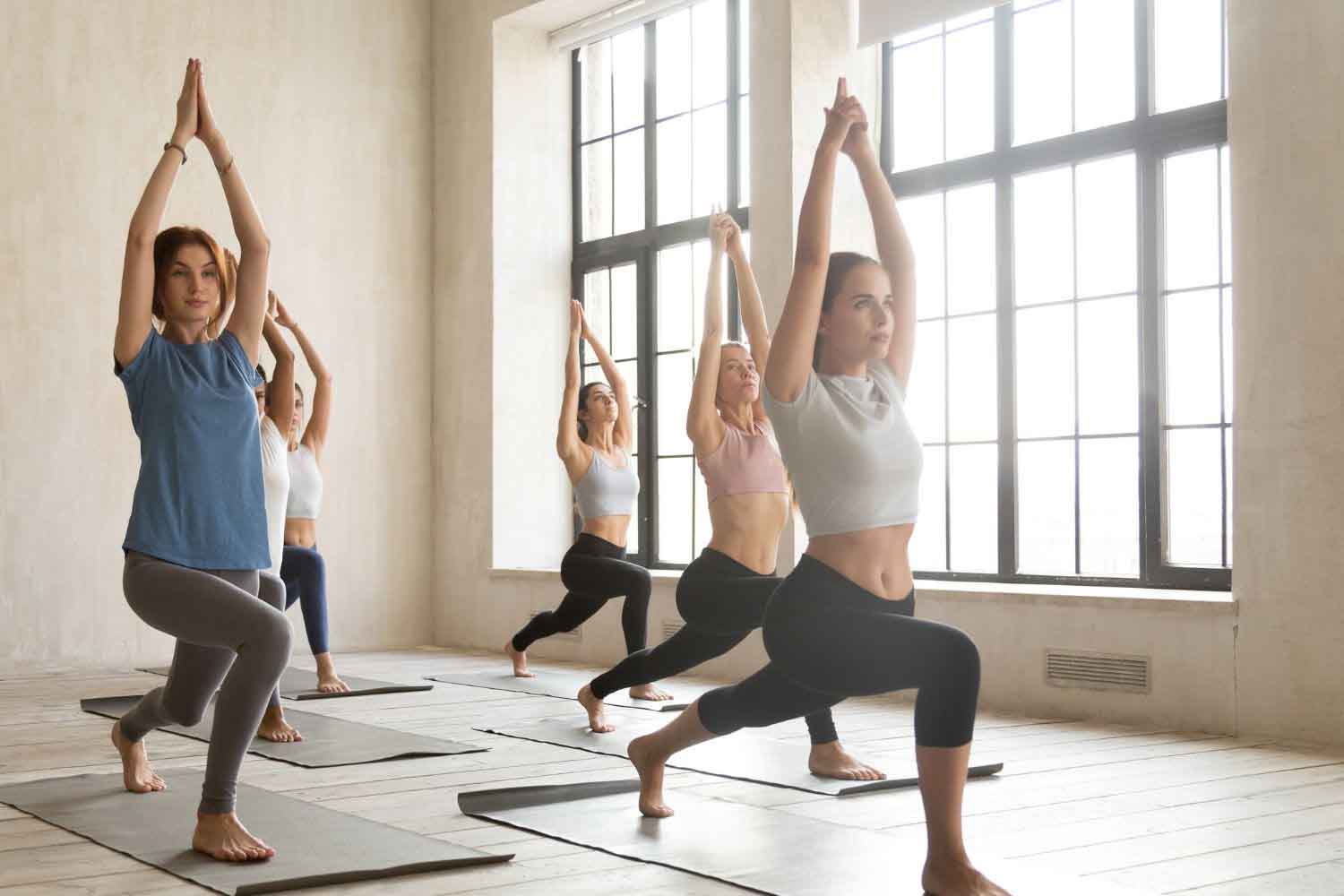
After a day spent in front of the computer, it can be enough to get up from the chair to feel stiff hips and a sore lower back. Hours in the same position, little movement and muscles that seem to have forgotten how to stretch. To regain some mobility, a yoga position may be useful which, despite its rather combative name, requires above all balance and control: Warrior I.
Also known as Virabhadrasana Iis one of the most recognizable exercises in yoga. One leg bent forward, the other stretched backwards, torso erect and arms raised towards the ceiling. It seems easy, at least until you try to hold it for a few breaths.
This position allows you to stretch the front of the hips, activate the leg muscles and work on the stability of the pelvis. It can also help relieve some sensations of stiffness that affect the lumbar area, especially when they are linked to poor mobility and a particularly sedentary lifestyle.
Because Warrior I helps to stretch the hips
When we are sitting, the hips remain flexed for a long time, that is, with the thighs bent in relation to the torso. A completely natural position, of course, but maintaining it for hours without changing posture can promote the feeling of stiffness. Warrior I proposes a different movement. By bringing one leg back and keeping the torso upright, the rear hip is accompanied into extension, favoring the lengthening of the muscles located in its front part. Among these is the iliopsoas, an important muscle group that connects the lower back and pelvis to the femur, contributing to hip movements and body stability.
Meanwhile, the front leg works to support the weight, engaging the quadriceps and glutes. Ankles and calves also participate in the exercise, while the abdominal and back muscles help maintain the position. In short, what seems like a simple stretch involves several muscles at the same time.
What about the lower back?
Hips and lower back work together in many daily movements. When we bend, walk or stand up from a chair, the mobility of the hips helps distribute the movement between the pelvis and spine. Working on their flexibility can therefore also be useful for reducing some tension felt in the lower back.
In Warrior I, however, it is important to keep the torso elongated and the pelvis stable. If we end up arching our back excessively to lift our arms, we risk concentrating tension that we wanted to relieve in the lumbar area. Breathing also contributes to the exercise. Inhaling and exhaling slowly helps maintain control of the position, avoiding unnecessarily contracting the shoulders and abdomen.
The benefits of yoga on the back have also been examined by scientific research. A Cochrane review of 21 studies and 2,223 participants found small improvements in pain and function in people with chronic nonspecific low back pain who practiced yoga compared to those who did not exercise.
How to do Warrior I without tiring your back
To try this position, all you need is a mat and some free space. You don’t need any special equipment and, above all, you don’t need to already be flexible. Start standing, with your back straight and your arms relaxed at your sides. Step your right foot forward and your left foot back, maintaining enough distance to feel stable. You can keep your feet slightly separated even laterally, as if they were on two tracks.
Rotate your back foot slightly outward, forming about a 45-degree angle, and place your heel on the floor. Then, slowly bend your front knee, keeping it pointed in the same direction as your toes. The back leg remains extended and the weight is distributed between both feet.
Try to orient your pelvis forward, without forcing a rotation that your hips cannot comfortably support. Inhaling, raise your arms above your head, palms facing each other. Keep your shoulders relaxed and lengthen your torso upwards, avoiding pushing your belly forward and accentuating your lumbar curve.
Remain in the position for five to ten slow breaths, then gradually return to standing and repeat on the other side. During the exercise you should feel a stretch in the front of the back hip, accompanied by muscle work in the legs. No need to descend as much as possible with the pelvis: the depth of the position comes after stability.
@Canva
Three tips to make the position easier
Warrior I can especially test those with little mobility in the hips or ankles. Fortunately, there are some modifications that allow you to adapt it to your possibilities. The first concerns the distance between the feet. Shortening your stride generally makes it easier to maintain balance and reduces the mobility demands on your hips. If your back heel is struggling to stay on the ground, you can lift it and adopt a variation of the lunge. In this way the movement is often more accessible, especially for those who feel tension in their ankles.
Finally, your arms can remain at your sides rather than being raised. It is a useful trick when your shoulders are stiff or when placing your hands above your head causes you to arch your back. For those who have balance difficulties, leaning on a stable chair can also help.
Another rule concerns pain. Stretching the muscles may feel tight, but should not be painful. If pain appears in the hips, knees or back, it is best to stop the movement. Anyone suffering from joint problems or persistent low back pain should discuss the most suitable exercises with a healthcare professional.
How often to practice it to feel the benefits?
Warrior I can be included in a short daily routine, perhaps after a day spent at the desk or together with other exercises dedicated to mobility. There is no need to remain still for several minutes. At first, a few breaths per side may be enough, gradually increasing the holding time as the position becomes more comfortable. The National Center for Complementary and Integrative Health, an institute of the US National Institutes of Health, also recognizes yoga as having possible benefits for physical well-being, balance and some painful disorders, including low back pain.
Regular practice can help you become familiar with movements that you don’t use much during the day. Because, between a desk, a car and the sofa, it happens that we spend many hours with our hips in the same position. The Warrior I offers an opportunity to move them differently, lengthen the legs and find some stability. Without expecting the pelvis to become flexible overnight and, above all, without asking the lower back to work overtime.
