
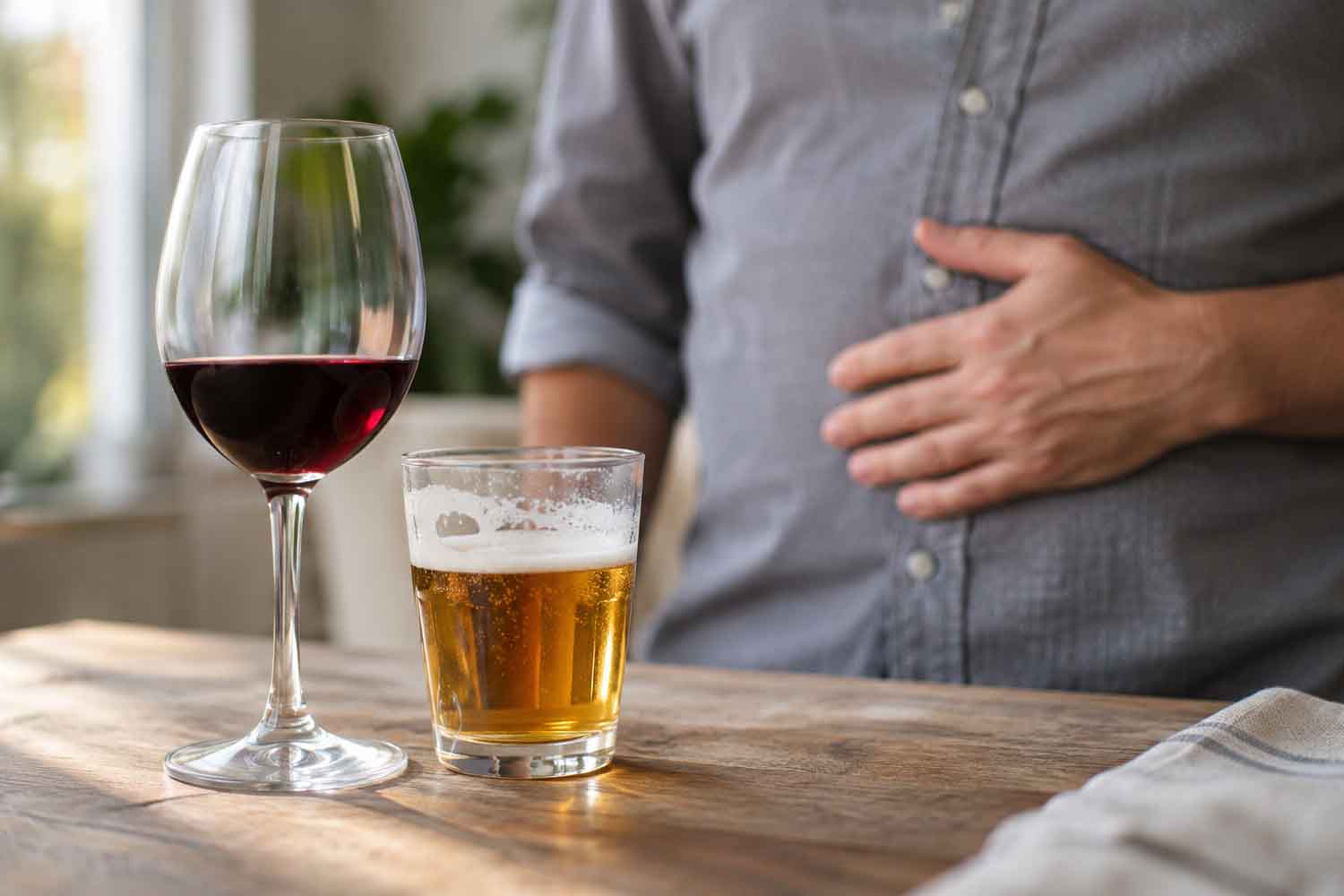
Two people can have the same weight, maybe even the same waist circumference, yet accumulate fat in very different places on the body. One especially under the skin, the other deeper, around the internal organs. A difference that the scale does not register and which could also have to do with how much alcohol we drink.
This is suggested by a study by the University of Oxford published inInternational Journal of Obesitywhich analyzed 5,761 adults between 25 and 75 years old. The researchers observed that those who consumed more alcohol also tended to have a higher proportion of visceral fat, which accumulates around the organs and is associated with a higher risk of type 2 diabetes and cardiovascular disease.
Among men with the highest consumption, the share was 10.7% higher than in the immediately preceding group; among women the difference reached 17.1%. In short, the famous “beer belly” does not necessarily tell everything that happens in the abdomen. And to notice it, this time, the researchers needed something more precise than a tape measure.
More alcohol, more visceral fat: what researchers found
To study the phenomenon, the researchers used data from the Oxford Biobank, a project that collects information on the health and body composition of the population. Of the 5,761 participants, 810 said they did not drink alcohol. The other 4,951 were divided into four groups, separately for men and women, based on the amount of alcohol they usually consumed each week. To measure body fat, the researchers used DXA, a low-dose X-ray scan that also allows them to estimate the amount of visceral fat. A more precise system than the tape measure, which can tell us how much the waist measures, but not how much fat is actually around the organs.
The results showed an association between higher alcohol consumption and a higher proportion of visceral fat, even after taking into account other factors such as age, smoking, physical activity, height, socioeconomic conditions and overall amount of body fat. The most marked difference was among participants who drank more. Among the men in this group, visceral fat accounted for about 5 percent of total body fat, versus 4.5 percent in the immediately preceding group. Among women the percentages were 1.62% and 1.39% respectively. Apparently modest differences, which in relative terms corresponded to approximately 10.7% more in men and 17.1% in women. And they involved a type of fat that is particularly important for metabolic health.
How much alcohol did people with more visceral fat drink?
In the group with the highest consumption, men declared a median of 24 British units of alcohol per week, while women declared 14. Pay attention, however, to the units of measurement: the British ones are different from ours. In the United Kingdom, one unit corresponds to 8 grams of pure alcohol, while in Italy, according to the Istituto Superiore di Sanità, it contains 12. We are talking, approximately, about a 125 milliliter glass of wine, a 330 milliliter can of beer or a small glass of spirits.
The median consumption observed in the two British groups therefore corresponded to approximately 16 Italian alcohol units per week for men and just over 9 for women. These numbers describe the habits of the participants, without identifying a precise quantity beyond which fat automatically begins to accumulate around the organs. Furthermore, the study is observational: it photographs the situation at a specific moment, without following changes in habits and body composition over time. Alcohol consumption was self-reported and detailed information on nutrition was missing. The researchers therefore identified a statistical association, without being able to prove that alcohol directly caused those differences.
Why might alcohol promote abdominal fat?
One possible explanation concerns metabolism. When we drink alcohol, the body has to deal with disposing of it and during this process the way it uses its energy reserves temporarily changes. Fat oxidation, for example, can slow down. The researchers also hypothesize that ethanol and some substances produced during its metabolism may influence the mechanisms that regulate the accumulation of adipose tissue. How much these processes contribute to the distribution of visceral fat has yet to be clarified.
Then there is a decidedly more immediate question: alcohol provides around 7 kilocalories per gram, almost double compared to carbohydrates and proteins. A glass of wine, beer or cocktail adds calories to your day. And they often arrive accompanied by chips, appetizers, generous aperitifs or sugary drinks. There is no need to organize a banquet to accumulate a significant energy surplus. Separating the direct metabolic effects of alcohol from those of additional calories, however, remains tricky.
Can visceral fat be reduced?
Visceral fat may decrease. And to achieve this you don’t necessarily need to see big changes on the scale. A systematic review published in Obesity Reviews examined 84 randomized clinical trials, involving a total of 4,836 people with overweight or obesity. The analysis found that aerobic activity, strength training, the combination of the two and high-intensity interval exercises can contribute to the reduction of visceral fat, with benefits that vary based on the type of activity and individual characteristics. Reducing alcohol consumption is also a useful choice to limit various health risks, although further research is needed to establish how much this reduction directly affects the distribution of abdominal fat.
The Oxford research adds an interesting element: the total amount of body fat does not necessarily tell you where that fat is distributed. The researchers observed that waist circumference was less sensitive than DXA scans in detecting differences associated with alcohol consumption, especially in women. Two people can step on the scale and read very similar numbers. To see what’s happening in more depth, the researchers needed a scan.
