
The 2027 America’s Cup was supposed to represent a great opportunity for Naples and, above all, to accelerate the reclamation of Bagnoli, which has been waiting for decades for a definitive recovery. But what is really happening on construction sites? Are the works to accommodate the boats really contributing to the reclamation or do they mainly respond to the needs of the competition?
These are the questions at the center of Report’s new investigation, which will be broadcast tonight 15 November on Rai 3, of which the program has released previews on social media.
In the videos, the journalist Luca Chianca documents the dredging operations and the construction of the new infrastructures, asking the mayor of Naples and extraordinary commissioner for Bagnoli to explain the methods of intervention, Gaetano Manfredi.
What the previews of Report show
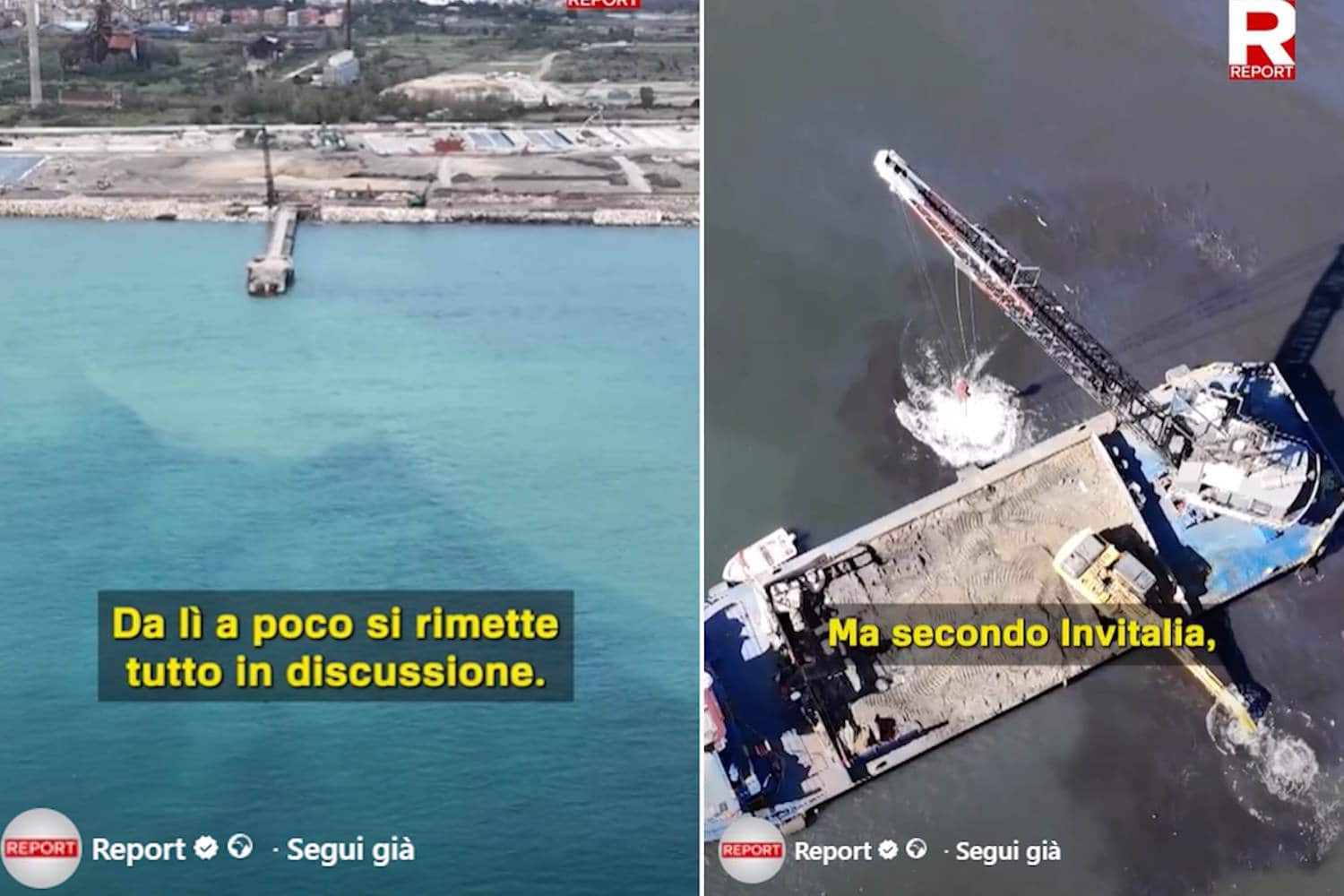
The dredging, which began during the summer, serves to lower the seabed to allow the mooring of the America’s Cup boats. The problem is that those seabeds preserve the legacy of decades of steelmaking activity: contaminated sediments which, if handled without adequate precautions, risk being dispersed into the marine environment.
In the first preview, Manfredi assures that the works are carried out with buckets equipped with systems to retain the dredged material and with containment barriers. But the images shown by Report raise doubts about the use of equipment different from that envisaged in the executive project. In some shots, according to the reconstruction of the program, we would see a large metal tip used to break the seabed and an excavator that directly moves the sediments into the water, causing a visible dispersion.
The mayor rejects the objections, maintaining that the dredging complies with what was expected and that the implementing body has communicated the operations to the control bodies. However, it remains to be verified whether the techniques used comply with the requirements and what the results of the environmental monitoring are: the visible dispersion of the sediments, alone, would not demonstrate that the contamination limits have been exceeded.
The investigation also focuses on the tanks in which the dredged material is deposited. Some are uncovered and, according to a technician interviewed anonymously by Report, they are filled beyond their capacity. The expert warns against the risk of dispersion of dust and volatile substances. Manfredi replies that the material must remain exposed to dry before analysis and subsequent disposal.
But it is above all a response from the technician to question the relationship between the works and environmental restoration. When asked whether dredging is linked to reclamation, the expert replies:
No. It only serves to lower the seabed to allow boats to enter.
A position that contrasts with that of the commissioner structure, according to which the interventions are instead part of the broader recovery program of the area.
From the public beach to the new port: how Bagnoli is changing
The second preview of the episode focuses on the transformation of the coast and the fate of the Bagnoli fill, the large artificial surface created during the expansion of Italsider. Previous redevelopment programs envisaged its complete removal, the restoration of the coastline and the return of a public beach to citizens. A project which, over the years, has undergone substantial changes. With the decree-law of May 2024, the regulatory constraint on restoring the natural morphology of the coast was eliminated, paving the way for the partial removal of the fill and the safety of the remaining part.
The images shown by Report compare the old renderings with the current construction sites, where docks, hangars and structures for boats are being built. Officially we talk about a “basin of calm”, but Grant DaltonCEO of America’s Cup Event, defined this in an interview with the Republic the «new port of Bagnoli». And the former president of the Campania Region Vincenzo De Luca also appears in the preview, who when asked if it is a basin of calm replies:
It’s a port.
To be precise, a “calm basin” is defined – that is, a body of water protected from the waves by breakwater cliffs, with dredged seabeds and piers for mooring boats – an infrastructure which, from a functional point of view, presents port characteristics, even if this definition does not automatically determine its administrative classification.
It is precisely on this distinction that one of the previews of Report’s investigation focuses. Beyond the definitions, the issue concerns the future destination of the works: which will be truly temporary and which will remain after the competition?
These are questions on which the full episode of Report promises to shed light. The America’s Cup may represent an opportunity to accelerate the recovery of Bagnoli, but the cleanup of a contaminated area cannot be measured only by the speed with which the infrastructure necessary for a sporting event is completed.
In short, when the America’s Cup boats have left Naples, which coast will really be returned to the citizens?
