
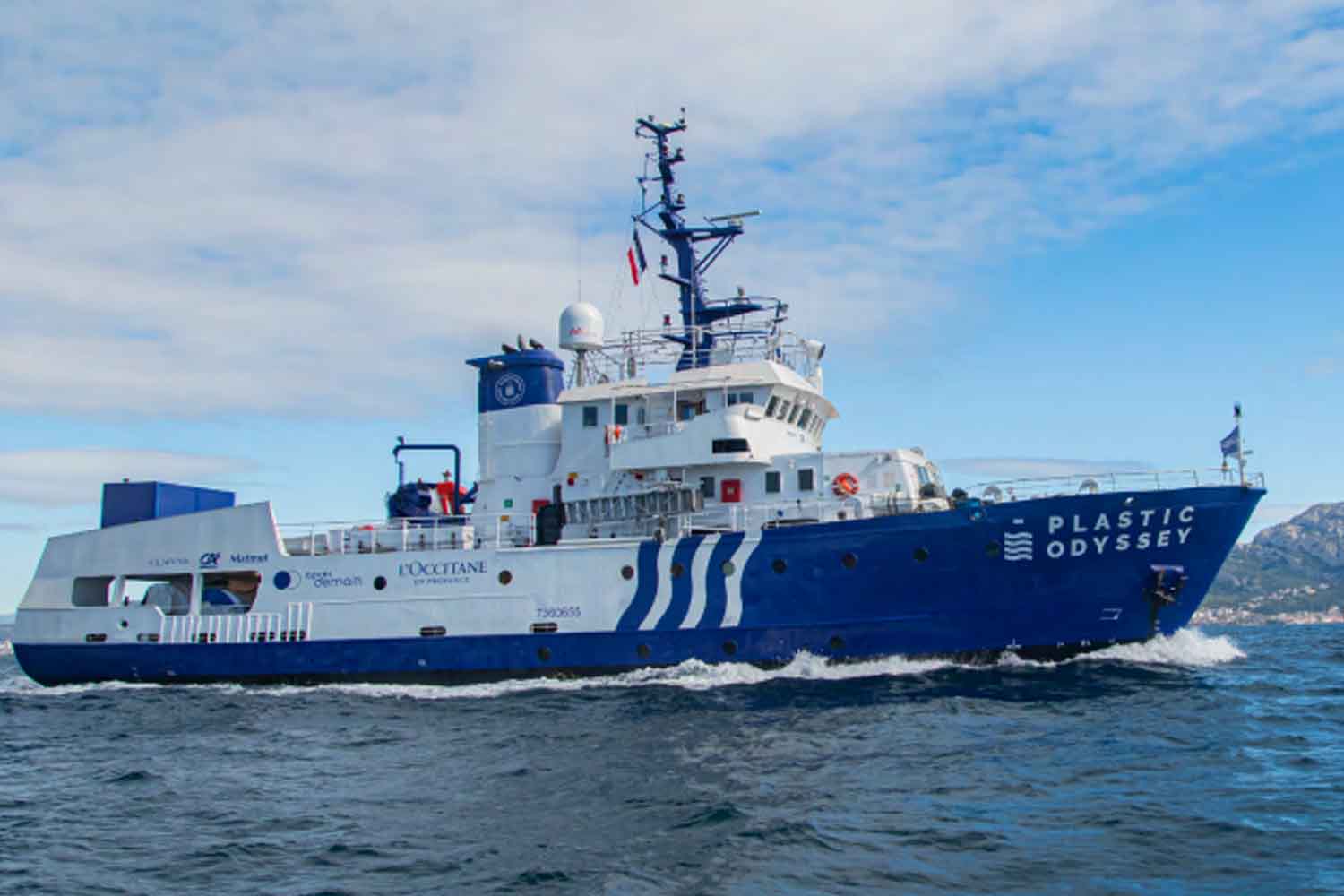
In Saint-Malo, between light stone, tourist docks and the Atlantic wind, there is a ship that seems to have arrived from another travel idea. It’s called Plastic Odyssey, it measures 40 metres, it’s a former oceanographic ship transformed into a floating laboratory and it brings with it three and a half years of navigation, stopovers, improvised workshops, meetings with communities that see plastic arriving every day on the beach, in the canals, in the markets, in the ports.
In 2026 she returned to France with a tour of nine cities, from Marseille to Saint-Malo, to open bridges, machines, work spaces and solutions collected along the way to the public. On board there is a research area, a recycling space, machines for shredding, washing, drying and extruding plastic, as well as demonstration areas dedicated to objects made from recovered material. The official presentation also talks about pyrolysis for some plastics excluded from mechanical recycling, with the production of fuel. It is a technology to be treated with caution: it requires controlled systems, energy, suitable waste and serious evaluations. In a sensible supply chain, reduction, reuse, good collection and mechanical recycling come next.
Before it becomes the sea
Plastic Odyssey starts from a simple observation. A bottle intercepted on the ground remains manageable. A bottle lost at sea becomes a more expensive, more fragmented, more difficult problem to recover. According to UNEP, every year between 19 and 23 million tonnes of plastic waste end up in aquatic ecosystems, therefore rivers, lakes and seas. Faced with numbers like this, a laboratory ship can demonstrate tools and practices. The scale remains that of a production and commercial system that has grown too quickly around disposable products.
On board you can see the less decorative side of the circular economy. Plastic must be recognized, separated, reduced to flakes, treated, melted, transformed. Each step requires skills, spare parts, market outlets. A panel made from waste makes sense if someone buys it, uses it, replaces it with a virgin material. A shredder makes sense if there is a stable collection around it. A floating laboratory makes sense if it leaves behind supply chains capable of walking even when the ship leaves.
The project has accumulated useful numbers to understand the ambition: 3 and a half years of expedition, 45 ports of call, four continents, 25 thousand nautical miles, over 200 widespread open source solutions, 415 trained entrepreneurs.
Small cars, big problems
The choice of low-tech technologies is the most concrete part of the project. Simpler, repairable, accessible machines, designed for contexts where a sophisticated industrial plant remains out of reach. In the ports visited, Plastic Odyssey looked for associations, companies, technicians and communities already dealing with waste collection, selection and transformation. This approach avoids the usual scene of the Global North arriving to explain to the rest of the world how it’s done. The work consists in documenting what exists, adapting it, making it replicable.
In Senegal, for example, experience has left the ship and become a micro-factory. In Dakar, in the Bel Air neighborhood, plastic waste is transformed into material for furniture and flooring. Reports from the site describe waste from the Mbeubeuss landfill, flaked, melted and extruded into wood-like planks. The project includes multiple plants in the country and is based on a model with entrepreneurs or local administrations.
It’s not simple: recycled plastic must compete with new materials that are often cheap, abundant, supported by already mature supply chains. Without packaging rules, producer responsibility, public and private demand for recycled material, recycling remains fragile.
Henderson says quite a lot
In 2024 Plastic Odyssey carried out a mission on Henderson Island, an uninhabited atoll in the South Pacific and a UNESCO site. The operation collected and sorted 9.3 tons of waste. UNESCO then announced a partnership with Plastic Odyssey to intervene on marine world heritage sites affected by plastic, with waste removal, data collection, education programs and the development of local supply chains.
Henderson is an uncomfortable photograph: no one shops there, no one empties bins on the seafront. Plastic arrives transported by currents. This is enough to explain the limitation of the reclamations: they are useful, in certain places they are necessary, but they arrive when the damage has already traveled for thousands of kilometres. Cleaning a remote island requires logistics, money, personnel, time, favorable weather conditions. Stopping part of the flow upstream remains much more reasonable.
The global picture leaves little room for illusions. The OECD estimates that, without stronger interventions, plastic waste could almost triple by 2060. The share of plastic waste successfully recycled would rise from 9% in 2019 to 17% in 2060, while landfill and incineration would continue to absorb a huge part of the total. Even with some improvements, the absolute amount of poorly managed plastic would remain too high.
What’s left on the dock
Plastic Odyssey shows something useful: recycling only exists when it stops being a word and becomes infrastructure. We need collection, selection, machines, training, salable objects, maintenance, present administrations. We also need a serious reduction in useless plastic, because recycling alone always comes late and always works uphill.
The ship has the value of a test bed. Bring examples, technologies, materials and stories collected in ports to the ports. It shows the plastic being treated, without turning it into a clean concept. From there a more honest discussion begins: which waste can be recycled, which should be avoided, which supply chains are viable and which cost more than they promise.
You might also be interested in:
