
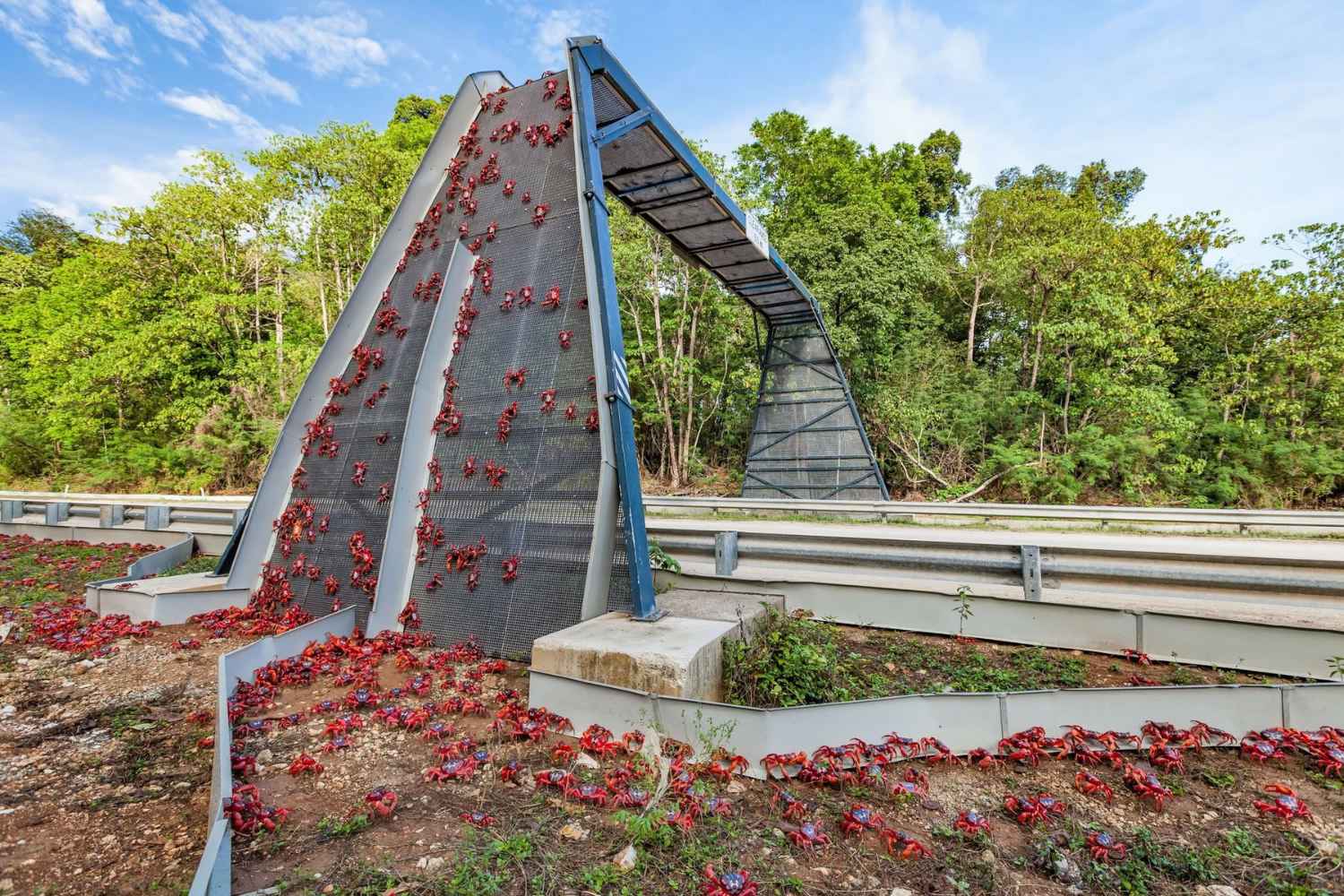
The streets disappear under an expanse of little red paws. The crabs cross the asphalt, climb the walkways built for them, advance through the leaves of the tropical forest and all continue in the same direction: the sea. On Christmas Island, an Australian territory in the Indian Ocean, the great red crab migration of 2026 has officially begun.
The images taken on November 14 and 15 show tens of millions of crustaceans engaged in one of the most spectacular mass movements in the animal world. This is not a sudden invasion, nor an anomalous behavior. It is an event that is repeated every year and which involves a huge part of the population of red crabs on the island, belonging to the Gecarcoidea natalis species. After spending much of the year sheltered in the forests, these terrestrial crustaceans abandon their burrows to reach the coast, mate and give rise to a new generation.
Why are millions of red crabs migrating right now?
The first heavy rains of the wet season, which on Christmas Island generally arrive between October and November, kick off the great exodus. Red crabs need sufficiently humid conditions to make the journey. During the dry season, in fact, they spend a lot of time hidden in burrows or in cracks in the rocks, where they can protect themselves from dehydration.
When rains soak the ground, millions of individuals begin to move almost simultaneously. The males leave first, followed by the females, crossing woods, streams, rocks and roads. But there is another surprising element: it is not enough that it rains. The migration must also respect a precise lunar calendar.
According to Parks Australia, the body responsible for managing the national park, the crabs time their journey so that the females can release their eggs into the ocean before dawn, during the high tide that begins to recede in the last quarter of the Moon. If the rains arrive early enough, the animals can proceed more calmly, stopping to feed along the way. However, if they arrive too late, some individuals may postpone their migration until the following month.
Bridges, tunnels and closed roads: on the island the right of way belongs to the crabs
The migration is as spectacular as it is delicate. For animals, reaching the coast means overcoming obstacles that once did not exist, starting with road infrastructures built by man. For this reason, long before the rains arrive, Parks Australia prepares the area for the event. The operators clear the underpasses, fix the bridges intended for crustaceans, install kilometers of barriers along the roads and place signs indicating the presence of the animals.
When the passage becomes particularly intense, some roads are closed temporarily to allow the crabs to continue without being crushed by vehicles. It is a concrete example of how infrastructure can be adapted to the needs of wildlife, rather than forcing animals to face increasingly dangerous routes. Among the most characteristic structures on the island are the so-called crab bridges, bridges designed to allow crabs to cross the roads from above.
Barriers placed at the edges of the roadways direct animals towards these safe passages or towards underpasses, reducing the risk of them ending up under the wheels of cars. Protection is essential: according to the official Christmas Island National Park guide, hundreds of thousands of crabs can die due to traffic during reproductive migrations. Bridges and temporary road closures do not completely eliminate the danger, but they represent an important measure for the conservation of a species that plays an essential role in the island’s ecosystem.
To facilitate the movement of crabs, so-called crab bridges, bridges designed to allow crabs to cross roads from above.
Each female crab can produce up to 100 thousand eggs
Once they reach the coast, the males briefly immerse themselves in the water to recover moisture, then dig burrows in areas close to the sea. Here they are joined by the females and mating takes place. The males then begin the journey back to the forest, while the females remain in their dens to allow the eggs to develop. Each female can produce up to 100 thousand eggs, which she carries in a pouch under her abdomen.
After about two weeks the decisive moment arrives: just before dawn, during the favorable lunar phase, the females gather along the shore and release their eggs into the sea. Contact with water causes hatching and the larvae are transported by ocean currents. Here they face numerous dangers, because they become food for fish, manta rays and even whale sharks.
Only a small part will manage to survive and transform into tiny crabs. After about a month at sea, the young specimens that survive return to land and begin to ascend towards the forests. A journey in the opposite direction to that of their parents, undertaken by animals measuring just a few millimetres.
