
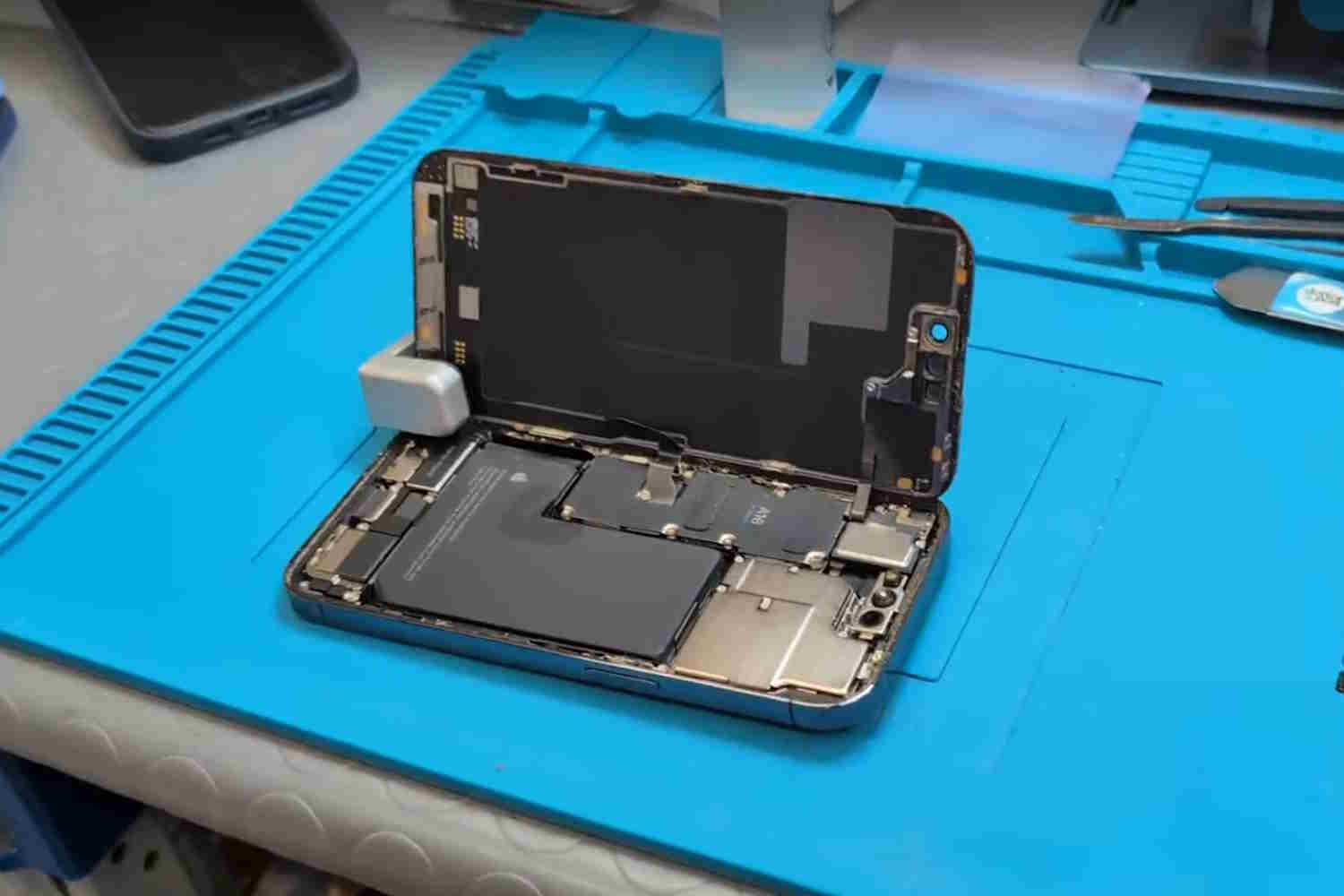
A smartphones that goes off at three in the afternoon doesn’t necessarily have to be thrown away: one can be enough new battery. Yet, for years, replacing a device was often easier than fixing it. Glued components, hard-to-reach batteries, expensive or unobtainable spare parts.
Since 22 October 2026, however, a law has come into force in Italy that strengthens the right to repair. And repairing a smartphone takes on a meaning that goes beyond saving: it means being able to decide how long to use an item that we have already paid for.
We bought smartphones, but who decides how long they should last?
When we buy a phone, we become owners of the device. The possibility of keeping it functioning over the years, however, still depends a lot on who built it. It’s the producer to decide how to assemble the components, which spare parts to distribute, under what conditions to make them available and for how long to update the operating system.
A stuck battery can require a complex intervention, a charging port that is difficult to reach can increase labor. And a perfectly good device can become less secure when it stops receiving updates. These are industrial decisions that end up impacting the lifespan of an object we own. And on our wallet, of course.
For years, environmental organizations, consumers and independent repairers have been asking for rules capable of rebalancing this relationship. The Right to Repair Europe coalition, which brings together associations and entities in the sector, has carried out campaigns to obtain accessible spare parts, technical information and greater guarantees against practices that hinder repairs.
Among the disputed issues there is also the so-called part pairingthe system that electronically associates certain components with the device and can limit their replacement without tools or manufacturer permission. Here’s why repairing a smartphone can become a political gesture: means choosing to extend the life of a product and claiming the possibility of doing so, even by turning to an independent repairer.
Repairing your phone is a right, and now Italian law also says so
With legislative decree 176/2026, Italy has implemented the European directive on the right to repair, introducing new obligations for manufacturers. When a device falls within the categories covered by the European repairability specifications and can be repaired, the consumer can request intervention even after the legal guarantee has expired. The repair must be carried out free of charge or at a reasonable price, within an equally reasonable time.
There is also a particularly interesting detail: the manufacturer cannot refuse a repair just because someone else has already worked on the device. Having taken the phone to the technician at home, therefore, should not automatically become a reason for having the door of official assistance closed.
The legislation also limits unjustified obstacles to the use, by independent repairers, of original, used or compatible components that comply with the requirements. And those who choose repair under the legal guarantee, in cases governed by the new rules, also obtain a twelve-month extension of the seller’s liability period. Interventions outside of warranty may be subject to payment and the obligations concern the products required by law. Compared to the past, however, the consumer has a few more tools.
More resistant and repairable smartphones: the new European rules
From 20 June 2025, the European ecodesign requirements are applicable for smartphones and tablets placed on the Union market from that date, with some exceptions. Batteries must retain at least 80% of their initial capacity after 800 charge and discharge cycles. Manufacturers must ensure the availability of certain replacement components for at least seven years from the end of the model’s marketing and operating system updates for at least five years from the same deadline.
An energy label has also appeared on the new devices which shows a repairability class from A to Ewhere A indicates the most easily repairable products. Information that deserves at least the same attention given to the camera’s megapixels. After all, having a smartphone capable of photographing the Moon is of little use if even replacing the battery becomes complicated after two years.
However, the application of the rules still requires some attention. In September 2026, Right to Repair Europe examined 2,334 smartphone records in the European EPREL registry and found that only 18% of them had information on spare parts prices or repair instructions easily accessible.
In almost half of the cards, links to the sites that should have contained them were even missing. In short, the law has arrived. The information necessary to exercise it has yet to find its way, possibly without forcing the consumer into an investigative investigation.
What are the easiest smartphones to repair in 2026?
Manufacturers are also starting to change their approach, albeit with rather different results. According to the independent evaluations of iFixit, an organization specialized in the disassembly and repair of electronic devices, among the most easily repairable models we find the Fairphone 6, which obtained 10 points out of 10, and the HMD Skyline, rated 9 out of 10. The first allows you to easily replace the battery, screen, cameras and USB-C port thanks to its modular construction. The second uses a particular mechanism that simplifies opening the body and accessing the internal components.
Even the most well-known brands are making progress. The iPhone 17e received a provisional score of 7 out of 10, thanks in part to a battery that is easier to remove and a structure that allows access to components from both sides. The Google Pixel 10 improves the accessibility of the battery and charging port, while Samsung offers self-repair programs for some Galaxys. In both cases, the complexity of the interventions varies from model to model.
Ease of repair, however, is only part of a smartphone’s lifespan. Software updates, availability of spare parts and the cost of interventions also count. All aspects that should be clear at the time of purchase.
How much can we save by repairing a smartphone?
A battery that needs to be replaced, a cracked screen or a faulty charging connector can cost much less than buying a new phone, especially when the device is still fully functional. Of course, each intervention has a different cost. For this reason it is advisable to request a quote, compare it with the value of the device and check the availability of spare parts.
A study by the European Commission’s Joint Research Center estimated that moving from a two-year to a three-year replacement cycle could reduce overall costs to the consumer by 4-10%, depending on the repairs needed. The same study calculated a possible carbon footprint reduction of 23-30%. Because producing a smartphone means extracting raw materials, processing materials, manufacturing components and transporting the finished product. A large part of the environmental impact comes before the first phone call.
Meanwhile, according to the United Nations Global E-waste Monitor 2024, in 2022 the world produced 62 million tons of e-waste. Only 22.3% was formally collected and recycled. A figure that includes all electronic equipment, including smartphones. Prolonging the life of a telephone therefore means postponing the production of a new device and reducing the quantity of devices destined to become waste.
And there is also a less visible consequence: every possible repair leaves the consumer with more choice and independent repairers with a work space that depends less and less on the exclusivity of the producers. Before buying your next smartphone, therefore, it is worth checking something besides the available memory and megapixels: how long the updates last, whether spare parts can be purchased and how much it costs to replace the battery.
Because we can have an excellent camera, a very powerful processor and all the artificial intelligence functions imaginable. But if a faulty charging port becomes impossible to replace, all that technology risks stopping short of a cable. And the bill, as always, reaches the owner.
