
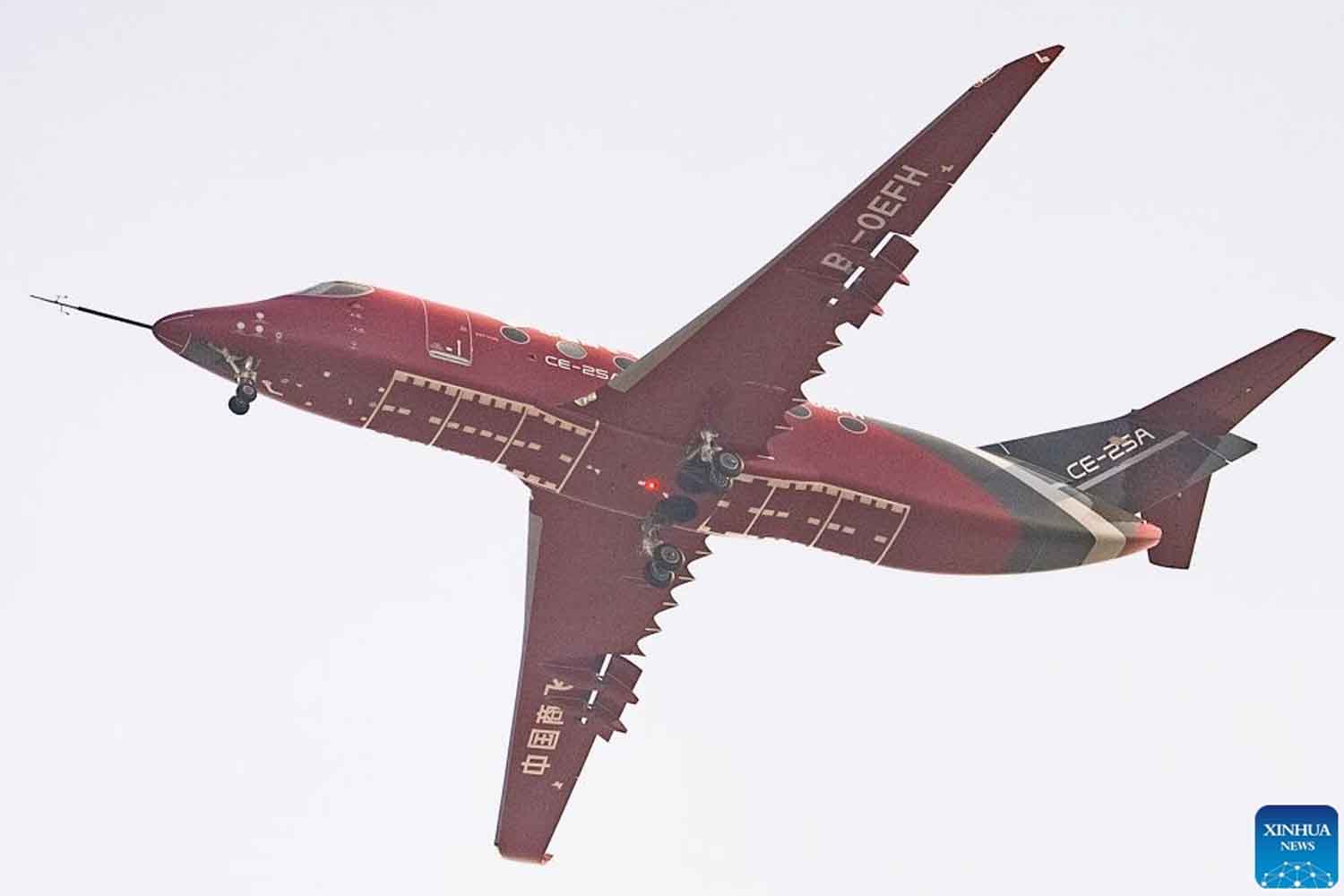
Sixteen minutes and 38 seconds in the air, 60.4 kilometers traveled and three people on board. On November 14, 2026, in Binzhou, China’s Shandong province, the CE-25A completed its first manned flight, marking a new milestone for electric aviation. At the controls were two pilots, accompanied by an engineer in charge of the tests. No passengers, for now.
The aircraft was developed by the Commercial Aircraft Corporation of China (COMAC), China’s state-owned aircraft manufacturer, together with battery maker CATL, Shanghai Jiao Tong University and other partners. According to what was communicated by the company and reported by the Civil Aviation Administration of China, the aircraft operated regularly and all parameters monitored during the test met expectations.
The CE-25A is an all-electric aircraft, designed to carry 19 passengers on routes of up to 400 kilometres. A distance which, at least on paper, would allow several cities to be connected without using traditional engines powered by fossil fuels.
Ten electric fans on the wings and 400 kilometers of autonomy
Looking at it, the CE-25A has something different from the planes we are used to seeing at airports. Ten ducted electric fans are distributed on the wings, five on each side, which replace the traditional propulsion systems. It’s a configuration called distributed electric propulsion, in which the thrust is split between multiple motors. The system is designed to reduce noise and improve some flight characteristics, including the ability to use relatively short runways.
The CE-25A has a maximum takeoff weight of 10 tons, can reach a cruising speed of 300 kilometers per hour and fly at an altitude of 2,400 meters. As for autonomy, COMAC declares 400 kilometers. We are therefore not talking about a plane destined to cross oceans, but rather about a vehicle designed for regional connections, where distances are shorter and batteries can represent a viable solution.
And the presence of CATL among the industrial partners is also interesting. The Chinese company is one of the world’s largest battery manufacturers and the possibility of storing enough energy without excessively weighing down the aircraft represents one of the main challenges for electric aviation. Batteries, in fact, have a rather concrete limit: they weigh. And on a plane every kilogram counts, especially when you have to lift a ten-ton machine off the ground.
First 19 unmanned flights, then the test with pilots
November 14th was the first flight with people on board, but the CE-25A had already left the runway several months earlier. On February 2, 2026, it had completed its first autonomous unmanned flight. Since then, according to data released by the manufacturer, a total of 19 flight tests have been carried out without people on board, necessary to verify the behavior of the aircraft and the functioning of its systems. Then it was time to get the pilots on board.
The entire experimental operation on November 14 lasted 57 minutes and 46 seconds, including ground activities. The actual time spent in flight was 16 minutes and 38 seconds, during which the CE-25A traveled 60.4 kilometers. A distance still short compared to the 400 kilometers of autonomy declared, but sufficient to complete the intended mission. COMAC confirmed that all indicators checked during the flight remained within expected values.
When will we be able to get on a 19-seater electric plane?
China has already started the necessary process to bring the CE-25A into commercial transport. The Civil Aviation Administration of China (CAAC) has in fact accepted the type certification application presented by COMAC. This is the procedure through which the technical characteristics and safety of an aircraft are verified before its entry into service. The manufacturer will therefore have to complete further checks and tests, including on the electrical systems and batteries.
Electric aviation, moreover, has already achieved some important goals. In June 2020, the European Aviation Safety Agency (EASA) certified the Pipistrel Velis Electro, a small two-seater aircraft intended primarily for pilot training. It was the first all-electric aircraft in the world to obtain a type certification.
Going from two seats to nineteen, however, means significantly increasing the size and energy needs of the vehicle. And it is precisely in this segment that the Chinese project wants to take a step forward.
An electric plane of this type could find space especially in connections between nearby cities, reducing direct emissions during flight and the noise produced by the engines. The overall climate benefit will also depend on the origin of the electricity used to charge it and the production of the batteries.
COMAC has not yet announced a date for the start of commercial flights. For the moment, therefore, the CE-25A has demonstrated that it can fly with people on board and its development continues towards certification. The 19 places are foreseen by the project. To start selling them, however, the green light from the Chinese authorities will still be needed.
