
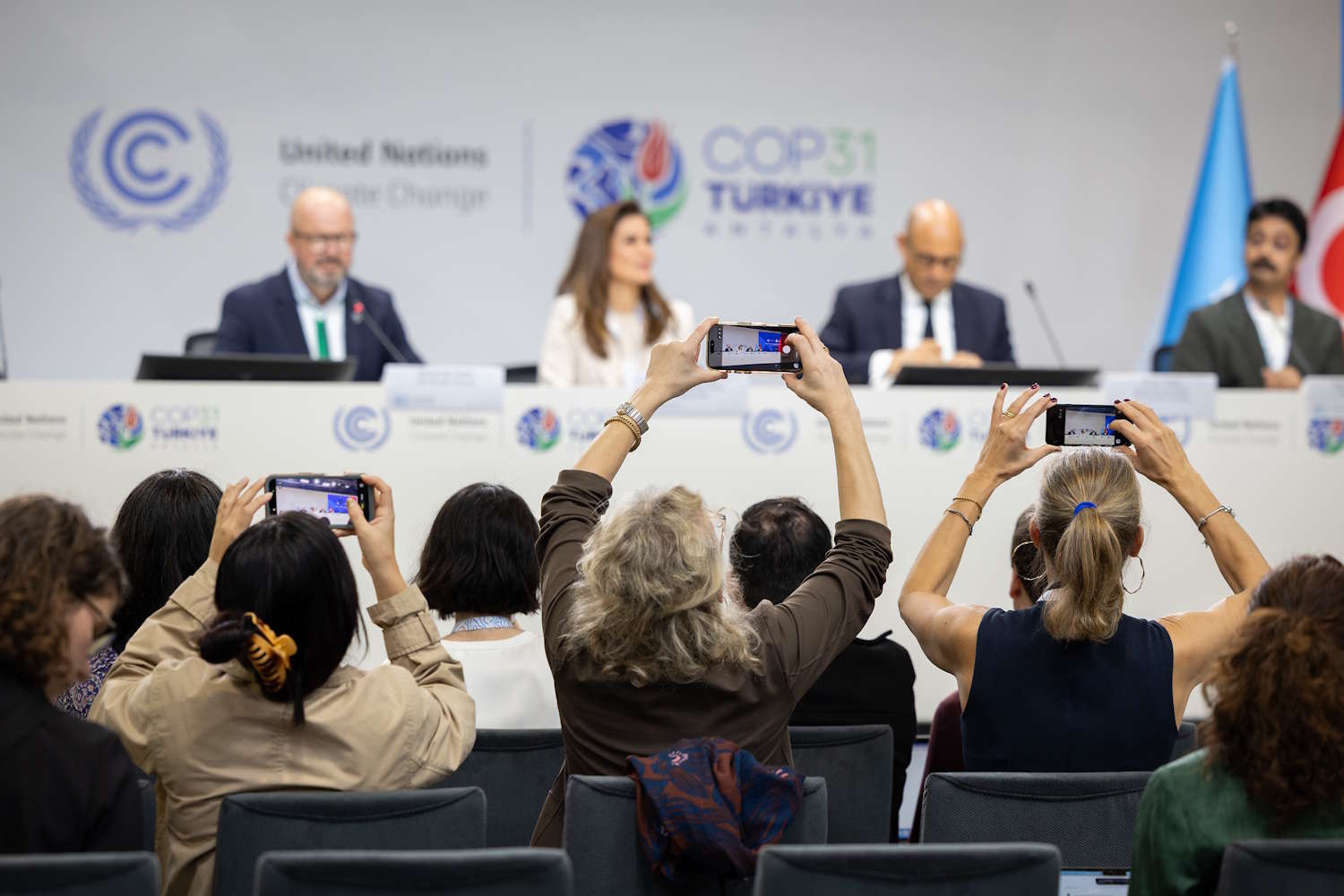
The second and decisive week of COP31 in Antalya, the UN Conference on climate change underway in Türkiye, has just begun. This means that the negotiations enter the purely political phase with the arrival of the ministerial delegations, called once again to find an agreement on the most controversial issues: fossil fuels, cutting emissions and, above all, who will have to pay the bill for the climate crisis.
Meanwhile, the draft agreement has just arrived on the table, of what will be there Cover decisionthe policy document that will chart the overall direction of the UN Climate Conference. Eighteen pages in 144 paragraphs that attempt to bring together the requests of industrialized countries, emerging economies and the most vulnerable nations.
While on the one hand, the document recognizes that the world is doing too little to contain global warming, on the other it relaunches the exit from fossil fuels and calls for new funding without however giving certain dates and objectives. In any case, the text is only a negotiating proposal, so many of its passages could change.
Let’s see the 15 fundamental points.
-
Accelerate the farewell to oil, coal and gas
The draft references Dubai’s first Global Stocktake and its commitment to transition away from fossil fuels, asking: “accelerated action to phase out fossil fuels,” starting from an “immediate” fair and equitable transition in energy systems. The text also welcomes the two roadmaps presented by the Brazilian Presidency, the one on fossils and the one on deforestation, but does not actually give a proposal on how to take them forward.
In fact, the nice thing is that there is no binding global date for eliminating oil, gas and coal, nor a detailed path with intermediate stages.
-
The threshold of 1.5 °C
The document acknowledges a reality that is increasingly difficult to ignore: current efforts are not enough to keep global warming within 1.5°C. The draft openly addresses the risk of overshooti.e. the temporary exceeding of this threshold, and proposes to bring temperatures back below 1.5 °C as soon as possible during the century. An overcoming which, even if temporary, could leave irreversible consequences.
-
Countries must do more to reduce emissions
As of November 9, 163 countries had submitted new national climate plans. But presenting them is not enough. The draft calls on governments to strengthen targets and accelerate implementation before the next global budget in 2028. For developing countries, however, greater ambitions will need to be accompanied by adequate economic and technological support.
-
More electricity and renewables by 2035
Among the new objectives is that of bringing electricity to 35% of global final energy consumption by 2035.
The document also relaunches commitments to triple the capacity of renewable energy and double the rate of improvement in energy efficiency by 2030, also investing in electricity networks, storage systems and infrastructure.
-
At least 120 billion dollars to adapt to the climate crisis
It is one of the most important nodes. The draft proposes to increase financing for climate adaptation to at least $120 billion, as part of the goal of tripling it by 2035.
A figure which, however, would remain far from real needs: according to the estimates referred to in the document, developing countries will need around 305 billion dollars a year by 2035 to deal with the effects of global warming.
-
Rich countries must answer for their historical emissions
The document explicitly recognizes the historical responsibility of industrialized nations in the climate crisis. According to the draft, their net cumulative CO₂ emissions have already consumed around four-fifths of the carbon budget compatible with a 50% chance of keeping warming to 1.5°C.
An annual ministerial comparison is also proposed, starting from 2027, on climate commitments not respected before 2020.
-
The loss and damage fund has too few resources
The numbers reveal a huge imbalance: compared to approximately 2.8 billion dollars requested through the fund’s mechanisms Loss and Damagejust 342 million have been allocated.
The draft calls for more resources and proposes a new initiative, the Antalya-to-Addis Ababa Roadmapto identify funding for the countries most affected by climate disasters.
-
The rights of indigenous peoples are recognised
A significant passage concerns indigenous communities, recognized as protagonists in the protection of ecosystems. The draft reiterates their right to free, prior and informed consent and emphasizes that climate solutions must not compromise the territories, cultures, livelihoods and rights of indigenous peoples.
An important recognition, which however must translate into effective participation in decisions.
-
Stop deforestation by 2030
Forests return to the center of climate commitments. The document relaunches the goal of halting and reversing deforestation and forest degradation by 2030, recognizing their role in absorbing CO₂, protecting biodiversity and the survival of local communities.
However, new specific obligations for individual governments are missing.
-
More space for technologies to capture CO₂
The draft proposes to accelerate the development of carbon capture, use and storage systems, targeting capacities in the order of 1.3-2.5 billion tonnes of CO₂ per year by 2035.
The document also specifies that the removal of CO₂ from the atmosphere must not replace or delay cutting emissions. However, the question of the role attributed to these technologies in the energy transition remains open.
-
Quickly reduce methane
It’s not just carbon dioxide. The draft calls for accelerating action against methane, a potent greenhouse gas, through repairing leaks in plants, reducing the intentional release of gas and recovering methane from waste.
However, a new global quantitative objective is not set.
-
Mountains and glaciers enter the COP agenda
For the first time in this draft the creation of a specific work program on climate change in mountain regions is proposed.
The aim is to strengthen research, adaptation and protection of glacier-dependent communities, with a high-level international dialogue expected at COP32.
-
Climate alert for the entire world population by 2027
Another point concerns early warning systems for floods, droughts and other extreme weather events.
The draft relaunches the UN objective of guaranteeing universal coverage by 2027, calling for greater cooperation and support for the most vulnerable countries.
-
More efficient buildings and less energy waste
With theAntalya Compact for Energy Efficient Buildingsthe COP31 Presidency promotes the goal of reducing the operational energy intensity of buildings globally by at least 25% by 2035, compared to 2020.
An initiative that aims to contain consumption and emissions in the construction sector, without introducing new binding obligations for individual states.
-
The ecological transition must respect human rights
The last major theme is social justice. The document recalls the rights of women, children, young people, migrants, workers and vulnerable communities.
We talk about decent work, participation in decisions and the fight against exploitation in clean technology supply chains. Because a transition cannot be said to be truly just if, in an attempt to resolve the climate crisis, it ends up creating new inequalities.
Meanwhile Australia…
While in Antalya we discuss how to accelerate the exit from fossil fuels, a new report by Climate Analytics, entitled Past its fossil fuel exit dateexposes the contradictions of Australian energy policy.
According to the analysis, Australia – which co-chairs the COP – will continue to export coal, oil and gas on a large scale for decades. By 2040, emissions associated with exported fossil fuels would fall only marginally, still hovering around 900 million tonnes per year, double the domestic emissions reported in 2025.
Since 2022, according to Climate Analytics, the government led by Anthony Albanese has authorized at least 37 new projects or expansions linked to fossil fuels, with mining concessions reaching as far as 2088. Furthermore, the report estimates that an exit path compatible with the Paris objectives could avoid up to 9.6 billion tonnes of emissions in the next 15 years, with benefits also for the Great Barrier Reef.
A contradiction that Bill Hare, CEO of Climate Analytics, summarizes in the distance between the climate ambitions declared by the Australian government and the continuous expansion of fossil exports.
In short, the text that arrives from Antalya contains important proposals, but also explains all the limits of international climate negotiations. On the one hand there is the increasingly explicit recognition of the urgency of reducing emissions, protecting ecosystems and supporting vulnerable populations; on the other hand, precise deadlines, sufficient funding and tools capable of ensuring that commitments are respected continue to be lacking.
The second week of COP31 will have to resolve precisely these issues. Meanwhile, today 17 November, the high-level segment with the ministers is scheduled and the Minister of the Environment and Energy Security, Gilberto Pichetto Fratin, will also be present. The thematic day is dedicated to oceans, seas, nature and land use.
HERE is the draft agreement.
