
Flooding, torrential rain, gusts of wind and increasingly fragile territories. In Italy the climate crisis is no longer a distant threat, but a reality that we deal with almost every day. And the numbers tell a story that we can no longer ignore: 2,689 extreme weather events in just under 12 years, 221 deaths and economic damage which, from 1980 to today, is estimated at 147 billion euros.
The situation is illustrated by the new report from Legambiente’s CittàClima Observatory, created in collaboration with Unipol and released in the opening week of COP31 in Antalya. An investigation that does not limit itself to counting disasters, but above all highlights a problem: Italy continues to chase emergencies, while interventions to prevent them proceed too slowly.
Let’s just think that the National Plan for Adaptation to Climate Change (PNACC), approved in 2023 after years of waiting, is not yet operational due to the lack of resources necessary for its implementation.
What are the most striking phenomena?
According to data collected by Legambiente between 2015 and 30 September 2026, over 60% of the extreme events that caused damage concerned two phenomena: 950 floods caused by intense rain and 684 episodes of wind damage.
What is especially worrying is the speed with which these events are increasing: flooding went from 18 in 2015 to 140 in 2025, with an increase of 678%. The growth in incidents of wind damage was even more marked, rising from 5 to 86 in the same period. And in the first nine months of 2026 there are already 88, more than those recorded in the entire previous year.
Things aren’t any better on the economic front. According to the report Strategy for climate peacecited by Legambiente, Italy is the European country with the greatest economic losses linked to extreme climate events, with overall damage estimated at around 147 billion euros since 1980.
The most affected regions and cities
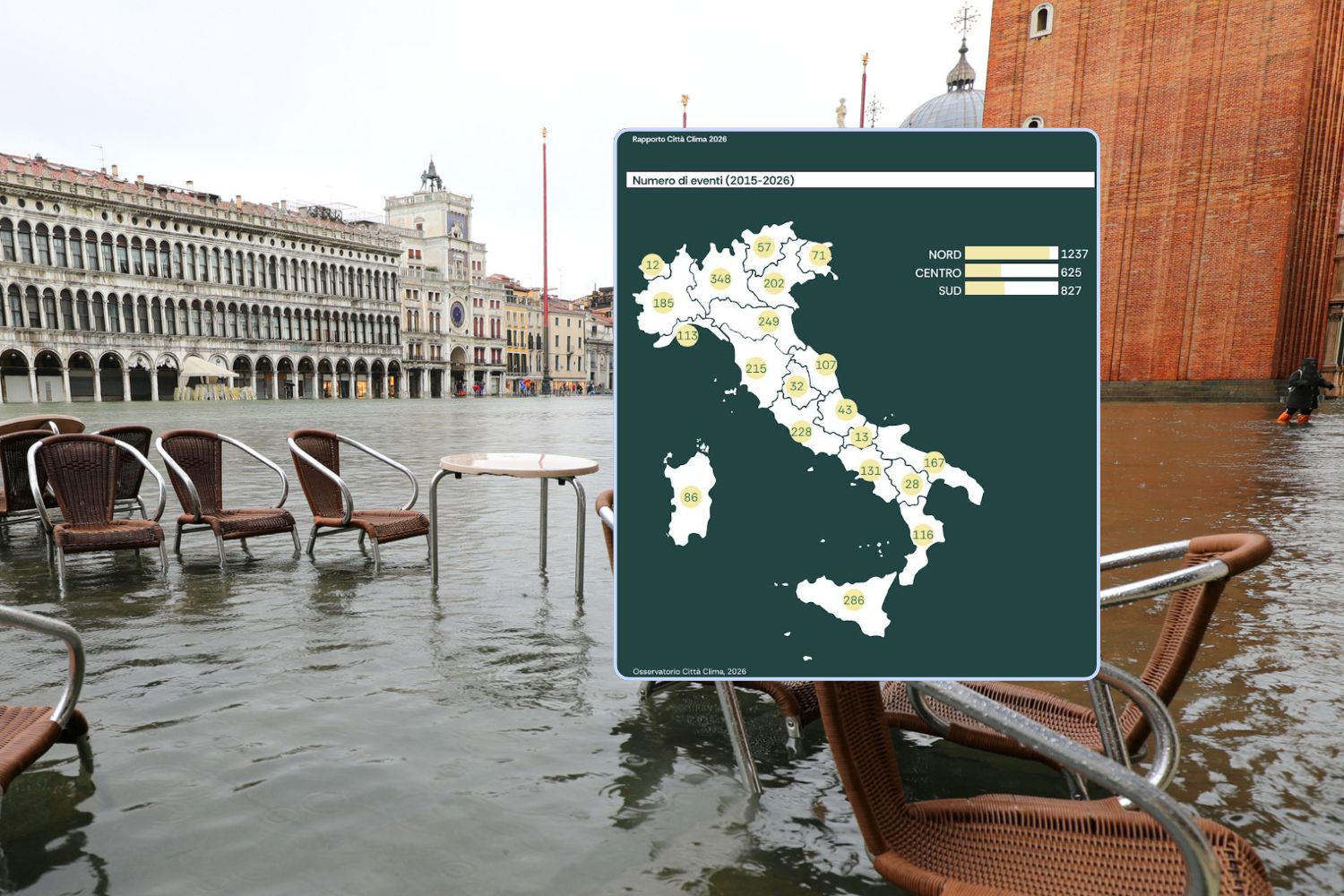
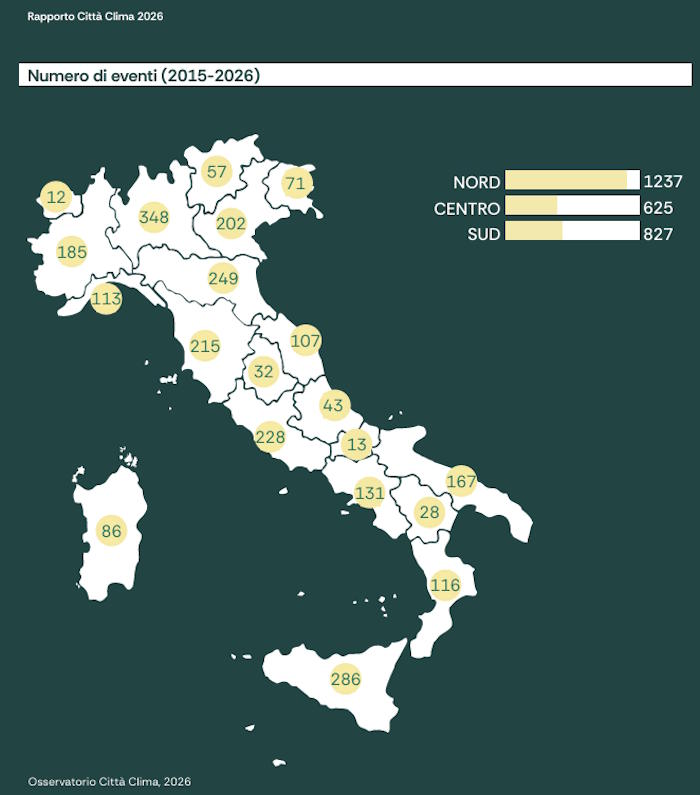
The climate crisis affects the entire Peninsula, but some areas are particularly exposed. The North records the highest number of events, with 1,237 episodes, followed by the South with 827 and the Center with 625.
These are the three regions that recorded the most extreme events from 2015 to September 30, 2026:
- Lombardy: 348 events
- Sicily: 286 events
- Emilia-Romagna: 249 events
Also striking is the acceleration recorded in some territories. In Sicily, the extreme events that caused damage went from 6 in 2015 to 45 in 2025. In Friuli-Venezia Giulia, however, they went from no harmful events recorded in 2015 to 14 in 2025.
If we look at cities, the picture becomes even more worrying. Urban areas, where housing, infrastructure and essential services are concentrated, are particularly vulnerable to the effects of intense rainfall and extreme temperatures.
According to the CittàClima report, these are the seven Italian cities that have recorded the highest number of extreme weather events since 2015:
- Rome: 103 events
- Genoa: 42 events
- Milan: 41 events
- Palermo: 36 events
- Bari: 33 events
- Agrigento: 30 events
- Naples: 21 events
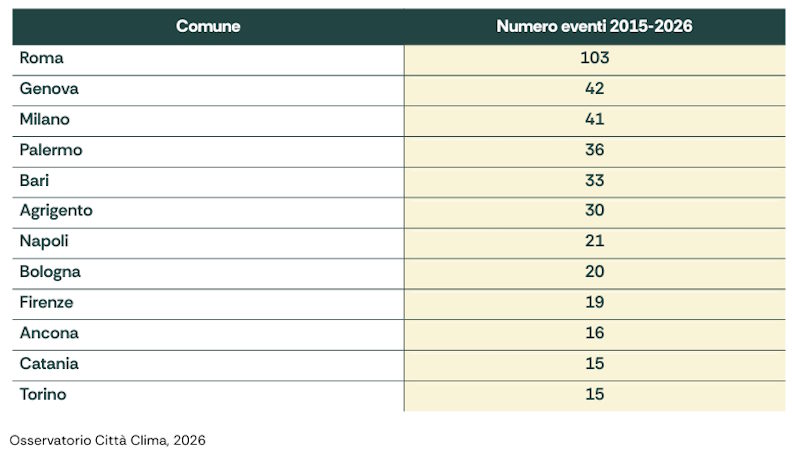
Rome clearly leads this ranking, with more than double the events recorded in Genoa and Milan. Numbers that highlight the need to rethink the management of rainwater, soil permeability and the presence of green spaces in cities.
Cities that are already changing
Yet, something is moving. The Legambiente report also recounts some positive experiences of climate mitigation and adaptation, demonstrating that intervening is possible, even through local projects.
In Ferrara, for example, a rainwater collection system was created under the pavement of Piazza Cortevecchia, used to irrigate and cool the ground during the summer. In the new Folco Quilici park, a floodable basin has been created equipped with intelligent sensors to monitor the urban microclimate.
In Lucca, the project Green schools involved seven school buildings with interventions to reduce the effects of climate change, including the creation of plant barriers. In L’Aquila, around 800 native trees were planted in a new green area of 17 thousand square meters near the Pile industrial area, while in Syracuse the redevelopment of Piazza Adda transformed a car park through new trees and a rainwater recovery system, which has already proven effective against heat and flooding.
There is also no shortage of planning tools: Rimini and Udine have activated greenery plans, Bologna has a climate adaptation plan and Rome has adopted its own adaptation strategy.
They are different examples, but with a common goal: to make cities less vulnerable to extreme events, rather than simply repairing the damage after each emergency.
The problem, according to Legambiente, is that these positive experiences remain insufficient without a funded and truly operational national strategy. For this reason, it asks the Government to allocate in the budget law the resources necessary to implement the PNACC, approve a law against land consumption and extend the construction ban to all areas classified as hydrogeological risk, not just those at high risk.
We need to stop chasing emergencies, we need to prevent them, underlines Giorgio Zampetti, general director of Legambiente, recalling that the lack of funding especially penalizes municipalities with fewer economic and technical resources.
To ask for concrete interventions, Legambiente also joins the national climate demonstration “The Earth called”, scheduled for 5 December in Rome, in Piazza del Popolo.
HERE you can find the complete Legambiente report.
