
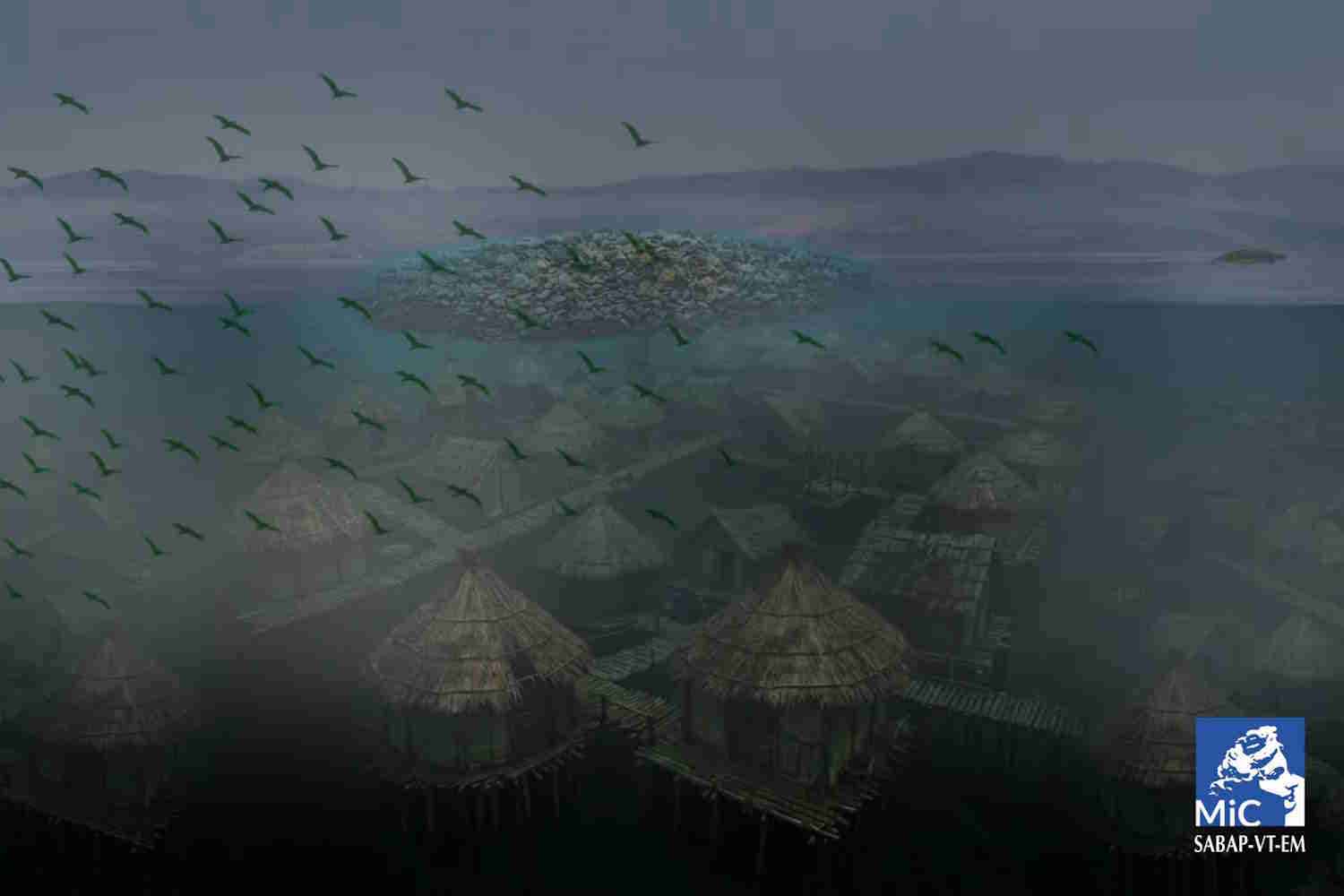
At the bottom of Lake Bolsena, a few meters deep, lies a village almost three thousand years old. There are remains of houses, wooden poles still stuck in the ground, tools, containers and even an ancient sacred area. Is called Big Dipperdates back to the Iron Age and has now become a submerged archaeological park that can be explored even without wearing a wetsuit or diving. Just get on a boat with a transparent bottom or rely on a virtual 3D reconstruction.
The valorization project, completed in December 2025 thanks to funding from the PNRR, made the site accessible through various visit routes, including snorkeling experiences and digital tools that can also be used from smartphones. On-site visits follow the organized openings. And as the public begins to learn about this little piece of history that has remained underwater for centuries, archaeologists continue to dig.
Precisely during the 2026 campaign, two particularly interesting discoveries emerged: a very rare fragment of Villanovan fabricrecovered among the charred beams of a house destroyed by fire, and an amphora containing remains of spelled, found in the sacred area of the village. This was announced on 11 November by the Superintendence of Archaeology, Fine Arts and Landscape for the province of Viterbo and southern Etruria, which coordinates the research.
A piece of fabric that has survived almost three thousand years of history
The fragment of fabric was recovered inside a wooden structure that burned and subsequently collapsed. The beams, as they fell, covered the objects present in the house, while the layers of combustion created particular conditions for the conservation of the materials. The result is a very rare find. Ancient fabrics, in fact, are among the most difficult materials to recover during an excavation: the fibers deteriorate, decompose and in most cases disappear completely.
At the Gran Carro, however, there is direct evidence of this. The fragment belongs toVillanovan agea phase of the First Iron Age, preceding the development of the great Etruscan cities. The village was inhabited by communities that worked wood, produced ceramics and already knew the techniques of spinning and weaving.
Archaeologists knew this thanks to the tools recovered during previous excavation campaigns. In the 2024 research report, for example, the Superintendence documented the discovery of two spindles, one of which still had the spindles inserted, and two combs probably used for working on the loom. Added to these are loom weights, spools, bone tools and a loom identified in Area 5, further studied during 2026. In short, the tools of the trade were already there. There was no direct testimony of what the inhabitants produced.
Now that has arrived too. The discovery allows us to reconstruct the village’s artisan activities with greater precision, even if archaeologists have yet to clarify the characteristics of the fabric and its original function. We don’t know if it belonged to a garment or another artifact.
The burned houses that preserved the inhabitants’ objects
The fabric is just one of the finds trapped in the dwellings of the Big Dipper. During the 2026 excavations archaeologists identified several buildings destroyed by fireswith structural posts still stuck in the ground, fragments of burnt plaster and large quantities of charred wood. Numerous ceramic containers were found under the collapsed beams. Some were still in the position they were in when the building was abandoned. Others were so distorted by the heat that it was difficult to even recognize their shape.
A detail that tells how violent the fires were, but which also allows us to study the organization of domestic spaces. The objects, which remained buried under the collapsed elements, offer indications on the activities carried out inside the homes. And there is another interesting detail: some houses were rebuilt exactly where they had been destroyed.
Archaeologists have recognized different levels of fire, collapse and subsequent reconstruction. The inhabitants, therefore, continued to use the same spaces even after destructive events, leaving a succession of structures that today allows us to reconstruct the different phases of life of the village.
Moreover, the houses were built largely with combustible materials and hearths could also be found inside them. The causes of the individual fires, however, have not yet been clarified. The submersion occurred later, following changes in the lake level. And the water helped protect what the fires had left.
An amphora with charred spelled in the ancient sacred area
While the remains of domestic life were emerging in the town, not far away archaeologists were recovering evidence of a completely different nature. The Aiola is a monumental accumulation of stones on the bottom of the lake, used by ancient communities for ritual practices. A place where objects intentionally placed were found, near the springs present in the area. During the 2026 campaign, new votive deposits emerged, including an amphora and a dipper, a vessel used to draw liquids. But it is the contents of the amphora that have particularly attracted the attention of archaeologists: charred remains of spelled.
Today we are used to considering it a cereal to be put in a pot, perhaps to prepare a soup or a salad. For protohistoric populations, however, spelled represented a fundamental resource for the nutrition and economy of the communities. Its presence inside a container placed in the ceremonial area suggests something more.
According to the Superintendence, the cereal may have been used as a ritual offering, as part of practices linked to fertility, regeneration and the relationship between communities and natural resources. It is an interpretation supported by the archaeological context: the container was found together with other materials intentionally placed in the sacred area. Studies will need to further clarify the significance of the deposit.
Numerous hitherto unknown wooden structures were also found around the Aiola, brought to light thanks to the controlled removal of sediments. They may have served to delimit the ceremonial space or may have been used during ritual activities at the springs. For the moment, their function remains to be ascertained.
The submerged village of Lake Bolsena can also be visited
The Big Dipper has been known since 1959, when the first submerged archaeological evidence was identified. Subsequent investigations made it possible to recognize a settlement with origins dating back to the Bronze Age and an important residential phase during the First Iron Age.
Today it is found at a depth of between two and four metres, not far from the shore. A position which, in addition to encouraging research, has made it possible to make part of the site accessible to the public. In December 2025 the Ministry of Culture announced the completion of the restoration and valorization interventions, also financed through the PNRR, with the creation of an underwater archaeological park.
Snorkeling routes, underwater itineraries also accessible to blind people, lighting systems and three-dimensional reconstructions of the seabed have been set up. It is also possible to observe the site through digital tools and boats with transparent bottoms, according to the methods established for visits.
Meanwhile, the research continues. The Superintendence is collaborating with the Central Institute of Restoration to study and conserve the recovered organic materials, which are particularly delicate once extracted from the lake environment. The new fragment of fabric thus joins vases, tools, remains of homes and ritual offerings that tell how the communities of the Big Dipper lived and worked. Weaving tools had already resurfaced. Now there is also the fabric.
