
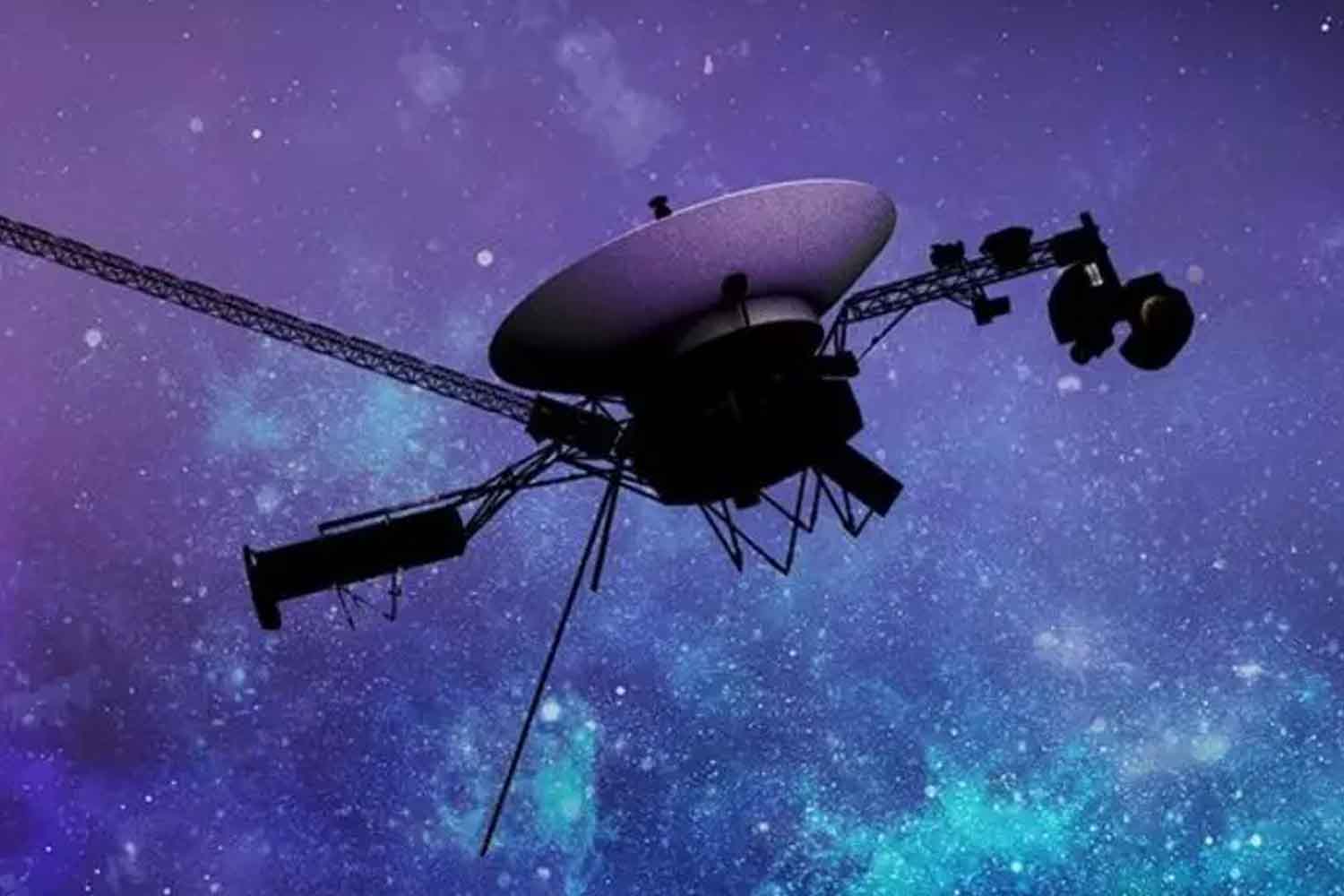
At 11:16 today, November 18, 2026, Voyager 1 reached a distance of 25.9 billion kilometers from Earth. It is the first man-made object to come within a light day of our planet, an achievement that makes even the simplest of communications rather complicated: a radio message now takes 24 hours to reach the probe and the same amount to come back. In practice, if NASA sent a command this morning, it might receive a response only two days later.
The data comes from official NASA calculations and marks a new record for a mission that began almost half a century ago. Voyager 1 launched on September 5, 1977, when no one could have imagined it would continue to operate for so long. Today it travels at around 61,000 kilometers per hour, passes through interstellar space and continues to send scientific information towards Earth. With some more difficulties, of course, but after 49 years of service we can also grant them that.
A light day from Earth, after almost 50 years of travel
To understand how far away Voyager 1 is, just compare the times it takes for light to cross some familiar distances. From the Moon it arrives on Earth in just over a second, from the Sun in about eight minutes. To reach the probe, however, it must travel for an entire day. Light day indicates precisely this distance: approximately 25.9 billion kilometers traveled by light in 24 hours. An enormity for us, a tiny fraction of the size of our galaxy.
The probe was designed to explore Jupiter and Saturn, which it reached in 1979 and 1980 respectively, collecting photographs and valuable information on the two planets and their satellites. During close encounters he also used their gravity to increase his speed and change his trajectory. Once the main mission ended, it continued to move away from the Sun until August 25, 2012, when it crossed the heliopause, the boundary beyond which the solar wind gives way to the interstellar environment. It has since become our first operational scientific laboratory in that region.
And it continues to be so, albeit with increasingly limited tools. When it left, Voyager 1 had ten scientific instruments. Today only two work: a magnetometer, which measures magnetic fields, and a detector of waves in plasma, the gas composed of electrically charged particles. They are the last instruments left on, while engineers try to conserve every available watt to prolong the mission as long as possible.
Voyager 1 is running out of power, but continues to communicate
At that distance from the Sun, using photovoltaic panels would be impractical. Voyager 1 is powered by three radioisotope thermoelectric generators, which use the heat produced by the decay of plutonium to generate electricity. At launch they provided a total of around 470 watts, while today the available power is less than half. According to NASA, the probe loses about four watts every year, an apparently modest amount which however forces technicians to gradually turn off on-board instruments and devices.
The last major intervention dates back to September 2026, when engineers replaced three devices with as many low-power systems. Then, on October 18 and 19, Voyager 1 temporarily stopped responding. The signal reappeared on October 20, while the technicians identified an automatic switch to reserve engines and started checks. A small inconvenience, if we consider that we are talking about a car built in the seventies, at a distance from which even understanding what happened takes days.
NASA hopes to keep communications active for a few more years, potentially until 2036, when remaining energy may become insufficient to transmit signals back to Earth. The end of communications, however, will not stop the probe. Voyager 1 will continue to move through space, following its trajectory around the center of the Milky Way. And it will bring with it something that tells much more than its scientific mission.
The golden record that tells about life on Earth
On the side of the probe is fixed a gold-plated copper disk, about thirty centimeters large. Is called Golden Records and was created by a group of researchers coordinated by the astronomer Carl Sagan to leave a testimony of our civilization to a possible extraterrestrial recipient. As documented by NASA, it contains 115 images, greetings in 55 languages, musical pieces and recordings of Earth sounds. There is the wind, the waves of the sea, the singing of birds, the human voices. A small archive of the planet we left behind.
Also engraved on the case are instructions for playing the disc and an astronomical map based on the position of pulsars, designed to indicate where the probe is coming from. The twin Voyager 2, launched on August 20, 1977, carries an identical disk. Of course, no one knows whether these messages will ever be intercepted by other intelligent life. The distances are enormous and the probability of an encounter remains unknown. But the idea of entrusting the stars with evidence of the Earth continues to fascinate scientists, enough to inspire new projects.
New probes could outrun Voyager 1
At the University of Arizona, in the United States, a group of students is developing LUMEN (Lunar Uranus Membrane Envoy)a small probe designed to carry an archive of human knowledge into interstellar space. The vehicle would weigh just 4.6 kilograms and use a square solar sail measuring over 18 meters per side. The system exploits the pressure exerted by light on a reflective surface to accelerate without consuming propellant, a principle already successfully tested by the Japanese space agency JAXA through the IKAROS mission.
The project envisages a rather particular trajectory. After release into lunar orbit, LUMEN should progressively get closer to the Sun up to about 30 million kilometers, where the light pressure would be 25 times higher than that at Earth’s distance. Using this thrust, it could reach a speed of about 26 kilometers per second, about 50% faster than that of Voyager 1. According to the group’s simulations, with a launch by 2033 it would cross the heliopause around 2058 and could surpass Voyager 1 in 2147becoming the furthest human object from Earth.
Then there is the Fermi Explorer Mission, an initiative that proposes to send a small probe towards Alpha Centauri, the star system closest to ours. Promoters are aiming for a launch by 2029, with a budget of less than $15 million and an electric propulsion system capable of taking the vehicle to around 24 kilometers per second. The expected journey would take something like 80,000 years. This probe is also expected to carry messages from Earth, including those written by children from different countries.
Both projects are still proposals to be realized, but they show how the Voyager experience continues to influence space exploration. New technologies could allow us to build smaller, cheaper and faster vehicles, capable of carrying much larger quantities of information. With current archiving systems, in fact, it would be possible to preserve an enormous part of human knowledge in media just a few centimeters large. In 1977, however, a thirty centimeter disc was already enough to try to tell who we were.
For now, the record still belongs to Voyager 1. According to NASA estimates, in about 38,000 years it will pass within 1.7 light years of a star in the constellation Ursa Minor. A distance still too great to consider it a close encounter. In the meantime, it will continue to move away from Earth, first with its last instruments turned on and then in silence, taking with it that golden record with the images, music and sounds of a planet that, in 1977, had decided to make itself known.
