
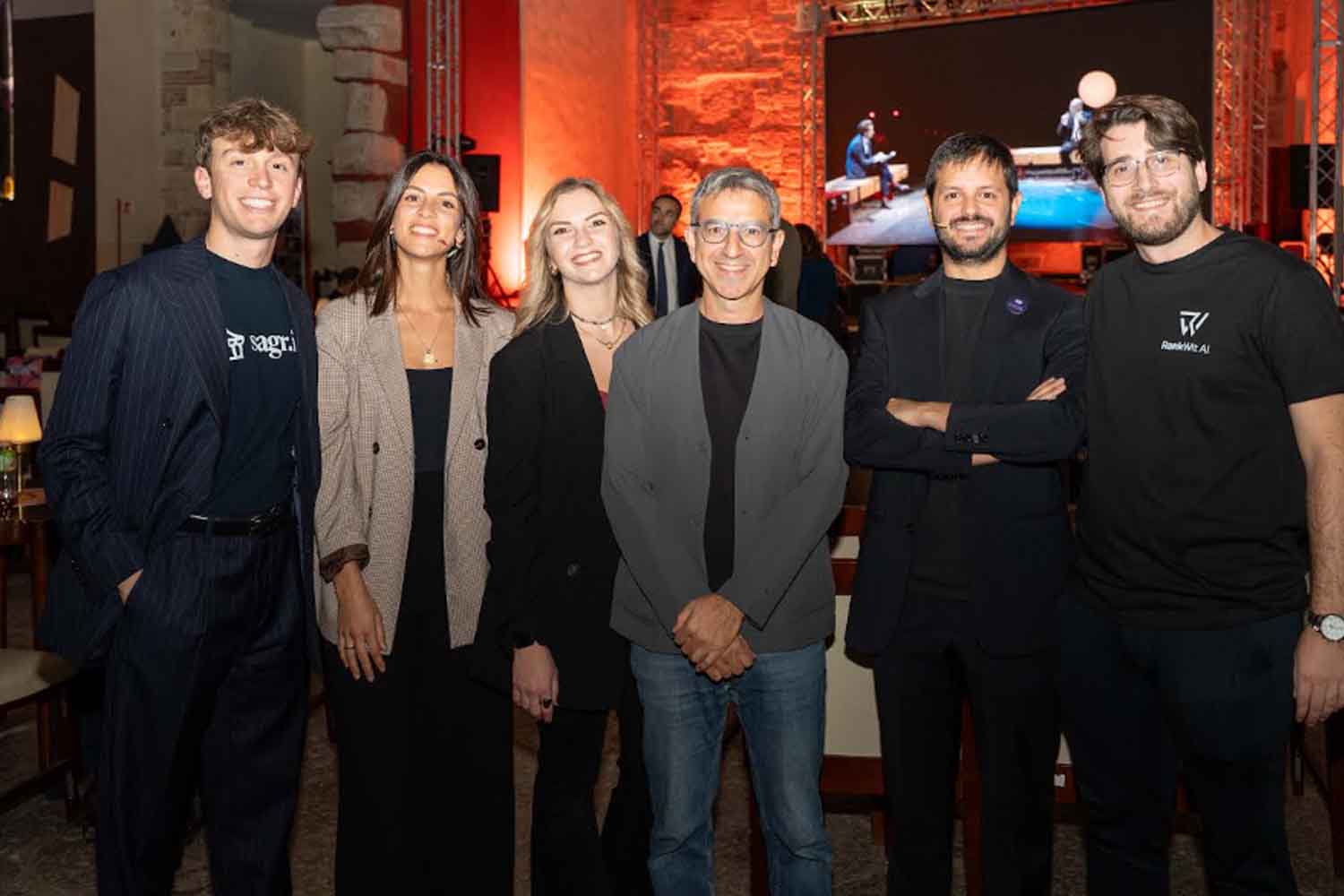
A receptionist who responds to guests in 25 languages, an application that organizes mountain excursions and a school where ancient professions once again become a job opportunity. These are some of the ideas presented on 17 November at the Real Teatro Santa Cecilia in Palermo, where five Italian companies competed for a place in the final of the 2026 Repower Innovation & Tourism Special Prize. Very different projects, united by the desire to rethink the way we travel, discover new places and get to know the traditions of our country.
The award, now in its ninth edition and promoted by Repower as part of the 2031 Award, has chosen Palermo this year thanks to the collaboration with Innovation Island, the community dedicated to Sicilian innovation. On stage, each startup had five minutes to tell their idea and the same number to discuss it with a jury of experts. The winner will be announced in December, at the MAXXI in Rome, and will have access to six months of mentoring and meetings with the business world, designed to accompany the growth of the project.
Between artificial intelligence and the recovery of local traditions, the five finalists also show how much the very concept of innovation in tourism has changed. Because if someone tries to make hotel hospitality more efficient, someone else has decided to start again from artisan workshops. And looking at the selected ideas, it doesn’t seem like a contradiction at all.
QuattroPuntoZero: ancient crafts return to school in Palermo
In Palermo there is a school where the classrooms are shops, ateliers and workshops, while the teachers are artisans who know the trade and pass it on. It’s called QuattroPuntoZero and it is a project created to recover traditional artisan skills, transforming them into new training and work opportunities. An idea that takes shape right in the historic center of the Sicilian city, where many artisan activities still preserve knowledge that risks being lost.
The school was born from the experience of the restoration of Palazzo Butera and offers training courses distributed throughout the area, involving artisans, artists and professionals. They range from ceramics to artistic restoration, from the processing of furniture to the care of greenery, through laboratories, workshops and internships. The project, also supported by the Fondazione con il Sud, looks above all at young people and people who encounter greater difficulties in accessing work.
The idea is simple: to bring together those who possess artisan knowledge with those who want to learn it, while at the same time contributing to keeping the workshops and local cultural heritage alive. Because the tourism of a city like Palermo certainly passes through monuments and historic buildings, but also through the people who continue to work wood, ceramics and other materials according to traditions handed down for generations.
AiDA: the virtual receptionist who speaks 25 languages
Let’s imagine a foreign tourist who calls the hotel at midnight to ask for information on a room. Or a guest who writes on WhatsApp to change a reservation while the reception staff is busy welcoming other customers. AiDA was created precisely to manage situations like these: it is a virtual assistant based on artificial intelligence, available 24 hours a day and capable of communicating in 25 different languages.
Developed by AIM Solutions, the technology responds via telephone, email and WhatsApp, checks availability and rates, prepares quotes and accompanies the customer until booking. When necessary, it transfers the request to hotel staff. The objective is to simplify the work of accommodation facilities, reducing response times and allowing employees to dedicate more attention to welcoming guests.
A solution designed for a sector in which requests now arrive at any time, often from distant countries and in different languages. With AiDA, even businesses that do not have a large reception can manage communications in a more organized way, leaving situations that require direct intervention to the staff.
Mountain Maps: artificial intelligence organizes excursions
Five young people from Trentino, a passion for the mountains and a problem that anyone who has tried to organize an excursion knows well: finding an itinerary suited to their abilities, the time available and the desired destination. From this need, Mountain Maps was born, an application that uses artificial intelligence to create personalized hiking routes throughout Europe.
Operation is quite intuitive. The user can indicate the starting point, how many kilometers he wishes to travel or the refuge he would like to reach. The MIA virtual assistant processes this information and proposes an itinerary directly on the map, accompanying it with details on the slope, difference in altitude and terrain characteristics.
The app also offers maps that can be downloaded offline, useful in areas where there is no telephone connection, as well as specific information for skiers, such as snow conditions and the slope of the slopes. A way to make organizing outdoor activities easier, especially for those who want to explore new territories without having to spend hours comparing dozens of routes.
RankWitAI: Helping hotels and destinations get found by ChatGPT
Once upon a time, to search for a hotel or organize a holiday, you typed a few words into Google and consulted the results. Today more and more people ask ChatGPT, Gemini or other virtual assistants directly where to sleep, what to visit and what experiences to choose. But how does a hospitality facility understand if it appears among the artificial intelligence’s suggestions?
It is from this need that RankWitAI was born, a platform that helps hotels, tourist destinations and local businesses monitor their presence in the responses generated by ChatGPT, Gemini, Claude and Perplexity. The system analyzes how often a business is mentioned, which competitors are suggested and which sources contribute to its visibility.
The aim is to provide tourism operators with tools to improve the content published online and understand how travellers’ search habits are changing. A new frontier of digital visibility, especially for small businesses that need to make themselves known in an increasingly competitive market.
SAGR: Italian festivals become digital
From the truffle festival to the wine festival, passing through the gastronomic specialties that are often only found in a handful of Italian towns. Local traditions represent an important part of our cultural heritage, yet many events remain known almost exclusively to the inhabitants of the area. SAGR wants to make this heritage more accessible through a digital platform dedicated to festivals, recipes and typical Italian products.
The portal collects events and demonstrations organized in the different regions, allowing users to search for them by territory and time of year. An interactive map helps to identify nearby festivals, while the sections dedicated to products and recipes tell about the gastronomic traditions of the places. Organizers can also propose the inclusion of their events for free.
The idea is to give greater visibility to popular festivals, helping to raise awareness of destinations that often remain outside of major tourist itineraries. A way to enhance local communities through what they produce, cook and pass on. After all, to discover an area, sometimes it is enough to follow the scent of a specialty prepared during a village festival.
The future of Italian tourism also passes through the territories
The five finalists describe a sector that is looking for new ways to grow, including increasingly sophisticated digital tools and initiatives that recover local cultural heritage. A direction also underlined by Fabio Bocchiola, CEO of Repower, according to whom the selected projects show tourism oriented towards a synthesis between artificial intelligence and territorial identity, with innovation used to generate economic and social value.
In December, during the national final of the 2031 Prize in Rome, the winning project will be announced. In the meantime, the five realities have already shown different ways of addressing the needs of contemporary tourism. There are those who teach artificial intelligence to talk to hotel guests and those who continue to teach how to work with their hands. Two very different skills, both with something to offer the future of Italian territories.
