
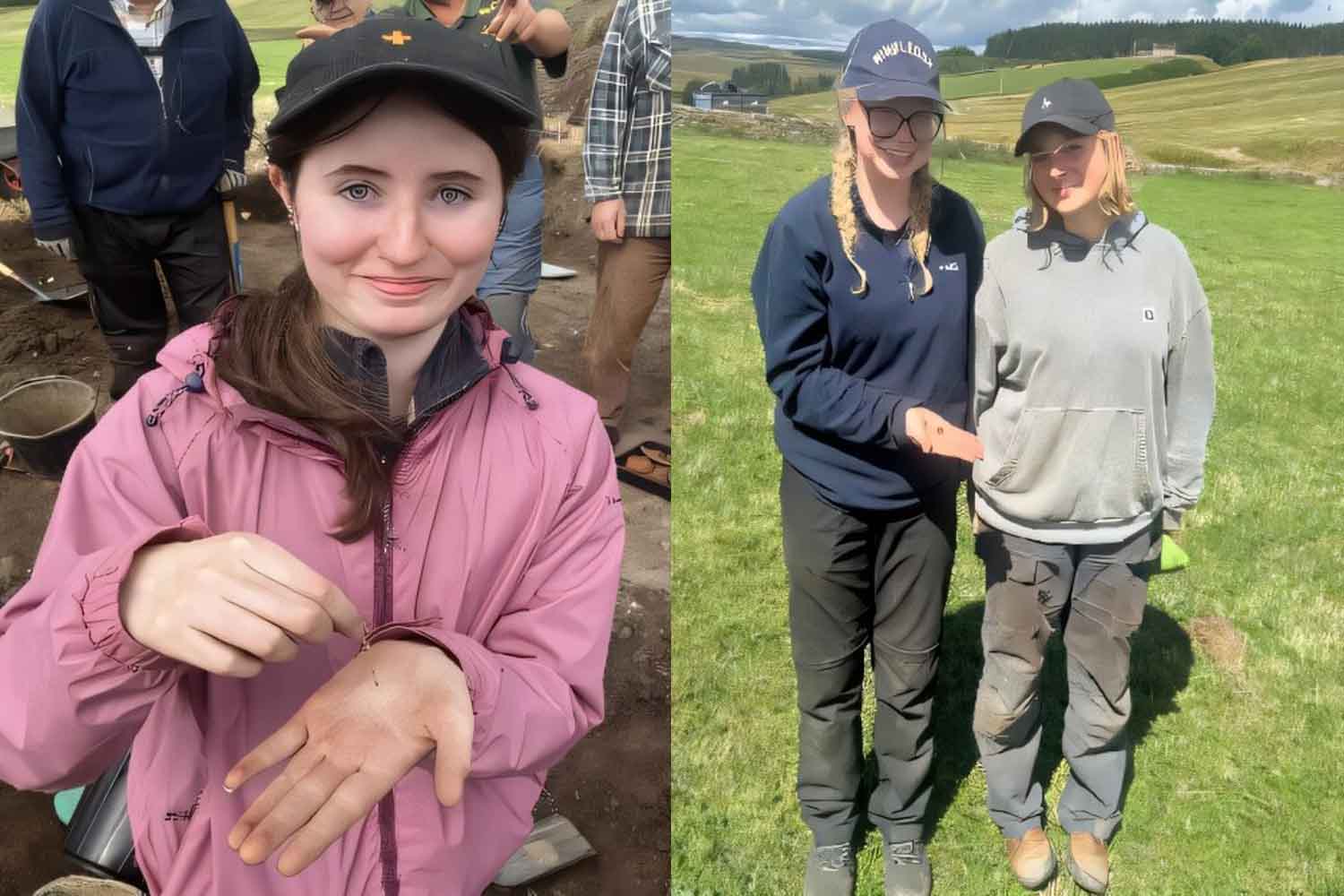
On the first day of her first archaeological dig, Elise Zallu found a Roman gold chain just seven centimeters longwhich remained buried for almost two thousand years. A jewel so well preserved that, if it were still whole, it could easily be worn today. For a first year university student, a rather promising start to her career. Especially considering that some archaeologists go an entire lifetime without finding a gold object.
It happened in the summer of 2026 in Redesdale, Northumberland, northern England, during an excavation campaign by Newcastle University. And that chain was just the beginning. A mysterious Latin inscription on lead, a golden military ornament, ceramics with engraved names and a small gem depicting Jupiter also emerged in the ground. Newcastle University itself reported the discoveries.
A Roman gold chain that could still be worn today
The chain discovered by Elise was made with a particularly refined goldsmithing technique, called loop-in-loopliterally ring within ring. Roman craftsmen shaped small gold elements into the shape of a figure eight, folded them and intertwined them until they obtained a flexible structure. A remarkable precision work, considering the size of the object and the tools available almost two thousand years ago.
Jewelry of this type was generally made from high purity gold and may have belonged to people of high status. They were used as personal ornaments, amulets or decorative elements linked to Roman army officers and their families. The identity of the owner of this particular chain remains unknown, but the quality of the workmanship already tells something of the value it must have had, as Elise explained:
Finding that gold chain was surreal, especially since it was the first day of my first dig. I didn’t expect to find something like this in my entire career.
Eric Tourigny, a researcher at Newcastle University, underlined how rare such a find is, even for the most experienced archaeologists. In short, Elise started from the level that many colleagues hope to reach after decades of work.
A mysterious inscription: it could even be a curse
On the same day, another student, Shannon Wood, recovered a thin sheet of lead folded on itself. Some hand-engraved Latin letters are still visible on the surface, partially hidden by the folds and deterioration of the metal. According to archaeologists, it could be a commercial seal used to identify goods, properties or operations linked to Roman military supplies.
But there is also a second possibility, decidedly more curious: that small sheet could have been used to write a personal message or a defixioa curse tablet. In the Roman world, in fact, the habit of engraving prayers, requests to the deities and, sometimes, curses directed against other people on thin sheets of lead was quite widespread. The sheets were then folded and deposited in places considered sacred.
To find out if someone, almost two thousand years ago, actually entrusted their misfortunes or some desire for revenge to that piece of metal, we will have to wait for the study of the inscriptions. Meanwhile, already the second day of excavation held another surprise: Megan Potter identified a bronze military ornament still partially covered by the original gilding.
It is a decorative element used in the equipment of the Roman cavalry, characterized by a particular crescent shape which recalls the ancient shields called peltae. It could be applied to a soldier’s belt, a horse’s harness or a sword’s sheath. The quality of the workmanship suggests that it belonged to an officer or at least a person of high rank. An object also designed to be seen, because military prestige also passed through what was worn.
A small orange gem depicts Jupiter, the king of the Roman gods
Among the most interesting discoveries of the archaeological campaign there is also one Finely engraved orange carnelian gemfound over the past week by students Maisy Watmough and Zoe Yuill. The stone depicts Jupiter, the main god of the Roman pantheon, with a scepter in his hand and a small figure of Victory. An eagle appears at his feet, one of the most recognizable symbols of the divinity.
The gem is a carvingan engraved stone that was generally mounted on a ring and also used as a personal seal. It was enough to press the worked surface onto the still soft wax to leave an imprint, useful for authenticating documents or identifying the owner. In this case, the choice of Jupiter also had a particular meaning: in the Roman military world it represented imperial authority, power and divine protection.
©The Archaeological Practice Ltd
The one discovered by the two students is the fourth engraved gem recovered from the site. Two other specimens emerged during the 2025 excavations, while a fourth discovery dates back to the 19th century. Alongside these precious objects, however, archaeologists also found much more everyday evidence: coins, spearheads, personal accessories and numerous ceramic fragments, some of which still retain writing.
A name interpreted as appears on a clay cup, a fine ceramic very widespread in the Roman Empire MARTIN(I) or MARTIN(US). It may refer to a man called Martinus, who would have engraved his name on the vessel to indicate ownership. The interesting thing is that the same inscription also seems to appear on other fragments recovered during the campaign. A very banal gesture, that of writing one’s name on an object, which after almost two thousand years becomes a precious testimony.
What do the finds tell us about Roman life beyond Hadrian’s Wall
The excavations take place near the ancient Roman fort of Bremenium, in the current location of High Rochester. As Northumberland National Park explains, it was one of the most important outposts north of the famous Hadrian’s Wall. Its position allowed it to control the military road of Dere Street, a strategic link to present-day Scotland, and to monitor any movements coming from the northern territories.
Of course, keeping a Roman fortress going required many more people than just soldiers. Artisans, traders and supply workers worked around the military structures; there were warehouses, workshops, streets and families. The archaeological project launched in 2021 focuses precisely on these areas outside the fort, where two large enclosures, remains of buildings and traces of productive activities have been identified.
Already during the 2025 excavation campaign numerous finds had emerged, including ceramics from different regions of the Empire, military objects and structures that testify to the transformations of the settlement over the centuries. This year 52 first year students from Newcastle University took part, split into two groups working for two weeks each, alongside volunteers from the Redesdale Archeology Group and professional archaeologists.
Richard Carlton, director of the excavations, explained that the value of these discoveries goes beyond the quality of the individual objects. The gold chain, the gem, the engraved ceramics and the military ornaments allow us to reconstruct the lives of the people who worked around the fortress and the relationships between the Roman and local communities. Because even along a military frontier, between fortifications and soldiers, there was a life made up of trade, personal objects and daily habits.
The work will continue with the study of the artefacts and structures found. Archaeologists will try to better understand who owned the most precious objects and what the function of the mysterious lead sheet was. As for Elise Zallu, she has already found something that many colleagues have been waiting for an entire career. And he still has all his university exams ahead of him.
