
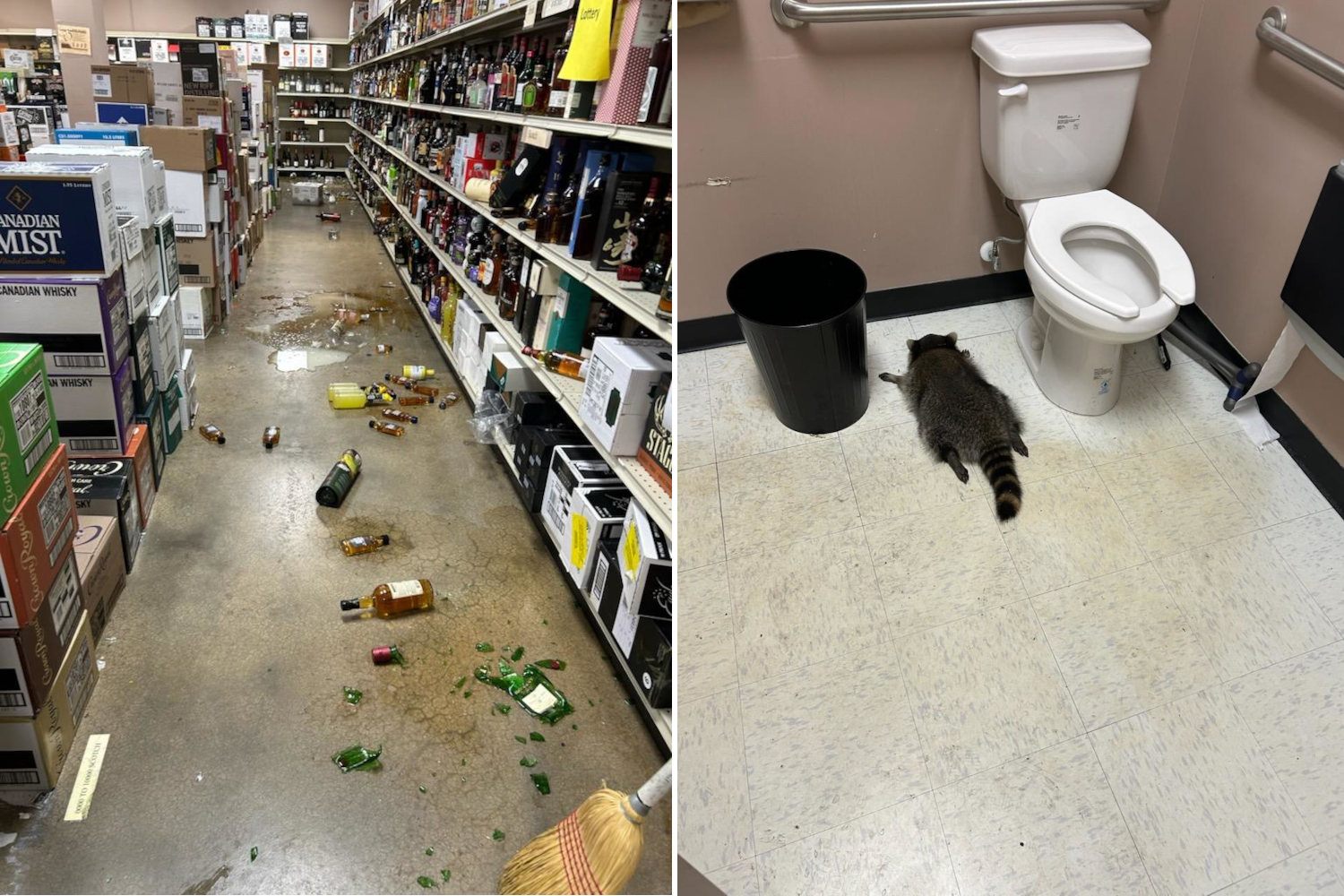
It all started on the night of November 29, 2025 in Ashland, Virginia, when a raccoon sneaked onto the roof of a liquor store and broke through a ceiling tile, falling directly between the shelves of spirits. Having remained locked inside the room and driven by nocturnal curiosity, the animal had hit several displays, shattering 14 bottles of whisky, scotch, rum and vodka.
Attracted by the smell of the liquids scattered on the floor, the mammal began to lick the alcoholic mix but was unable to metabolise it, quickly ending up intoxicated. The following morning the employees found themselves faced with a collapsed tile, glass everywhere and the intruder lying on the bathroom floor next to the toilet, completely unconscious. Responding to the scene, animal control operator Samantha Martin transferred him to the Hanover County Animal Protection and Shelter, managed by Jeffrey Parker, where after a few hours of observation the specimen recovered from his hangover without any damage or injuries and was released about 1.5 kilometers away.
The Trashed Panda gadget line and the viral phenomenon
The images of the unconscious animal next to the medical workers immediately went around the world, even inspiring a sketch on the famous American television program Saturday Night Live. Sensing the potential of that collective sympathy, the organization led by Jeffrey Parker started a collaboration with the Bonfire platform to launch a line of t-shirts, sweatshirts, hats, mugs and stickers with the illustration of the raccoon lying next to a bottle and the writing Trashed Panda, a play on words between the English nickname for the raccoon and the slang term used to indicate a colossal hangover. The initiative registered orders from all over the United States, prompting the center to expand the catalog with summer editions, Halloween collections and new celebratory items for the first anniversary accompanied by the slogan One Bad Night, A Whole Lot of Good.
Over $290,000 raised for officers’ animals and body cams
The campaign raised over $290,000, an extraordinary amount for a company accustomed to receiving less than $20,000 in donations in an entire year. The resources are already financing new accommodations for dogs, cats and other guests, toys, refrigerated food storage systems and a program of free distribution of food and veterinary products to families in economic difficulty.
A portion of the money will also be used to purchase body cameras for the 8 officers involved in animal protection in the county, so as to document interventions and collect evidence in cases of mistreatment, while approximately 140,000 dollars remain to be allocated to future projects including a fund dedicated to veterinary emergencies for injured specimens. The protagonist of this adventure, however, was never heard from again after his release, a sign that he returned to his wild life without attempting new forays into the shops in the area.
