

PFAS, the so-called eternal chemicals, are now widespread in the environment, in food and even in the blood of Europeans. Yet, although the health risks have been known for some time, the European Union struggles to control their production and use. The European Court of Auditors is highlighting the system’s shortcomings and, in the new Special Report 31/2026, highlights how slow and inadequate the regulatory tools still are to address the problem of PFAS.
The numbers reveal a truly worrying situation: around 10,000 substances belonging to this chemical family, thousands of industrial and daily applications, insufficient controls and procedures that can take years before achieving a ban. In the meantime, continued exposure and the costs of contamination risk falling increasingly on the community.
For those who don’t know them yet, PFAS (per- and polyfluoroalkyl substances) are a large family of synthetic chemical compounds used for their non-stick, waterproofing, heat- and chemical-resistant properties. They are found in numerous products, from non-stick pans to waterproof clothing, from food packaging to cosmetics, to industrial applications, medical devices and firefighting foams.
The main problem is their extreme persistence: the strong bond between carbon and fluorine means that these substances degrade very slowly, accumulating in the environment and, in some cases, in living organisms. Exposure has been associated with several health effects, including some cancers, reproductive problems, changes in cholesterol, and a reduced antibody response to some vaccines.
According to estimates reported by the European Court of Auditors, there are, as already mentioned, around 10,000 PFAS, but over 1,400 are actually produced and used. More than a third of the family is made up of polymers, including PTFE, also used in non-stick coatings on pans.
@Court of Auditors
One in 7 European adolescents has levels of PFAS in their blood above the EFSA guideline value
Among the most alarming data reported by the Court is that of the European biomonitoring HBM4EU: 14.26% of the adolescents examined had concentrations of PFAS in the body higher than the health guideline value derived from the tolerable weekly dose established by the EFSA. The latter is equal to 4.4 nanograms per kilogram of body weight per week and concerns the sum of four substances: PFOS, PFOA, PFNA and PFHxS.
The surveys were conducted between 2014 and 2021 in nine European countries, excluding Italy. The European Environment Agency reports an average of 14.3%, with important differences between countries: in France the percentage reaches almost 24%.
It is a worrying result because it concerns substances that can persist for a long time in the body and in the environment, making it difficult to quickly reduce exposure.
Only 231 registrations for thousands of substances
One of the most serious problems identified by the Court concerns the European REACH regulation, which should ensure that chemical substances placed on the market are accompanied by adequate information on their dangers.
The underlying principle is simple: “no data, no market”, i.e. without sufficient safety data a substance should not be able to be marketed. But, according to the Court, in the case of PFAS this mechanism remains largely theoretical.
In fact, in the REACH system there are only 231 registrations referring to 119 PFAS. And there is another significant detail: none of these registrations fall within the production range exceeding 1,000 tonnes per year, the one for which the most complete toxicological and ecotoxicological data are required.
The explanation is also in the exemptions provided by the legislation. Polymers, which account for more than a third of PFAS, are not subject to REACH registration. Among these is PTFE, widely used in non-stick pans and waterproof fabrics: for this substance, the Court underlines, ECHA has not collected safety information through the REACH system.
In practice, for a substantial part of this chemical family there is still a lack of adequate data to evaluate the dangers.
It takes almost 5 years to ban a PFAS (and replacement may not solve the problem)
Even when risks are identified, intervening is not easy. According to the auditors, the European Chemicals Agency’s (ECHA) hazard assessment of a PFAS takes 6 years on average, with times ranging from six months to ten years. And the conclusions are not always definitive, especially when sufficient information is lacking.
However, on average it takes almost five years to reach a European restriction. In the meantime, the substances can continue to be used.
Then there is the problem of the so-called “regrettable substitution”: when a PFAS is banned, it can be replaced with another very similar molecule, with similar properties and potential critical issues. A way to get around the problem without actually eliminating it.
The universal restriction proposal presented in 2023 by Germany, Denmark, the Netherlands, Sweden and Norway aims to intervene on thousands of PFAS and their different uses. But, according to ECHA estimates reported by the Court, it will take around four years just to complete the evaluation of its scientific committees. This phase must then be followed by the European decision-making process.
Meanwhile, France and Denmark have already introduced stricter national restrictions. In France, from 1 January 2026, the sale and import of products containing PFAS is prohibited in some categories, including cosmetics, clothing fabrics and ski waxes, with specific exceptions.
A third of EU states have not carried out targeted checks
What makes the situation even more difficult is the lack of checks. The responses provided by national authorities to the Court of Auditors show that 9 out of 27 Member States did not carry out targeted controls on PFAS between 2020 and 2025 to verify compliance with European rules on chemicals.
Among the reasons given are the priority given to other pollutants, the lack of laboratory capacity and the high costs of analysis.
We also highlight that the system relies heavily on companies themselves, who are required to self-assess and manage the risks of chemicals and provide the necessary safety information.
PFAS in food
Another particularly significant passage concerns the European limits for the presence of PFAS in foods. Currently the maximum thresholds concern only four substances (PFOS, PFOA, PFNA and PFHxS) and some product categories, including fish, shellfish, meat, offal and eggs.
The Court explains that these limits were also established taking into account the need to ensure the availability of food on the market. Typically they are set at the 95th percentile: it means that approximately 5% of the most contaminated production exceeds the limit and cannot be marketed.
But there is one aspect that deserves particular attention: respecting the legal limits does not necessarily mean that the regular consumption of those foods is risk-free.
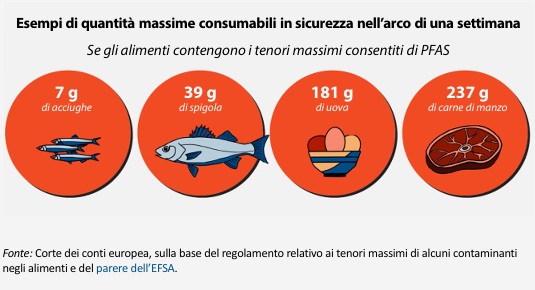
To show this, the Court calculated how much a 70kg person could eat each week if foods contained PFAS at precisely the maximum permitted levels. The result is surprising: 7 grams of anchovies, 39 grams of sea bass or wild salmon, 181 grams of eggs or 237 grams of beef or pork.
@Court of Auditors
These are the quantities which, in the hypothesis considered, would be sufficient to reach the EFSA tolerable weekly dose. These are not dietary indications nor do they mean that these foods are normally contaminated at maximum levels: the Court itself specifies that the concentrations detected in checks are generally lower. The calculation, however, serves to highlight how the current limits can leave significant exposure margins.
Nearly 100,000 samples analyzed, but five countries did not submit data
Europe has a food monitoring system which has grown considerably in recent years. The samples analyzed increased from 17,300 in 2020 to 99,000 in 2024. Yet, even in this case, the collection of information has gaps: five Member States did not submit any data to EFSA in the period 2020-2024 and more than half of the results come from just four countries: Denmark, Germany, France and the Netherlands.
We also point out that the European database does not yet contain monitoring data on TFA (trifluoroacetic acid), a very persistent and mobile substance, which also results from the degradation of some PFAS and is increasingly detected in drinking water and plant foods.
Another limit concerns foods for which European maximum values have not yet been set. These include fruits, vegetables and various drinks. We found that over 50 different PFAS have already been identified in foods and that some substances are also present in products for which there are no specific limits.
Drinking water
Even on the drinking water front, the Court identifies a problem: the European parameters were established in 2020 on the basis of the scientific evidence available in 2017 and have not yet been updated, despite new data emerging in the meantime.
The European directive provides two parameters: 0.5 micrograms per liter for the total of PFAS and 0.1 micrograms per liter for the sum of 20 PFAS. The Court specifies that these limits are generally respected, but underlines the need to re-evaluate their adequacy in light of the most recent knowledge.
Eight Member States have already introduced additional national limits, a sign of a non-uniform European framework. These include Germany, Denmark, Sweden and the Czech Republic.
Cleaning up PFAS will always cost more
The problem does not only concern the health and quality of the environment, but also the economic resources necessary to intervene on contamination. Water treatment and cleanup costs can become enormous, especially if prevention continues to be postponed.
We also point out that the European Union has funded numerous research and response projects on PFAS, but does not yet have an overall and consolidated picture of all funds allocated to this issue.
A contradiction thus emerges in the report: on the one hand, resources are invested to study, remove and replace these substances; on the other hand, the procedures to limit its spread remain slow and the controls are not homogeneous.
What the European Court of Auditors asks for
The report does not limit itself to photographing the critical issues, but formulates a series of recommendations to the European Commission. Among the main ones are accelerating the procedure for the universal restriction of PFAS, speeding up regulatory tools, strengthening controls in Member States and updating limits for food and drinking water based on the latest scientific evidence.
For some of these measures we indicate 2028 as the implementation target.
The message is clear: it is not enough to intervene when a single substance is recognized as dangerous, especially if it can be replaced by a very similar molecule. We need a strategy capable of tackling the problem as a whole, progressively reducing non-essential uses and preventing new PFAS from simply taking the place of those already banned.
Because eternal substances do not disappear when you stop producing them. And the longer we wait to limit its spread, the more difficult and expensive it becomes to repair the damage.
