
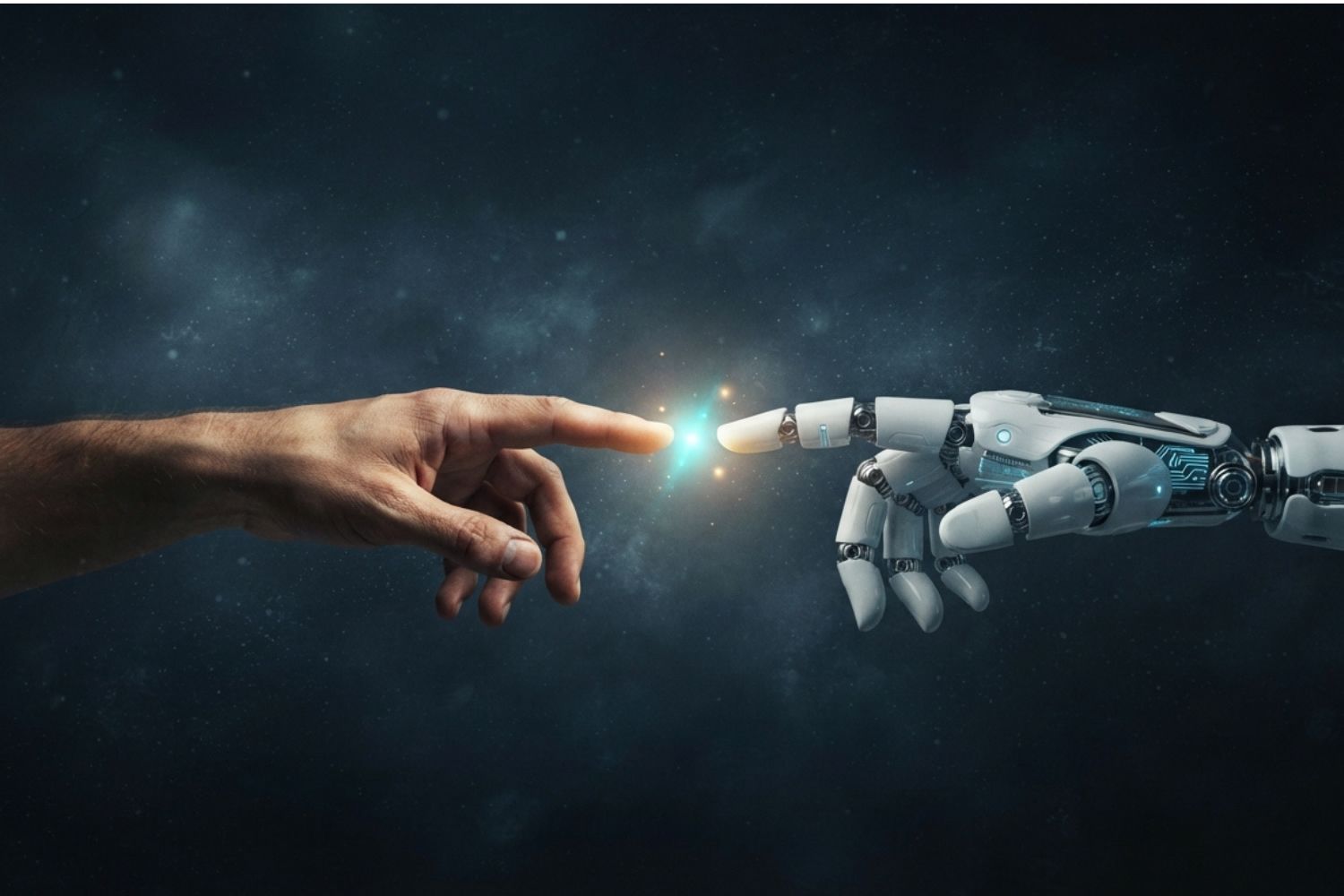
In a world where artificial intelligence writes texts, creates images, composes music, translates languages and suggests medical diagnoses, the word of the year could not be more significant: “human”. It was chosen by the Cambridge Dictionary, which for 2026 has decided to bring attention back to people, just as the boundary between what we do and what machines can do is increasingly blurred.
Why did Cambridge choose “human”?
Since the arrival of ChatGPT in 2022, artificial intelligence has increasingly entered our lives, transforming the way we work, study and communicate. And along with the opportunities, doubts have also grown: how much of our thinking are we willing to entrust to algorithms? According to Colin McIntosh, editor of the Cambridge Dictionary, AI is even changing the way we talk about humans. It is no coincidence that expressions such as human-made are used more and more often to distinguish what is made by people from what is artificially generated.
View this post on Instagram
The debate even goes so far as to question the possibility that machines develop a form of consciousness, a question that is still open and controversial. As Rachel Adams, an expert on artificial intelligence and human rights at the University of Cambridge, observes, AI brings us back to questions we have been asking for millennia: who are we and what does it mean to be human?
Not just “human”: the other words that describe 2026
The choice of the Cambridge Dictionary becomes even more interesting when looking at the other terms considered for recognition. Among the candidates was agent, a word that today is also used to indicate artificial intelligence systems capable of carrying out complex operations and making decisions with different degrees of autonomy. Then there was similar, a term that recalls activities and experiences far from digital tools: a paper book, a manual activity, a moment spent without connection.
Another candidate word was wholesomea word used to describe something positive, healthy or capable of improving physical and emotional well-being. Three apparently different terms which, alongside human, describe some of the tensions of our time: growing automation, the desire for non-digital experiences and the search for what makes us feel good.
In an increasingly artificial world, we rediscover the value of humanity
Cambridge’s choice does not represent a rejection of artificial intelligence, nor does it mean that everything produced by people is necessarily better. However, it brings back to the center a question that risks taking a backseat as we focus on the increasingly surprising capabilities of machines: how much space do we want to leave for human abilities, relationships and decisions?
AI can offer important opportunities in scientific research, education and many other sectors, but it also raises questions about technological dependency, inequalities and decision control. For this reason, the word of the year 2026 can also be read as an invitation not to confuse technological progress with the simple increase in automation. And, above all, not to forget our humanity.
