
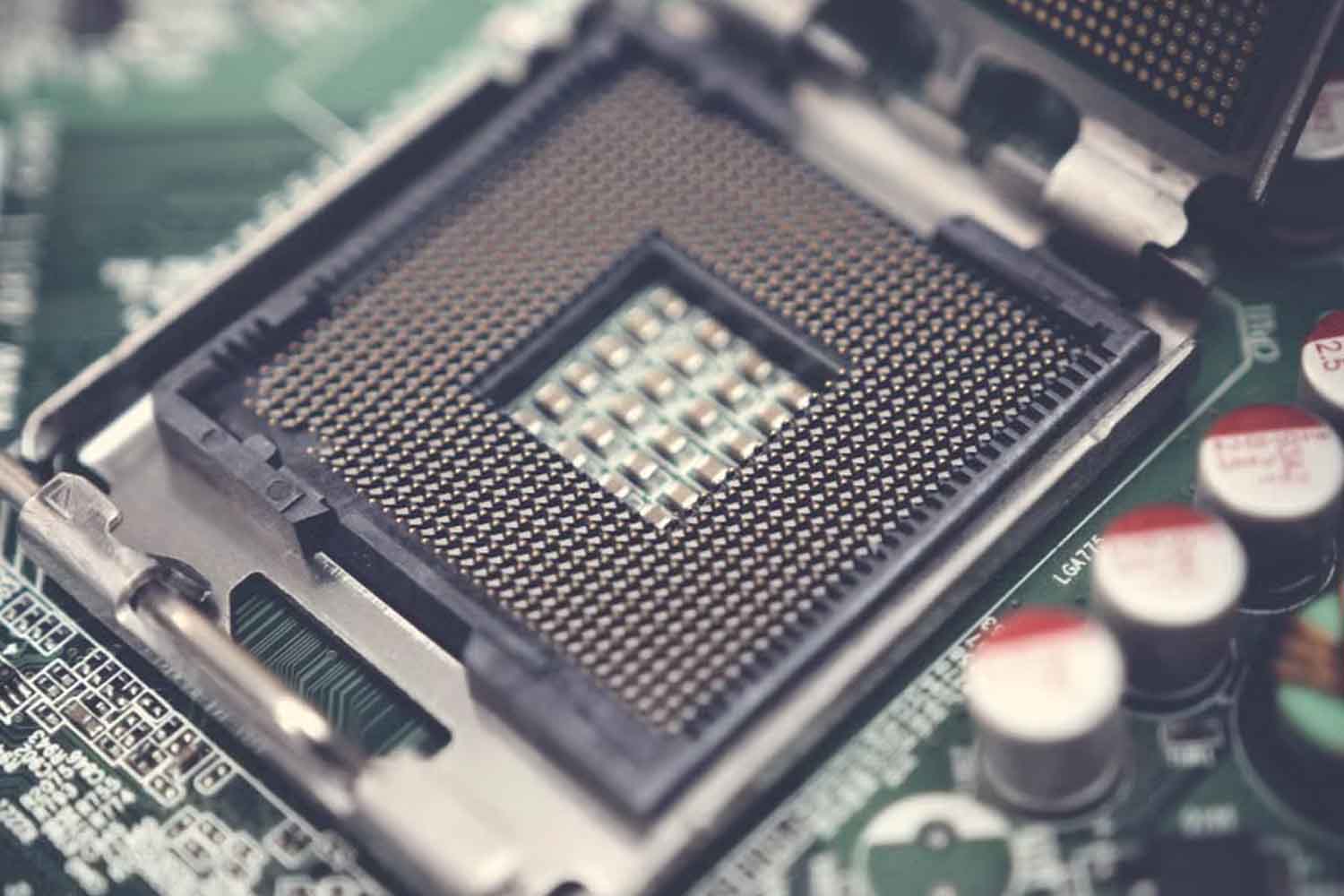
A drop of coolant, just a few millimeters in diameter, managed to lower by 17°C the temperature of a simulated chip in just 15 seconds. All while the device was immersed in water. This is the result obtained by researchers at the University of Waterloo, in Canada, who experimented with a cooling system for data center processors, increasingly stressed by artificial intelligence applications. And the interesting part is that that single drop cooled the hottest spot faster than an entire vat filled with the same coolant.
The research, published in Journal of Colloid and Interface Scienceproposes a rather ingenious system: use water, which is cheap and capable of dispersing heat, for ordinary cooling and reserve small quantities of a more expensive refrigerant for areas that suddenly overheat. A division of labor that could make server thermal management more efficient by reducing the amount of specialized fluids needed. For the moment the result concerns a laboratory experiment, but the principle has been demonstrated.
Because a single drop can cool so quickly
Processors do not all heat up in the same way and, above all, they do not do so uniformly. During more demanding operations, some areas can become much hotter than the rest of the chip within a matter of seconds. They are the so-called hotspots, localized overheating points which can slow down the performance of components and accelerate their aging. The problem especially affects high-computing-power systems, such as those used to train and operate artificial intelligence models.
To limit overheating, immersion cooling systems are also used in data centers, in which electronic components are surrounded by specific liquids that do not conduct electricity. These coolants can be expensive and heat loss does not always occur quickly enough when the temperature rises at a specific point. The Canadian group therefore tried to combine two liquids with different characteristics, taking advantage of their different response to heat.
Led by Sushanta Mitraprofessor of mechanical and mechatronics engineering, researchers Tian-Yu Zhang and Arnav Banerjee used a thin sapphire surface measuring 30 millimeters per side with a heating coating to simulate the thermal behavior of a chip. They immersed it in deionized water and, through a small needle, deposited on the surface a drop of Novec 7100, a refrigerant fluid that boils at around 61°C, much faster than water.
The drop, denser than water and poorly soluble, remained on the heated surface. When the temperature rose high enough, the refrigerant began to boil, forming bubbles that rose through the surrounding water. When boiling, the liquid absorbed a large amount of thermal energy, while the movement of the bubbles helped to disperse the heat. In essence, a drop worked directly on the hottest spot, while the water took care of the rest.
The chip cools by 17 degrees in 15 seconds
The researchers repeated the experiments at three different heating levels, monitoring the temperatures through an infrared camera and filming the bubble formation with a high-speed video camera. They then compared the results with those obtained using only water or a refrigerant bath. At the maximum thermal intensity experienced, equal to 14.4 watts per square centimeter, the center of the superheated zone recorded a decrease of approximately 17°C over 15 seconds.
In the bath composed entirely of refrigerant, the surface reached similar maximum temperatures, but subsequent cooling was much slower. Using only water, however, the hot spot continued to increase in temperature. The drop therefore offered a faster response precisely in the hottest conditions, also contributing to lowering the temperature of the surrounding surface.
As explained by the University of Waterloo, according to Mitra the mechanism works because boiling absorbs a lot of heat and the bubbles, rising, mix the water surrounding the refrigerant, improving its ability to transport thermal energy. This way you get the benefits of boiling only where and when you need it, without having to fill the entire system with large quantities of a specialized fluid.
The coated drops that react to heat
The research group also experimented with another solution: wrapping the drops of refrigerant in a very thin film of silicone oil. To do this, the researchers used a layer of oil floating on the water, through which the drops were made to pass. Along the way, the refrigerant acquired a coating that changed the way it started to boil. A technique called liquid-liquid encapsulationwhich allows you to intervene on the behavior of the drops without directly modifying the fluid contained within them.
Tests showed that a simple silicone coating could delay boiling, which then encouraged the sudden formation of a large bubble. By adding tiny particles of aluminum nitride, a ceramic material capable of conducting heat, to the oil, the behavior changed again: instead of a single large bubble, many smaller ones formed. In the most intensive tests, these coatings allowed reductions of approx 10 °C is the maximum temperature reached by the hot spot.
The system still has some technical limitations. Oil residue left on the surface can slow cooling over time, and uncoated drops performed better in some conditions. However, the experiments have shown that it is possible to intervene on the moment and methods of boiling, an important detail for designing systems capable of reacting to sudden changes in temperature.
How it might work in data centers
The researchers imagine two possible applications. The first involves a system equipped with sensors capable of identifying the hottest points of a processor and release a drop of coolant exactly where needed. The second instead focuses on coated droplets that circulate within the coolant and begin to boil when they reach a sufficiently hot surface. In both cases, the goal would be to address temperature peaks quickly, using limited quantities of specialized refrigerant.
To reach an industrial application, further tests will be needed. The experiments were conducted on a heated surface immersed in still water, while in real systems the liquids are normally moved through special circuits. The Waterloo group will therefore have to study the behavior of the drops in the presence of continuous flows, identify coatings that leave less residue and verify the performance on functioning electronic components.
The technology could also find application in other sectors in which heat management is particularly delicate, from electric vehicle batteries to high-power lasers, up to LED lighting systems. In data centers, where heat dissipation is an important part of energy needs, being able to direct coolant only to the hottest areas could offer an interesting advantage. For now everything happened on a small square of sapphire just three centimeters wide. The coolant did its job in fifteen seconds. Now researchers will have to figure out how to get that drop inside an entire server.
