
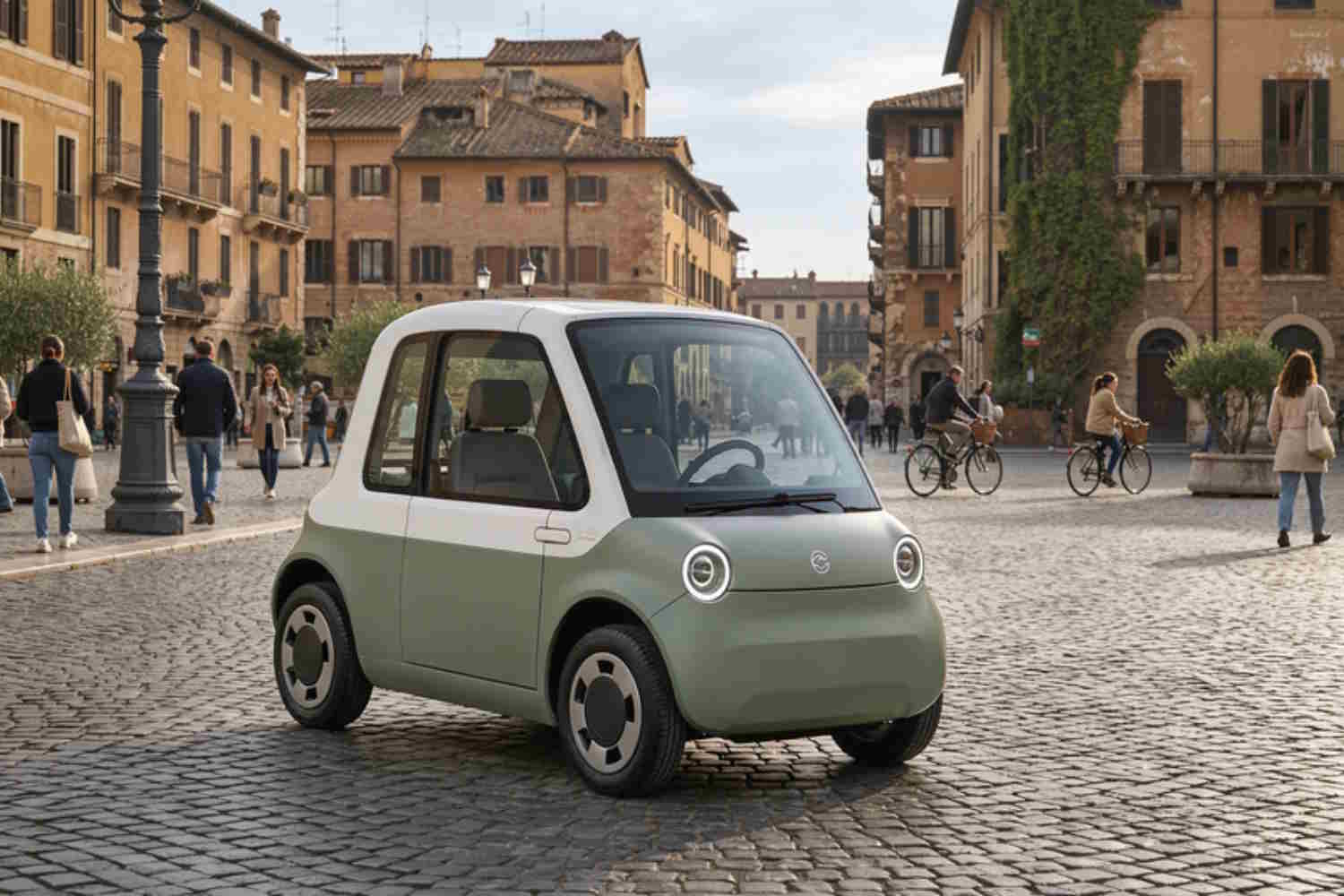
Every year, in Italy, we spend a total of 1.33 billion hours stopped in traffic. A time that costs the country around 22 billion euros, 1% of the GDP, and over 80% of which is lost within the cities. Yet most car journeys are short: two out of three cover less than 8 kilometres, distances that in many cases could be covered otherwise.
These are some of the numbers presented by Fabrizio Meroni of MOST, the National Center for Sustainable Mobility, at the conference Last Mile. A more sustainable European urban mobilitywhich was held on 19 November in Rome at the Italian Office of the European Parliament and brought institutions, local authorities, researchers, associations and businesses to the same table.
A fleet of cars that is slowly renewed
There is another piece of data that helps to understand why cities struggle to change: the Italian car fleet is renewed at only 3.71% per year. It means that, even if we bet everything on electric cars, the transformation would take many years. For this reason, it emerged from the conference, electrification remains important but alone is not enough: concrete alternatives are needed for short journeys, the ones that clog the roads every day.
Why is it called the “last mile”
The expression indicates the final stretch of a route, the one that separates the bus stop, station or car park from the actual destination. Stefano Paleari, advisor to the Minister of University and Research, compared it to sport: just one step away from the finish line the path becomes more difficult. It is often this missing piece that pushes people to take the car even for a few kilometers. Micromobility – scooters, bicycles, small electric vehicles – can fill this gap, provided that the services are high-quality and the vehicles are safe and low-impact.
The direction indicated by Europe
According to the European Commission, recalled Pierfrancesco Maran, president of the Environment Commission of the European Parliament, urban areas are responsible for 23% of greenhouse gas emissions from transport in the Union. There are four priorities indicated: strengthening public transport, making walking and cycling safer, integrating the different means of transport and making delivery logistics in the city more efficient and cleaner.
On the same line, Rome’s Mobility Councilor, Eugenio Patanè, mentioned the strengthening of rail lines, the extension of cycle paths and sharing services and the aim of making the different means of transport communicate with each other. Rome and Bologna are among the Italian cities of the EU Mission “100 smart cities with zero climate impact by 2030”.
From the microcar with assistant to services for vulnerable people
Among the experiences presented is that of YourButler24, one of the promoters of the conference together with Terravision Electric: a service active in Rome from May and in Milan from September which combines an electric microcar with a personal assistant, bookable for 30 or 60 minute sessions. The idea is to help residents and tourists with travel and small daily errands. The amount spent returns to the customer in the form of a bonus to be used to purchase electrical products and related maintenance.
According to what was announced, from the end of November the service will also be offered to companies, as a benefit for employees, and to public administrations for initiatives aimed at the most vulnerable people. An example of how urban mobility can also become a service to the person, as well as a means of transport.
Technology yes, but at the service of quality of life
Enrico Giovannini, scientific director of ASviS, underlined that technological innovation is already changing mobility, but it only matters if it translates into services that improve people’s lives. Benedetta Squittieri, president of the Network of Sustainable Municipalities, recalled that the game is played in the Municipalities, called to rethink spaces and services, and that no one can do it alone: alliances between administrations, businesses, research and the third sector are needed.
So before taking the car for a journey under 8 km, let’s check if there is an alternative: public transport, bike, sharing or simply on foot. Let’s find out with the apps and at our municipality about sharing services and new cycle paths available, there are often more than we think and if you work in a company ask if among the welfare benefits there are public transport subscriptions or shared mobility services.
The message that emerged from Rome is that more liveable cities do not depend on a single solution, but on the possibility of choosing, every day, the most suitable means of transport for each stretch of the route. And the first step is often to leave the car at home for short trips.
