
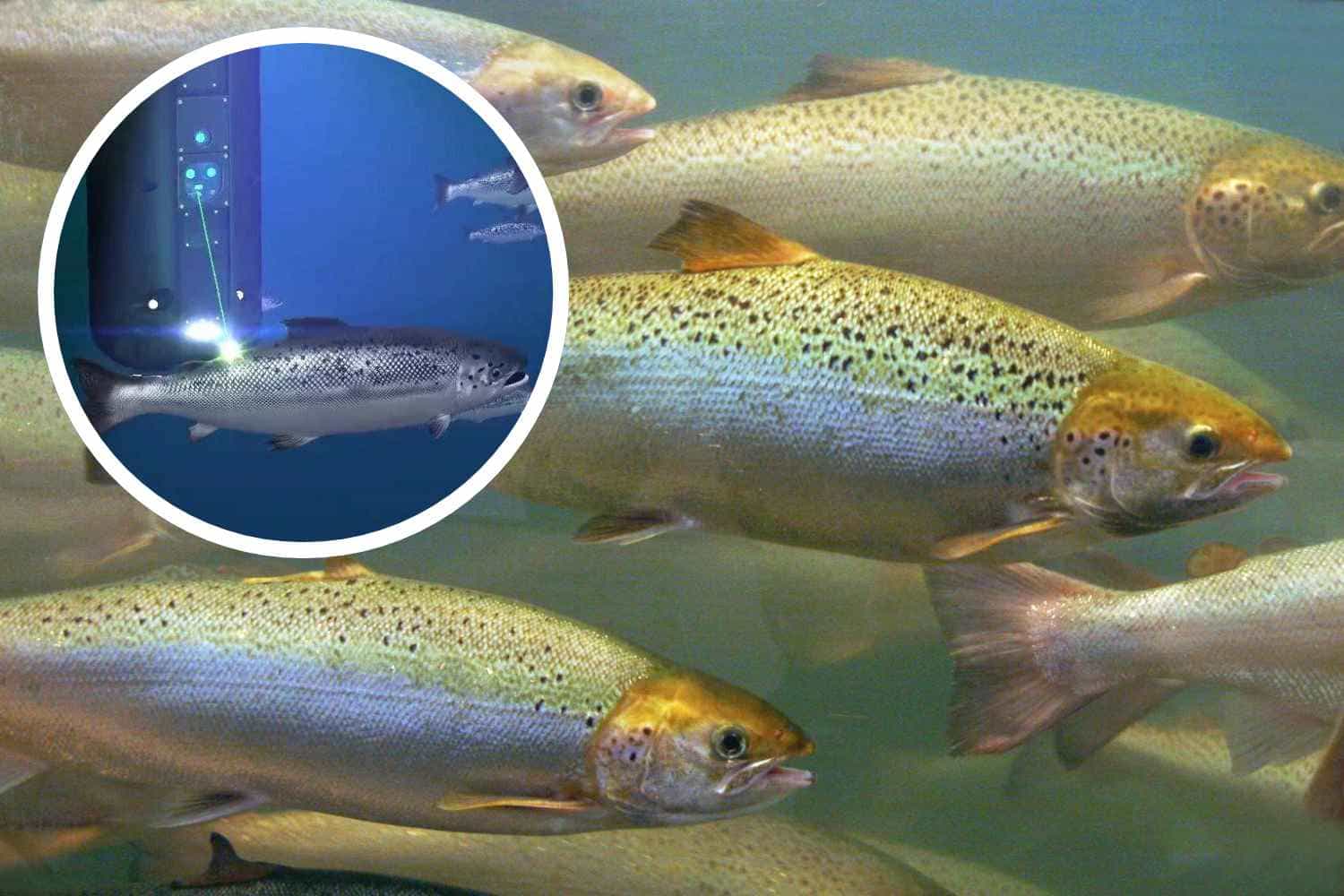
In large salmon farms in Norway, fighting sea lice is one of the most important challenges for fish health. These small parasites can in fact cause injuries and weaken animals. To combat them, some companies are experimenting with a decidedly unusual solution: underwater devices that use artificial intelligence to identify parasites and hit them with laser pulses.
And this is not an experimental solution: the systems developed by the company Stingray Marine Solutions are now thousands and have exceeded 3,500. A diffusion that demonstrates how much the Norwegian fishing industry is focusing on this technology, also with the aim of reducing the use of traditional pesticide treatments, which are often stressful for fish.
View this post on Instagram
But how effective are these devices that use AI really? And above all, what consequences do they have on animal welfare? Some recent results show interesting benefits, while others open up new questions about fish welfare.
Laser robots in salmon farms
Stingray devices are installed directly in marine cages, where salmon live and swim freely. The system is designed to operate continuously, without having to capture or move fish for treatment.
The operation combines stereoscopic cameras, artificial intelligence algorithms and laser pulses. When a salmon passes in front of the device, cameras capture images of its body and the software analyzes them in real time, looking for sea lice based on characteristics such as shape and color.
Once the parasite has been identified, the system calculates its position and directs the laser towards the target. The light pulse is designed to hit the louse without harming the salmon and the device can emit up to five pulses per second.
At the basis of the mechanism there is also a physical difference between the two organisms: the body of the parasite absorbs the laser light, while the scales of the salmon tend to reflect it. This allows the technology to distinguish the target from the fish that host it.
Finally, the cameras perform another function, that of collecting images and monitoring the conditions of the salmon, keeping the evolution of the infestations under control.
View this post on Instagram
Why sea lice are a problem on farms
The sea louse, especially the species Lepeophtheirus salmonis, it is a parasitic crustacean that attaches to the surface of fish and feeds on skin, mucus and blood. Infestations can cause injuries, weaken animals and, in the most serious cases, cause death.
The problem is particularly relevant in intensive farming, where the concentration of numerous salmon in the same cages facilitates the spread of parasites. These can also reach wild salmon that pass through coastal areas during migration.
Different methods are used to combat them, including pharmacological treatments, fresh water, thermal treatments and mechanical systems that remove parasites. Some procedures, however, require catching and handling fish, subjecting them to stress and increasing the risk of injury.
It is precisely on this aspect that the promise of lasers is concentrated: eliminating parasites directly in cages, intervening on individual animals without subjecting them to collective treatments. One of the reasons why the devices are attracting the attention of farmers is the possibility of reducing the number of interventions necessary to contain infestations.
An in-depth study published on November 12, 2026 by International Aquafeed reports the first results of the Norwegian ContrLaser project, coordinated by DNV and funded by the Norwegian Seafood Research Fund (FHF).
Preliminary data, collected by comparing some farms equipped with lasers with others used as references, show interesting differences. In one of the pairs analysed, the number of antiparasitic treatments per cage was equal to 0.63 in the laser farm, compared to 4.01 in the comparison farm. In another pair the values were 0.32 and 1.23 respectively.
These are results that suggest a possible reduction in the use of other treatments, but should not be interpreted as definitive proof of the effectiveness of the technology. The observations in fact concern a limited number of farms and are still preliminary.
Other research has also returned results that are not always in agreement. A study published in 2020, which compared cages equipped with lasers and cages without these devices for 54 days, found no significant differences in the density of mobile lice. Technology, therefore, could represent an aid in the management of infestations, but it is not yet possible to consider it a definitive solution. And in any case the problem is upstream: in the very concept of intensive salmon farming, with all the environmental and health consequences they imply.
What consequences for fish
However, there is a particularly delicate aspect that emerged from the most recent data from the ContrLaser project. When comparing farms, significantly more frequent ocular hemorrhages were observed in salmon from cages equipped with laser systems. In most cases they would have been mild, but the data deserves attention and further investigation.
At the moment it is not proven that these alterations are caused directly by the devices. However, the result represents a signal that should not be underestimated, especially since one of the declared objectives of this technology is to improve the well-being of farmed animals.
The project data is still preliminary and has not been subjected to scientific review. Further checks will therefore be needed to understand whether there is a link between the use of lasers and the alterations observed, as well as to evaluate the long-term effects.
The technology that promises to free salmon from parasites without subjecting them to invasive treatments could therefore represent a step forward for aquaculture. But the fact that it is automated and uses artificial intelligence does not automatically mean that it is without consequences for animals. Again, the true measure of progress should be the welfare of the fish, not just the reduction of costs and treatments on farms.
Sources: Nordlaks / Acquafeed
